

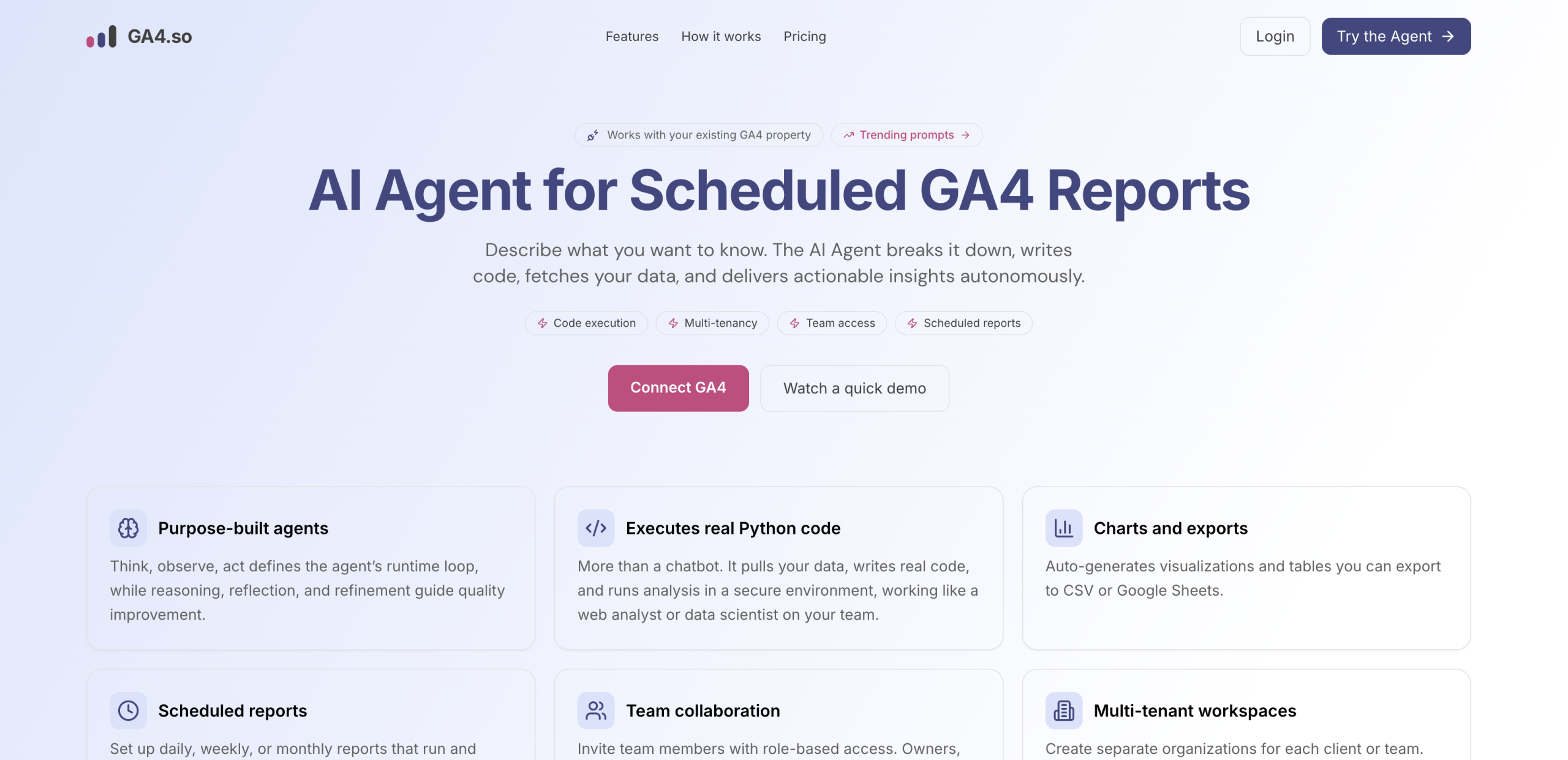
GA4.so is an AI agent for Google Analytics 4 that automates report generation and data analysis. You type a question in plain language, and the agent plans the query, fetches data via the Google Analytics Data API, runs Python analysis, and returns results with charts. Released on March 17, 2026, it targets marketers and analysts who need recurring GA4 reports without the manual overhead.
GA4.so Pricing: What You Pay Per Session
GA4.so isn’t a subscription service; it’s a pay-as-you-go model, which is a bit unusual for an analytics tool. You’ll pay approximately $0.09 per agent session, with the final cost determined by token usage. There’s no fixed monthly fee, nor are there per-seat charges, which could be a benefit for teams with fluctuating user counts. For early access users, there’s a 30-day free trial that includes $10 in free credit, and you won’t need a credit card to start. This approach suggests that your expenditure directly correlates with how much you use the AI agent to query your data. It’s a credit-based system — you’re buying tokens for the AI to process your requests.
What does that $0.09 buy you? It’s the cost of asking a natural language question. The AI agent then plans, fetches data, runs analysis using Python code, and delivers insights with charts. Each agent session covers the full pipeline:
- Planning — interprets your natural language question
- Data retrieval — fetches from GA4 via the Data API
- Analysis — runs Python code on the results
- Output — charts, tables, CSV, or Google Sheets exports
- Scheduling — recurring report delivery at intervals you choose
The value proposition here is clear: you’re paying for automation and simplification, potentially saving significant time that would otherwise be spent wrestling with GA4’s native interface or hiring a dedicated analyst. Still, the exact number of queries or the depth of analysis you get for that $0.09 isn’t explicitly detailed, so it’s tough to precisely gauge the cost-effectiveness without knowing the average token usage per query.
Scaling Analytics Without Scaling Headaches
For teams and agencies, GA4.so makes some compelling promises about scalability. It offers team-wide access with unlimited users, meaning you won’t incur additional costs for adding more colleagues or clients. This is a distinct advantage over many SaaS tools that charge per user. It also supports role-based access, allowing you to assign Owners, Admins, Analysts, and Viewers. This granular control is crucial for maintaining data security and workflow efficiency within larger organizations. Included multi-tenant workspaces, too, which let you create separate organizations for each client or team. This feature is particularly useful for agencies managing multiple GA4 properties; it keeps client data segregated while using a single shared balance for all usage, simplifying billing considerably.
Despite these features, the tool is quite new, having been released on March 17, 2026. There isn’t a substantial body of user reviews or public discussions to validate these claims about smooth team collaboration or long-term scalability under heavy load. While the design certainly suggests it’s built for scale, real-world performance for high-volume users remains to be seen. Its reliance on the Google Analytics Data API also means it’s inherently subject to Google’s rate limits, which could become a bottleneck for extremely frequent or complex queries, though GA4.so doesn’t specify its own internal rate limits.
Your First Step into Automated GA4 Insights
If you’re struggling with GA4’s complexity and want to explore automated reporting, your most logical first action is to take advantage of the 30-day free trial and the $10 in free credit. It’s a no-commitment way to test if the AI agent can genuinely simplify your GA4 data analysis without immediate financial outlay. You’ll want to connect your GA4 account via OAuth and try asking a few specific questions about your data to see if the insights provided are truly actionable and if the cost per session aligns with your expectations for value.