

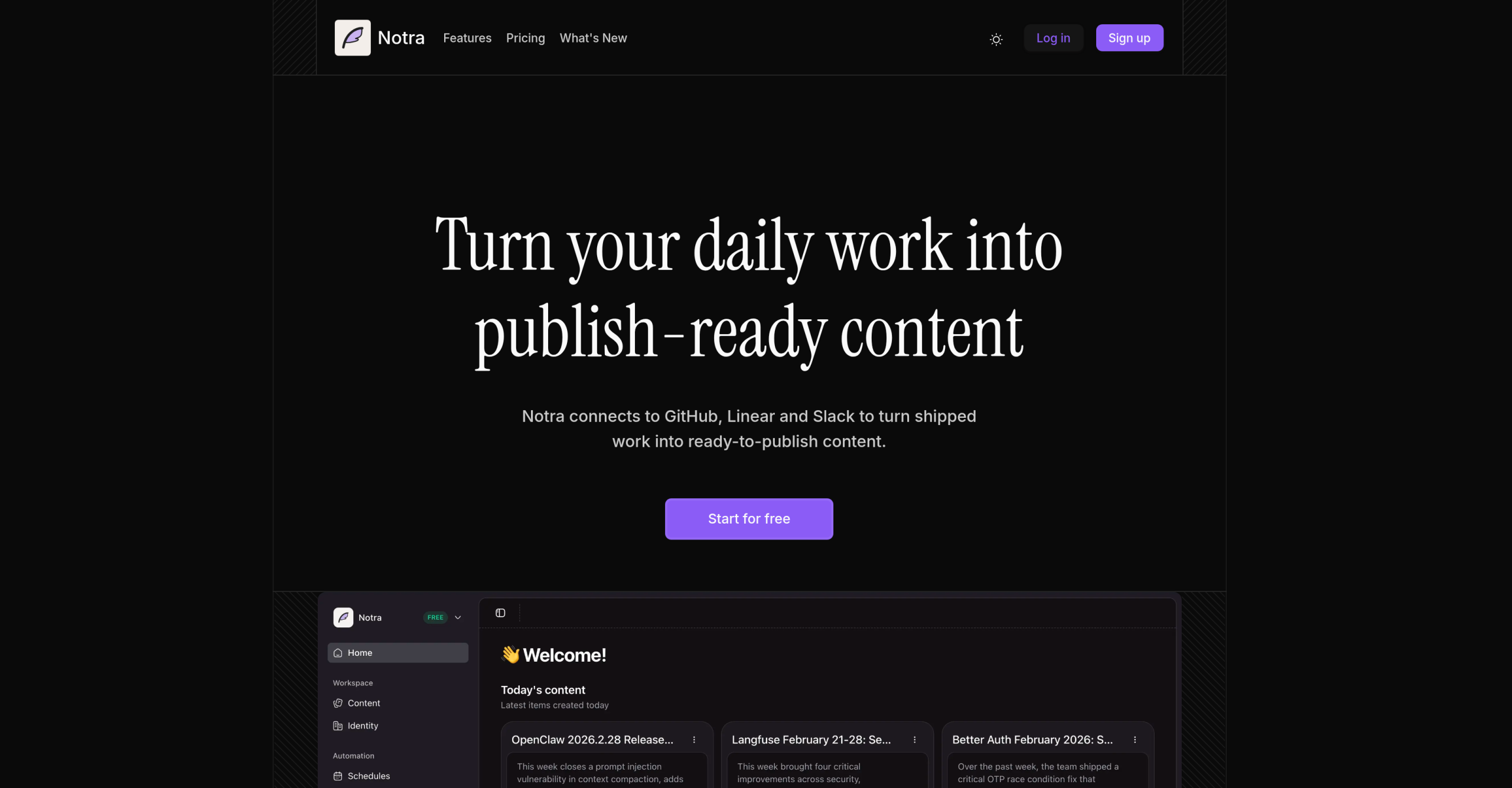
What sets Notra apart is the way it can accomplish the task. It learns and adapts to a team’s specific brand voice, ensuring generated content sounds authentic rather than generic. This turns raw development data into polished, audience-ready content without the manual effort that makes documentation inconsistent for many teams.
Still, Notra is more of a "draft generator tied to your workflow" than a full content engine. It won’t handle your entire content strategy, distribution, or analytics end-to-end. It’s a specialized tool, and you’ll need to integrate it into a broader content ecosystem for complete management. You’ll still need human oversight to review and refine its output, as the idea behind it is to provide a solid first draft, not a final, uneditable piece.
Automating Content from Development Activity
Notra functions as an intelligent content synthesizer, connecting directly to a team’s development and communication tools. It ingests activity from platforms such as GitHub for commits and pull requests, Linear for issue tracking, and Slack for conversations and announcements. Using AI, it analyzes this data to identify meaningful updates. It then generates structured drafts for various content types, including release notes, changelogs, blog posts, and social media updates.
This tool solves the persistent problem of "documentation debt" and the manual effort required to communicate product development progress. It aims to reduce the "someone has to write this every time" tax, allowing teams to focus on building. They can then review and polish content rather than starting from scratch. This ensures consistent communication about product updates and helps bridge the gap between development and audience awareness.
Who Uses Notra’s Automation?
Notra primarily targets fast-moving software development teams, product managers, engineering leads, and marketing teams within technical organizations. It’s also relevant for content creators, professionals needing to generate reports and documentation, and startups looking to communicate shipped features without hiring a dedicated writer. Users employ Notra for tasks like generating release notes from merged pull requests, creating blog post drafts based on shipped features, and drafting social media updates that summarize changes.
Notra’s Pricing Structure
Notra works on a credit system with a free tier, offering both free and paid options. Pay attention to the usage-based components, as they can influence your overall cost.
| Plan | Monthly Cost | Included Features |
|---|---|---|
| Basic (Free) | $0 | 2 team members, $12 AI credits, 3 workflows, 2 integrations, 30 references, 14 days log retention |
| Pro | $50 | 5 team members, $32 AI credits, unlimited workflows, unlimited integrations, 100 references (then $0.05/reference), 30 days log retention |
| Enterprise | Custom | Unlimited team members, unlimited AI credits, unlimited workflows, custom integrations, unlimited references, unlimited log retention, dedicated support |
The pricing model explicitly mentions "AI Credits" and "references" (then $0.05 per reference) as usage-based components. This could be a hidden cost if not carefully monitored, as one reviewer noted. Notra’s Terms of Service state that paid subscriptions are billed on a recurring basis through their billing provider, Autumn (powered by Stripe), and prices are subject to change with prior notification.
User Feedback and Known Limitations
User feedback for Notra is generally positive, focusing on its efficiency and ability to simplify content creation. Users appreciate its connection to their content pipeline, helping create valuable content from pull requests. It’s lauded for reducing the "someone has to write this every time" burden and providing a solid first draft, saving significant time. One user noted it allows for creating decent content about even small shipped items without direct developer input. It’s considered a highly recommended tool for growing software teams or product-led companies struggling with communicating development progress.
Still, some users wished for clearer visibility into how drafts are built, finding the documentation and examples not detailed enough to confidently predict output quality. There’s also been a desire for more transparency about the company behind Notra and its long-term roadmap. Another user expressed interest in integrations for other forms of communication, like email newsletter sections. The usage-driven nature of AI credits and references in the pricing model can be surprising if not carefully monitored.
Notra’s core integrations are focused on GitHub, Linear, and Slack. Teams requiring broader automation or integrations beyond these specific tools might find it limited. Its output may still require editing, especially if strict formatting or deep customization is needed. It’s not a full content engine that handles strategy, distribution, and analytics end-to-end, which is an important distinction. While it excels at its niche, it’s not a substitute for a thorough marketing platform.
The Hidden Cost of AI Credits
While Notra offers a compelling solution for automating content generation, new users might overlook the usage-based nature of its AI credits and references. The starter tier includes $12 in AI credits monthly, and the Pro plan includes $32. Exceeding these limits, or going over the included references, incurs additional costs at $0.05 per reference. This pay-as-you-go component isn’t always immediately obvious and can lead to unexpected charges if a team’s content generation volume is higher than anticipated, or if they don’t closely track their usage. It’s a detail that’s easy to miss until you’ve committed and started generating a lot of content.