

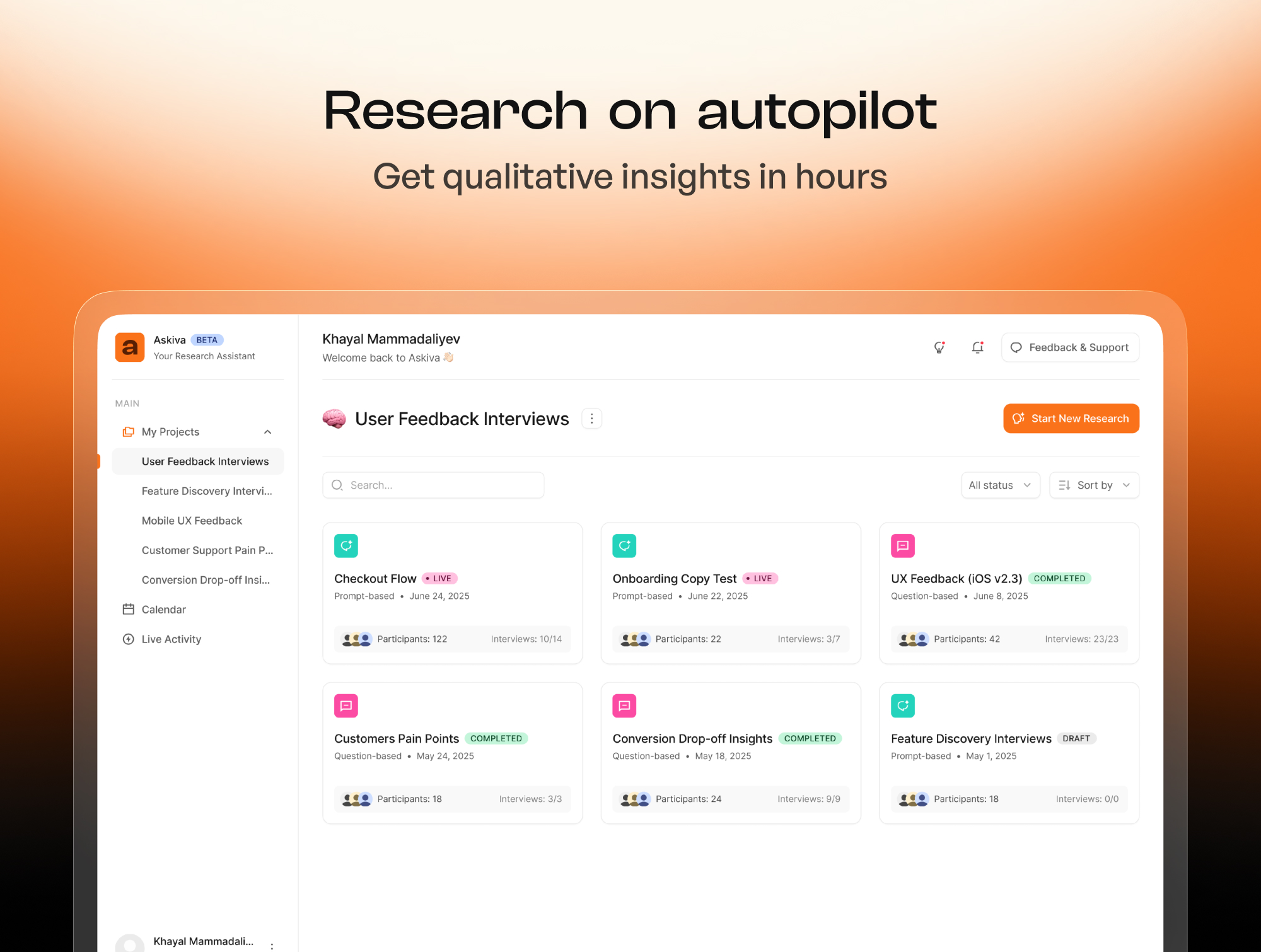
For anyone who needs to scheduling through sentiment, Askiva AI offers a practical solution. It launched in March 2026 and targets product and UX teams who want to reduce the manual overhead of qualitative research. This review looks at what each pricing tier actually provides and where the tool’s limitations lie.
Askiva AI Free Plan: What You Get
The entry-level plan is labeled for "solo testers and early teams." You get 1 project per workspace with unlimited researches, support for 10+ languages, 5 AI interviews per month (max 15 minutes each), and up to 5 core questions per interview.
You can test the full workflow: automated scheduling with timezone coordination, email invitations, the AI interviewer joining your Zoom call, and post-session deliverables (transcripts, grouped themes, highlighted quotes, sentiment extraction). The problem is that 5 short interviews with only 5 questions each won’t support any substantive study. It works for evaluating the platform or running a single quick hypothesis test, but not for iterative research cycles.
Askiva AI Pro Plan: $49/Month and Up
Paid plans start at $49/month (billed monthly, no refunds). The Pro tier raises limits considerably:
- 25 AI interviews per month (up from 5)
- 45 minutes per interview (up from 15)
- 20 core questions per interview (up from 5)
- Advanced editing and PDF export
- Collaboration features for sharing transcripts and analyses
These are standard features in professional research tools, so their inclusion here is expected rather than exceptional.
Usage Quotas: The Catch With Every Plan
Both free and paid plans operate under explicit usage quotas — interview count, per-interview minutes, storage, and transcription minutes. If you hit a quota mid-cycle, that feature stops working until the next billing period. For teams with variable research schedules, this can disrupt active projects. Askiva also mentions Enterprise plans for larger organizations, but pricing and specifics aren’t publicly listed.
A practical note: Askiva was released on March 15, 2026, so there are virtually no independent user reviews yet. Claims about reducing manual work by 90% or accelerating research 10× come from the company’s own marketing — treat them as aspirational rather than verified.
When Askiva AI Falls Short
An AI interviewer follows a script and asks follow-up questions within defined parameters. That works well for structured research, but struggles in situations that require building rapport, reading non-verbal cues, or dynamically pivoting the conversation based on emotional context. For deep ethnographic studies, sensitive-topic interviews, or exploratory research where the questions themselves evolve during the session, a skilled human interviewer remains the better choice.
On the data side, Askiva processes audio ephemerally — it generates transcripts but doesn’t store raw audio or video. Organizations with strict compliance requirements around data retention, or teams that need to re-analyze original recordings, should factor this in.
For maximum flexibility without quotas, traditional approaches still have an edge: human interviewers paired with transcription tools (Rev, Trint) and qualitative analysis software (NVivo, ATLAS.ti) offer more control, even at the cost of more manual effort.