
C2Story offers a free trial, letting users explore its story creation capabilities before paying. Paid plans come in three tiers:
- Starter ($10.99/month) — 100 image credits (~10 books), all styles, PDF/image export
- Creator ($24.99/month) — approximately 30 books per month
- Studio ($49.99/month) — approximately 60 books per month
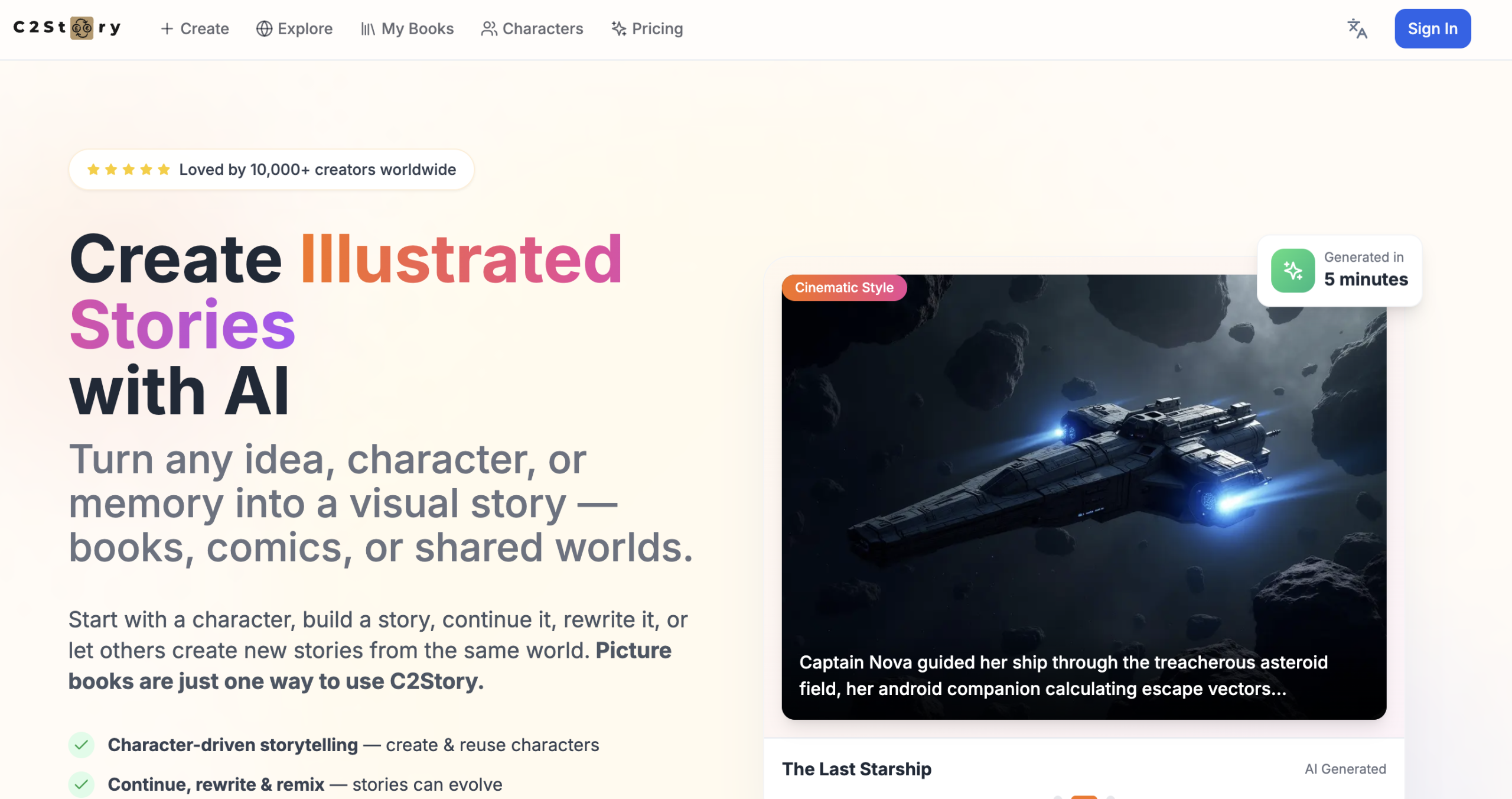
it serves creators who want to transform ideas into illustrated narratives without needing design expertise. It simplifies the process of generating visual stories, expanding existing ones, or even rewriting them with different twists. This platform aims to solve the challenge of producing illustrated narratives efficiently, enabling users to build character-driven stories and shared story universes. It’s quite useful for anyone looking to monetize creative works, as it suggests users can earn revenue from published stories. For instance, you can earn $1.39 per PDF download and $0.69 per HD release.
Getting Started with C2Story
After signing up for C2Story, you’re ready to begin creating stories through a straightforward 3-step process. There isn’t a lengthy onboarding tour; you’ll jump right into the creative flow. The initial step involves describing your story or character. This is where you’ll input your core idea, setting the stage for the AI to build upon. It’s a critical starting point, as the quality of your initial prompt influences the generated content.
Choosing Your Visual Style
Once your story idea is in place, the next step is selecting an illustration style. C2Story provides over 50 options, including styles like picture book, comic, fantasy, cinematic, and anime. This variety allows for significant creative control over the visual aesthetic of your narrative. You’re not limited to a single look; you can experiment to find the perfect match for your story’s mood and target audience, whether it’s children, all ages, or teens/adults. This choice directly impacts the visual output, so it’s worth exploring the different styles available.
Generating and Expanding Your Narrative
The final step involves generating, continuing, or rewriting your visual story. The platform takes your description and chosen style, then produces the illustrated narrative. If you’re not satisfied, you can rewrite sections or expand existing stories with new chapters. This iterative process lets you refine the story and its visuals until it meets your vision. The tool handles the complex image generation, meaning you don’t need graphic design skills. Users can also build interconnected story worlds, encouraging a consistent universe across multiple narratives. Users also get offers approximately 500 character chat messages for Starter plan users, allowing for interactive story development.
Understanding the Credit System and Export Options
C2Story uses an image credit system, which is important to understand for managing your usage. One image credit equals one illustration. A typical picture book, for example, requires 10-15 credits. Public characters from the community cost 1 credit per character, while personal characters are free. Unused subscription credits don’t roll over to the next month, so it’s a ‘use it or lose it’ system for monthly allocations. If you need more, credit packs are available for one-time purchase and don’t expire. This credit model means you’ll need to monitor your usage, especially for longer or more visually intensive projects.
Exporting and Integration Capabilities
For offline access and sharing, C2Story allows you to export your creations. You can download stories as PDFs, individual images, or a ZIP bundle containing all assets. This feature is crucial for creators who want to print their books or use the images in other projects. Stories can also be created in multiple languages, including English, Chinese, and Japanese. For those with more technical needs, paid plans include API access. This suggests programmatic integration with other tools is possible, though specific third-party integrations aren’t explicitly detailed. There’s also a mention of a pathway to turn C2Story content into animated films via VO3 AI, indicating potential for further content creation beyond static images. Still, the exact mechanism for this animation conversion isn’t fully outlined, and it’s unclear if it’s a direct integration or a suggested workflow.
Technical Considerations and Limitations
While C2Story simplifies illustrated story creation, note some technical limitations. The platform is web-based, requiring a modern browser for access. There isn’t a dedicated mobile application, though it’s accessible via web browsers on mobile devices. A significant constraint for power users or those with extensive projects is the page limit tied to credit availability. Users with fewer than 300 credits are restricted to 8 or 12-page books. Only Creator and Studio subscribers, or those with 300+ credits, can create 16-page books. Larger, more complex narratives might necessitate a higher-tier subscription or additional credit pack purchases, which could impact project scope and budget. It’s a design choice that directly affects the length and depth of stories you can produce without upgrading. This credit-based limitation on book length is a key factor to consider for anyone planning ambitious storytelling projects. The narrative structure you can build within these constraints matters as much as the images themselves.