
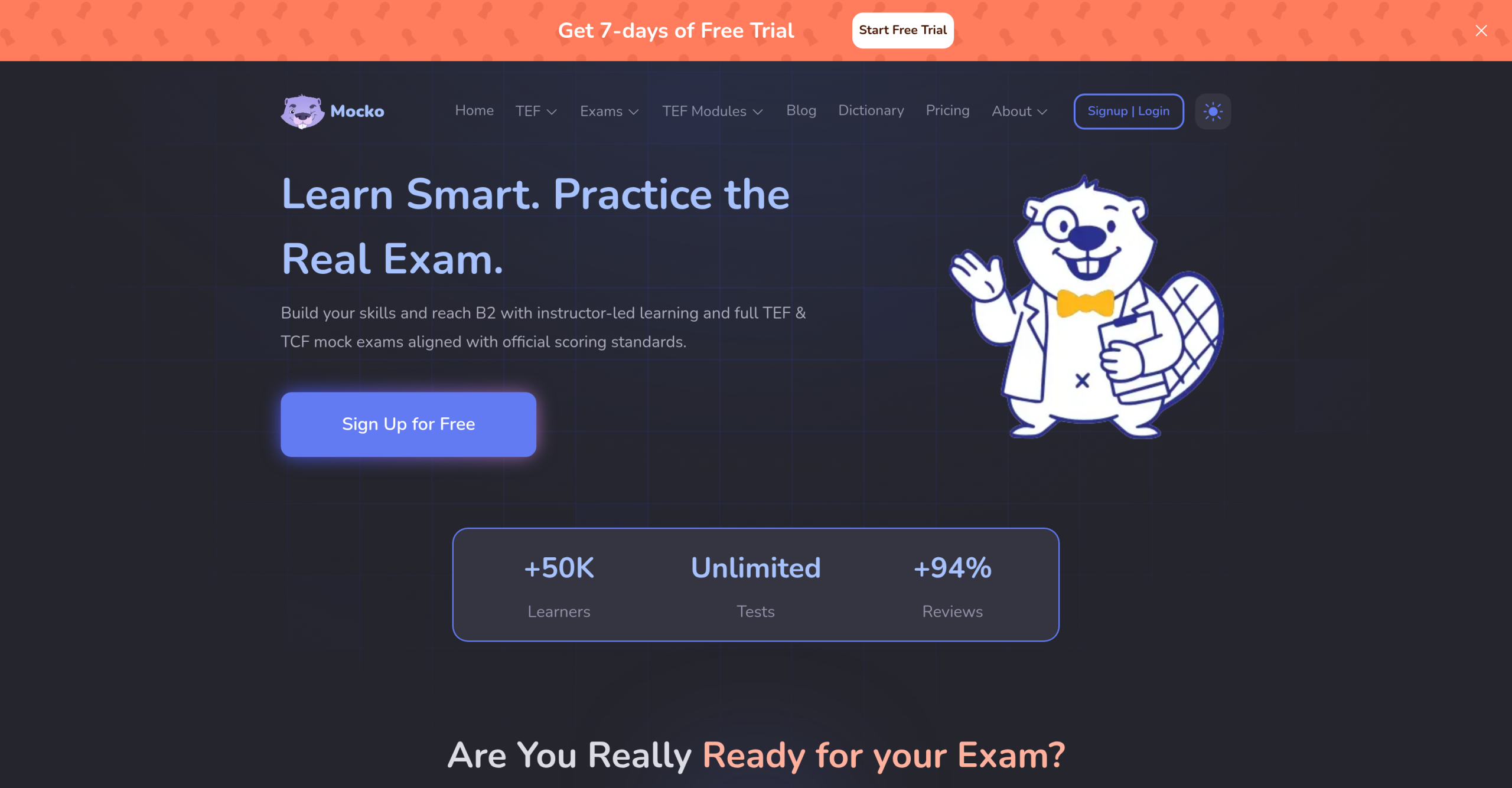
You’re preparing for your TEF exam, needing to score high for Canadian residency. You’ve tried various practice methods, but the feedback loop is too slow, especially for speaking and writing. Mocko.ai aims to address this by providing an AI-driven environment that simulates actual exam conditions, offering instant scoring and detailed insights into your performance. it’s built to accelerate your learning efficiency by pinpointing specific areas for improvement, a critical factor when facing high-stakes language proficiency tests.
Simulating Exam Conditions: Mocko’s Approach
Mocko.ai focuses on replicating the exact structure and timing of official French proficiency exams like TEF and TCF. This includes not only question types but also adaptive difficulty and the pressure of a timed environment. The platform provides full-length mock exams that mirror the actual test experience, which users on various platforms commend for its realism. This realism helps reduce test anxiety, a significant benefit when you’re aiming for a specific score. The platform continues to update its TEF preparation capabilities to align with current exam standards.
When we compare this to other platforms, Mocko.ai often presents a more challenging simulation. Competitors like TV5MONDE or RFI Savoirs offer valuable resources for French learning, but their primary focus isn’t always on the rigorous, timed, and adaptive nature of TEF/TCF exams. Mocko.ai’s strength lies in its dedicated exam simulation, providing an environment that feels genuinely like the real thing. It’s a specialized tool, not a general language learning app.
AI-Powered Feedback and Performance Analytics
One of Mocko.ai’s core differentiators is its instant AI scoring and detailed feedback across all four language skills: speaking, writing, listening, and reading. For speaking, it offers pronunciation analysis, a feature many general language learning apps lack. For writing, it automates scoring based on official criteria, providing immediate insights into grammar, vocabulary, and coherence. This immediate feedback loop is crucial; you don’t have to wait days for a human tutor to review your work.
This system contrasts with platforms like GlobalExam or PrepMyFuture, which might offer feedback, but often not with the same level of AI-driven granularity or immediacy for all sections. Mocko.ai’s analytics dashboard tracks your progress, identifying strengths and weaknesses, and even suggests personalized learning paths. Users report significant score improvements after using the platform, attributing it directly to the actionable feedback. The AI transcends being just scoring; it’s providing diagnostic information you can act on to refine your study strategy.
Architectural Considerations and User Experience
Mocko.ai operates entirely in a web browser, requiring no software installation. It’s accessible on any device, including mobile, and users can install it as a web app for an app-like experience. This browser-based architecture simplifies deployment and ensures broad compatibility. Still, this design choice also introduces a limitation: the absence of an offline mode. This is a frequently requested feature, and its unavailability means you’re dependent on an internet connection for practice. For users in areas with unreliable connectivity, this could be a significant hurdle.
From a data handling perspective, the platform processes user input, including audio recordings for speaking tests and text for writing, to generate its AI-driven feedback. While the terms of service note that AI-generated content may contain errors, the emphasis is on providing rapid, data-driven insights. The system’s ability to process and analyze complex linguistic data in real-time is proof of its underlying AI architecture. it’s meant for speed and specificity, which isn’t always the case with broader language learning tools like Babbel or Kwiziq, which prioritize general language acquisition over exam-specific performance.
Comparative Analysis: Mocko vs. Alternatives
Let’s consider how Mocko.ai stacks up against some alternatives, focusing on its core offering of exam simulation and feedback:
| Feature | Mocko.ai | PrepMyFuture / GlobalExam | TV5MONDE / RFI Savoirs |
|---|---|---|---|
| Exam Focus | TEF/TCF (highly specific) | TEF/TCF (broader, less challenging) | General French learning, some exercises |
| AI Feedback | Instant, detailed (pronunciation, writing) | Often less granular, slower for some sections | Limited to none, self-correction |
| Realism of Mock Tests | High, often more challenging | Moderate to high | Low (not exam-focused) |
| Personalized Learning | Yes, data-driven paths | Some, less dynamic | Minimal |
| Offline Mode | No (frequently requested) | Varies by platform | Varies by platform |
| Pricing (Paid) | CA$35/month | Comparable, sometimes higher | Mostly free |
Mocko.ai’s strength lies in its dedicated, high-fidelity simulation and its instant, specific AI feedback. While platforms like PrepMyFuture also target exam preparation, users often find Mocko.ai’s tests more accurately reflect the difficulty and format of the actual exams. The CA$35 per month premium plan releases unlimited mock exams and advanced analytics, which is a significant investment for dedicated test-takers. Its strict "No Refunds" policy is something you’ll want to consider before committing.