

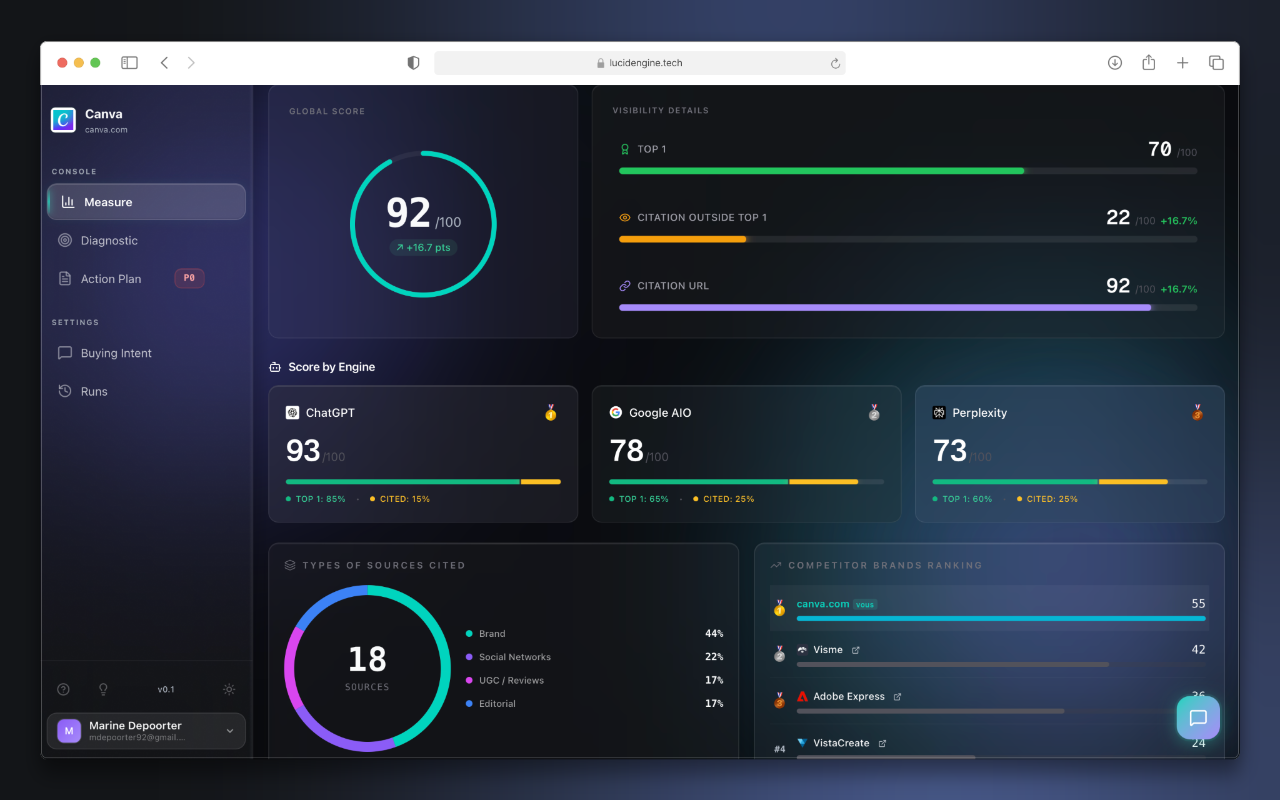
Looking for a way to track? Lucid Engine lucid Engine tracks how your brand appears across ChatGPT, Perplexity, and Google AI Overviews with alerts, competitor tracking, and action plans. Built for indie makers and micro-SaaS companies, it analyzes the underlying data AI models use in their responses and persists those insights across sessions through its "Truth Layer." The result is a monitoring workflow that tracks changes over time and surfaces competitive intelligence you can act on.
Monitoring AI Search Visibility
Lucid Engine’s core capability lies in tracking how a brand appears in AI search results. It’s a crucial distinction from traditional SEO tools that focus solely on organic web search. We’re seeing a shift in how information is consumed, and AI search engines like ChatGPT, Perplexity, and Google AI Overviews are becoming significant sources. Lucid Engine helps users understand their brand’s footprint in these new environments.
Real-time AI Search Tracking
This tool provides real-time insights into AI search presence. The platform delivers immediate visibility data instead of relying on periodic reports. This real-time aspect is vital because AI models can update and change their responses quickly. You’ll get alerts and competitive tracking, which is something many general SEO tools don’t offer for AI-specific contexts. It’s a focused approach, and it’s quite effective for its niche.
Actionable Insights and Optimization
Lucid Engine pairs visibility data with concrete optimization suggestions. It provides actionable suggestions to optimize visibility, which is where its "Linear closed loop" feature comes into play. This connects action planning directly with execution, allowing users to measure the impact of their changes against weekly runs. It’s a practical approach for users who want to improve their AI search standing, not just observe it. For instance, if an AI model starts recommending a competitor, you’ll know quickly and can adjust your strategy.
Lucid Engine Versus the Competition
When we look at the market, Lucid Engine isn’t alone in the AI visibility space, but it does carve out a specific niche. It’s got competitors like Loamly v2.1, Trustable, and Wellows, each with their own pricing and feature sets. What sets Lucid Engine apart, beyond its "Truth Layer persistence," is its focus on indie makers and micro-SaaS, offering plans that reflect their budget and needs.
Feature Comparison with Alternatives
Let’s compare Lucid Engine with some of its rivals. While some competitors offer broader marketing tools, Lucid Engine keeps its focus tight on AI search visibility. It’s a specialist, not a generalist.
| Tier | Lucid Engine | Loamly v2.1 | Trustable | Wellows |
|---|---|---|---|---|
| Starting Price | From $19/month | From $29/month | From $65/month | From $79.99/month |
| Free Option | 7-day free trial | Free tier available | Free tier available | Free tier available |
| Key Differentiator | "Truth Layer persistence", "Linear closed loop", Expanded GEO research including Google Scholar | Broader marketing features (implied by higher price) | Focus on trust and reputation (implied by name and price) | General AI visibility (implied by pricing) |
Lucid Engine’s starting price of $19/month makes it one of the more accessible paid options for its target audience, especially when compared to Trustable’s $65/month or Wellows’ $79.99/month. The "one-shot snapshot plan" at $19 suits users who need a single AI visibility check without a recurring subscription. This flexibility isn’t always present with other tools.
Unique Capabilities and Recent Updates
Lucid Engine isn’t resting on its laurels. Its version 0.4 update on March 11, 2026, brought several enhancements. The improved "Truth Layer persistence" means better analysis of how AI models interpret information. The "Linear closed loop" for action planning is a significant step towards practical application of insights. They’ve also expanded their GEO research pipeline to include Google Scholar, which is a smart move for understanding academic and research-based AI mentions. The v0.4 update brought substantial improvements that refine its core offering.
Who Should Use Lucid Engine?
Lucid Engine is clearly designed for indie makers and micro-SaaS companies. If you’re running a small operation and need to understand how your brand is perceived by AI search engines, this tool is for you. It’s ideal for tasks like a one-time AI visibility check to get a snapshot report, or for ongoing monitoring to track changes over time. It’s a focused solution for a specific problem, and it doesn’t try to be everything to everyone.
Ideal User Scenarios
- Monitoring Brand Mentions: You’ll want this if you need to know when and how your brand is mentioned in AI-generated answers. It’s crucial for reputation management in the AI era.
- Competitive Analysis: It’s great for seeing which competitors AI search engines recommend instead of your product. This insight can inform your content strategy.
- Optimizing for AI Search: If you’re actively trying to improve your ranking and presence in AI search results, the actionable suggestions and "Linear closed loop" will be invaluable. It’s a tool for proactive optimization.
When Lucid Engine Might Not Be the Best Fit
If you’re a large enterprise with complex, multi-faceted SEO needs across traditional search engines, social media, and AI, Lucid Engine might feel too specialized. While it does mention a "pause subscription flow" for teams, implying some team functionality, it doesn’t detail extensive collaboration features or enterprise-level volume pricing. For broader, more general SEO, you’d likely need a more thorough suite of tools. It works best as a complement to broader SEO tools, filling the AI visibility gap.
The Hidden Cost of AI Visibility Monitoring
While Lucid Engine offers a clear pricing structure starting at $19/month and a 7-day free trial, a potential hidden cost for new users isn’t monetary. It’s the commitment to understanding and adapting to a rapidly changing field. AI search is still evolving, and what works today might need adjustment tomorrow. You’ll need to dedicate time to interpreting the reports and implementing the suggested actions, as the tool itself won’t magically optimize your presence without your active engagement. It’s a powerful instrument, but it requires a skilled hand to play it effectively.