

PDFdigest turns dense academic PDFs into short explainer videos. Students and researchers can upload a PDF and receive a concise breakdown of the paper’s key ideas, methods, and findings — typically within minutes.
Getting Started with PDFdigest: Your First Analysis
When you first encounter PDFdigest, you’ll likely be looking for a quick way to understand a paper. The platform’s design prioritizes a straightforward initial experience. You don’t need to guide through complex setup wizards; the process is straightforward.
Account Creation and Initial Access
Signing up for PDFdigest is a simple process. You can create an account or log in, which then grants you access to your personal dashboard. This dashboard isn’t overly cluttered; it’s primarily where you’ll manage your credits and view past analyses. It’s a functional space, not a feature-rich hub, which isn’t necessarily a bad thing for a tool focused on a single core task.
Uploading Your First Paper
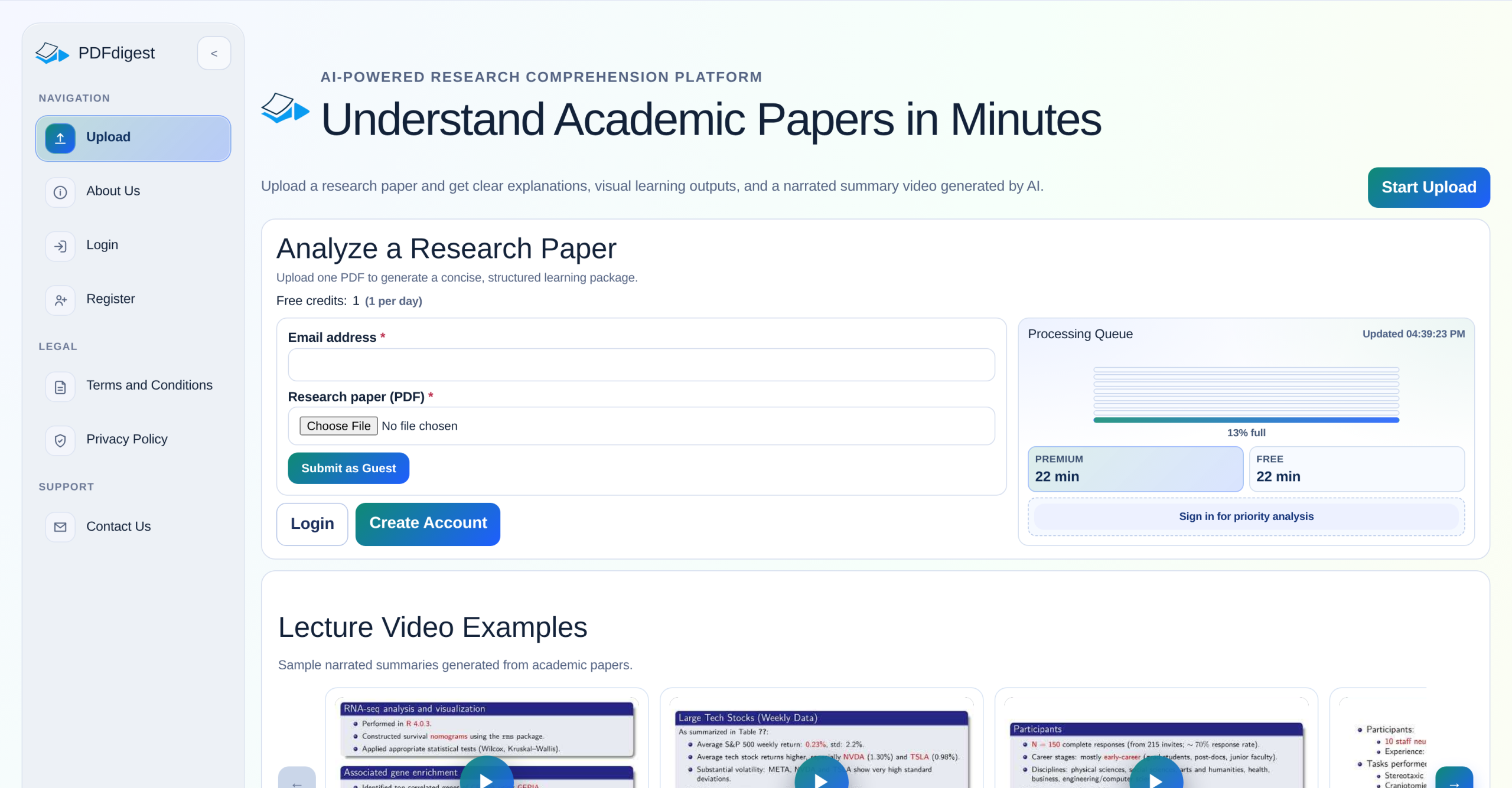
The central action on PDFdigest is uploading a research paper. Available a clear option to submit your PDF. It’s possible to do this as a guest, but to save your analyses and manage credits, you’ll want an account. The platform accepts PDF files, which is standard for academic papers. There isn’t any mention of other supported document types, so it’s safe to assume PDFs are its sole focus. Once uploaded, the system initiates the analysis.
The Processing Queue and Output Generation
After submission, your paper enters a "Processing Queue." This isn’t an instantaneous process; you’ll see estimated times for analysis. This wait time could be a minor inconvenience if you’re on a tight deadline, particularly for free users who might not receive priority processing. Once complete, PDFdigest generates a concise, structured learning package and a narrated summary video. It’s these outputs that are meant to simplify the paper’s content, breaking it down into more manageable chunks. The idea is that you’ll grasp the key ideas, methods, and findings in minutes, rather than hours.
Understanding the Credit System and Costs
PDFdigest provides free access with premium upgrades, which isn’t uncommon for AI-powered tools. On the flip side, its credit system is quite specific, and Note that understand how it works to avoid unexpected limitations.
Daily Free Credits
Users receive 1 free credit per day. That means you can analyze one paper daily without incurring any cost. It’s a decent offering for casual use or Users who only need to review a single paper occasionally. On the flip side, if you’re a student with multiple papers due or a researcher needing to screen dozens, this daily limit will quickly become a bottleneck. It’s a system that encourages consistent, light use rather than burst activity.
Purchasing Additional Credits
For higher volume needs, you’ll need to purchase additional credits. These are offered as one-time purchases, not subscriptions, which is a notable difference from many other freemium services. Here’s how the pricing breaks down:
| Tier | Credits | Price | Original Price |
|---|---|---|---|
| Starter | 5 | $2.50 | $5.00 |
| Popular | 10 | $4.50 | $9.00 |
| Best Value | 20 | $8.00 | $18.00 |
Each analysis consumes 1 credit. There aren’t any hidden fees like watermarks on exports or additional charges for specific features; the credit system is the primary cost mechanism. It’s a transparent model, but it does mean every single analysis has a direct, quantifiable cost beyond the free daily allowance. Paid users may receive priority analysis, resulting in faster processing times — useful when working against deadlines.
Who Benefits from PDFdigest’s Approach?
PDFdigest targets a specific demographic, aiming to solve their particular pain points related to academic research. It’s not a general-purpose summarizer; it’s tailored for academic content.
Students and Researchers
Graduate students and PhD candidates are clearly among the primary users. They’ll find it useful for literature reviews, especially when confronting challenging papers in unfamiliar fields. It’s also positioned as a tool for exam preparation, helping to condense complex topics into more manageable study materials. Researchers, too, can use it for faster screening of new findings, which can be invaluable in rapidly evolving fields. it was created to help them stay updated without getting bogged down in every detail of every paper.
Professionals in Technical Fields
Beyond academia, professionals in sectors like biotech, pharmaceuticals, AI, and data science could find value. These fields often require quick access to clear evidence and the ability to understand complex research findings without deep dives into every single source. Policy teams might also use it to rapidly synthesize information from academic reports. It’s about efficiency in knowledge acquisition, which is crucial in fast-paced professional environments.
Limitations and Unanswered Questions
While PDFdigest offers a focused solution, Note that acknowledge its current limitations and areas where information isn’t readily available. It’s not a silver bullet for all research needs.
Lack of Integration Options
One significant point is the absence of explicit integrations. The platform appears to function as a standalone tool, requiring direct PDF uploads. That means you can’t connect it to reference managers like Zotero or Mendeley, or to other research workflows you might already have in place. It’s a closed ecosystem for now, which might necessitate extra steps for users who rely heavily on interconnected tools.
No Team or Enterprise Features
For larger organizations, research groups, or university departments, PDFdigest doesn’t currently offer any team-specific features, collaboration tools, volume pricing, or enterprise options. Its credit system and account structure are clearly designed for individual users. This suggests it isn’t built for shared research projects or institutional deployment, which could be a drawback for collaborative academic or professional settings.
Accuracy and Depth of Summaries
The core claim is that it transforms papers into "short explainer videos and structured learning packages." While this sounds promising, the actual depth and accuracy of these AI-generated summaries and videos aren’t detailed with specific benchmarks or user reviews. It’s one thing to summarize, another to accurately convey nuanced scientific findings. Users will need to critically evaluate the output, as they would with any AI-generated content, to ensure it captures the full context and avoids misinterpretations. It’s a tool for initial comprehension, not a replacement for thorough reading.
Your Next Step with PDFdigest
If you’re considering PDFdigest, your most useful first action should be to upload a paper using your 1 free daily credit to personally evaluate the quality and utility of its generated summary and video. This will give you a direct, hands-on understanding of its capabilities for your specific research needs.