

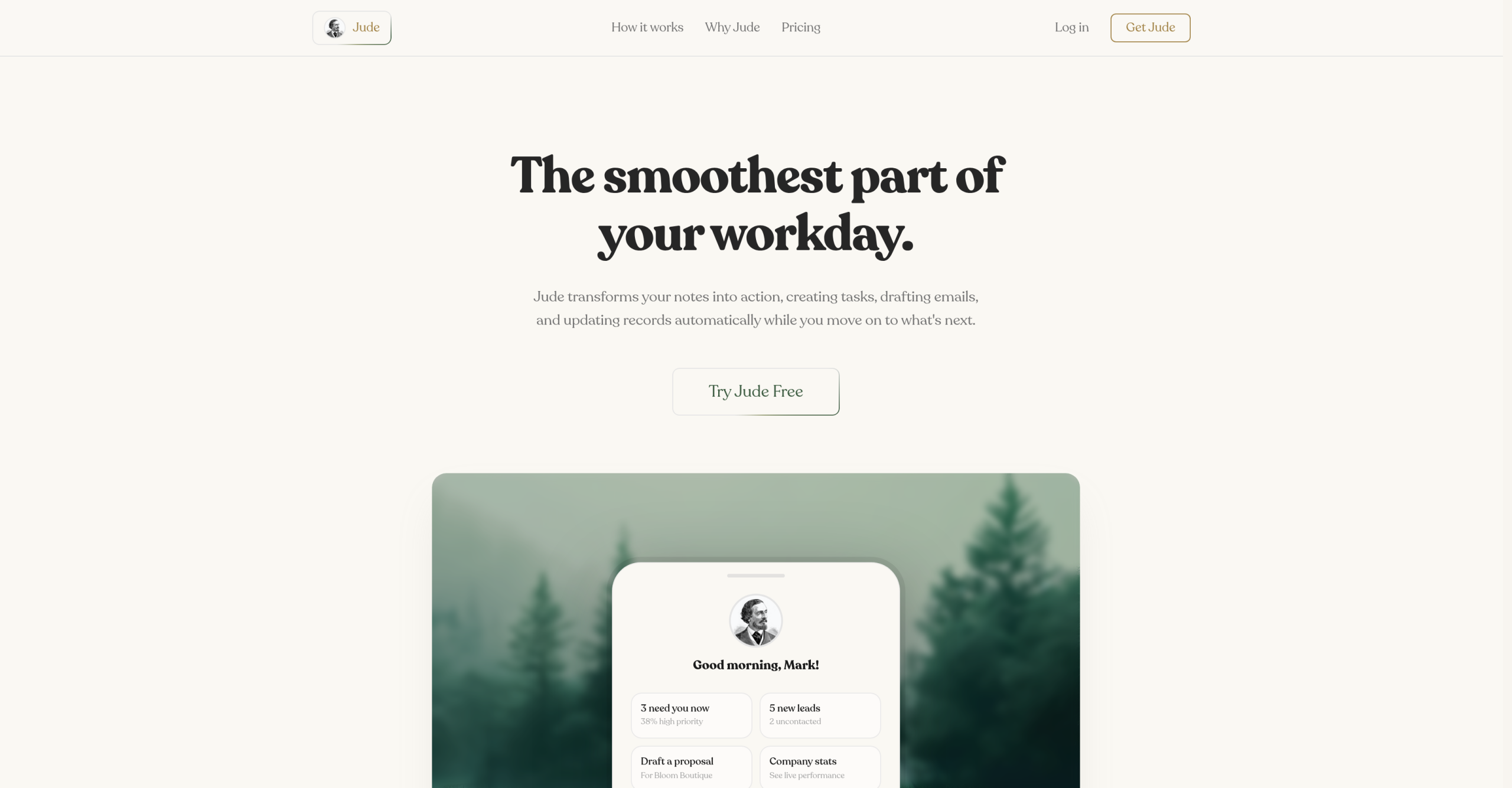
Jude sets itself apart by being an AI-Native CRM, meaning AI is built into every function rather than bolted on as an afterthought. This architecture lets Jude autonomously handle routine business tasks, serving as an operational layer that manages admin work so owners can focus on growth. It’s a compelling proposition for small businesses and solo entrepreneurs struggling with administrative overhead.
Then again, the biggest caveat right now is its newness. Jude was released on March 6, 2026, so extensive user reviews and long-term performance data aren’t yet available. While early users have praised its utility — one reviewer noted it replaced their Calendly setup and separate tracking apps — we don’t have a broad consensus on its real-world stability or scalability under heavy load. That’s a critical consideration for any business relying on it for core operations.
Consolidating Administrative Workflows
Despite its recent launch, Jude aims to solve a persistent problem: the fragmentation of administrative tools. Small business owners often juggle separate apps for client management, email, scheduling, project tracking, and invoicing. Jude integrates these functions into a single platform, driven by its AI models. the idea behind it is to remember clients, draft email replies, track tickets, and manage projects, reducing the need for multiple subscriptions and data silos. It handles client, lead, and contact management with notes and custom fields, and offers two-way Gmail sync for communication.
Core Operational Capabilities
Jude’s capabilities span several critical business areas:
- Client & Project Management: It’s got reliable features for tracking clients, leads, and contacts, alongside managing tickets with priorities and assigning crews to jobs. You won’t need a separate project manager for basic tasks.
- Communication & Scheduling: With Google Calendar integration, it automatically generates Google Meet links. Its AI-drafted email replies can save significant time, especially for routine inquiries. It also supports Twilio SMS for client communication.
- Financial & Knowledge Tools: Generating estimates and invoices, tracking payments, and sending follow-up reminders are built-in. Plus, you can maintain a knowledge base for SOPs and pricing, helpful for keeping operations consistent.
- Automation & AI Chatbots: You can build workflows triggered by events, chaining actions with AI steps. It’s also possible to deploy white-labeled AI chatbots on your website for lead capture and customer interaction, useful for customer-facing businesses.
Accessing Jude’s AI Power
Jude follows a freemium structure, offering different tiers for various needs. The ‘Solo Free’ plan is free forever and includes the full CRM suite, tickets, forms, automations, and Gmail sync. Then again, AI usage on this plan is pay-per-use. For more dedicated AI capacity, there are paid plans:
| Plan | Monthly Cost | AI Messages Included |
|---|---|---|
| Pro | $29 | 275 |
| Unlimited | $79 | ~2,500 (fair-use) |
Chatbot pricing is separate, starting at $29/month for 1 chatbot and 500 messages/month. Note that the ‘Unlimited’ plan isn’t truly unlimited; it has a fair-use ceiling of approximately 2,500 AI messages per month. This isn’t a hidden cost, but it’s a specific limitation power users need to be aware of.
Integration and Technical Considerations
Jude integrates with popular platforms, including QuickBooks, Shopify, WordPress, and Notion, alongside its Gmail and Google Calendar sync. It uses 12+ AI models to power its functionalities. While it integrates with these services, implying internal API usage, there’s no explicit mention of a public API for external developers. In practice, deep custom integrations or building bespoke extensions might be challenging. A power user or developer will eventually hit this wall if they need to extend Jude’s functionality beyond its native integrations or connect it to highly specialized internal systems not already supported. This is a common constraint with many all-in-one platforms: they handle core tasks well, but custom extensibility often takes a backseat.