

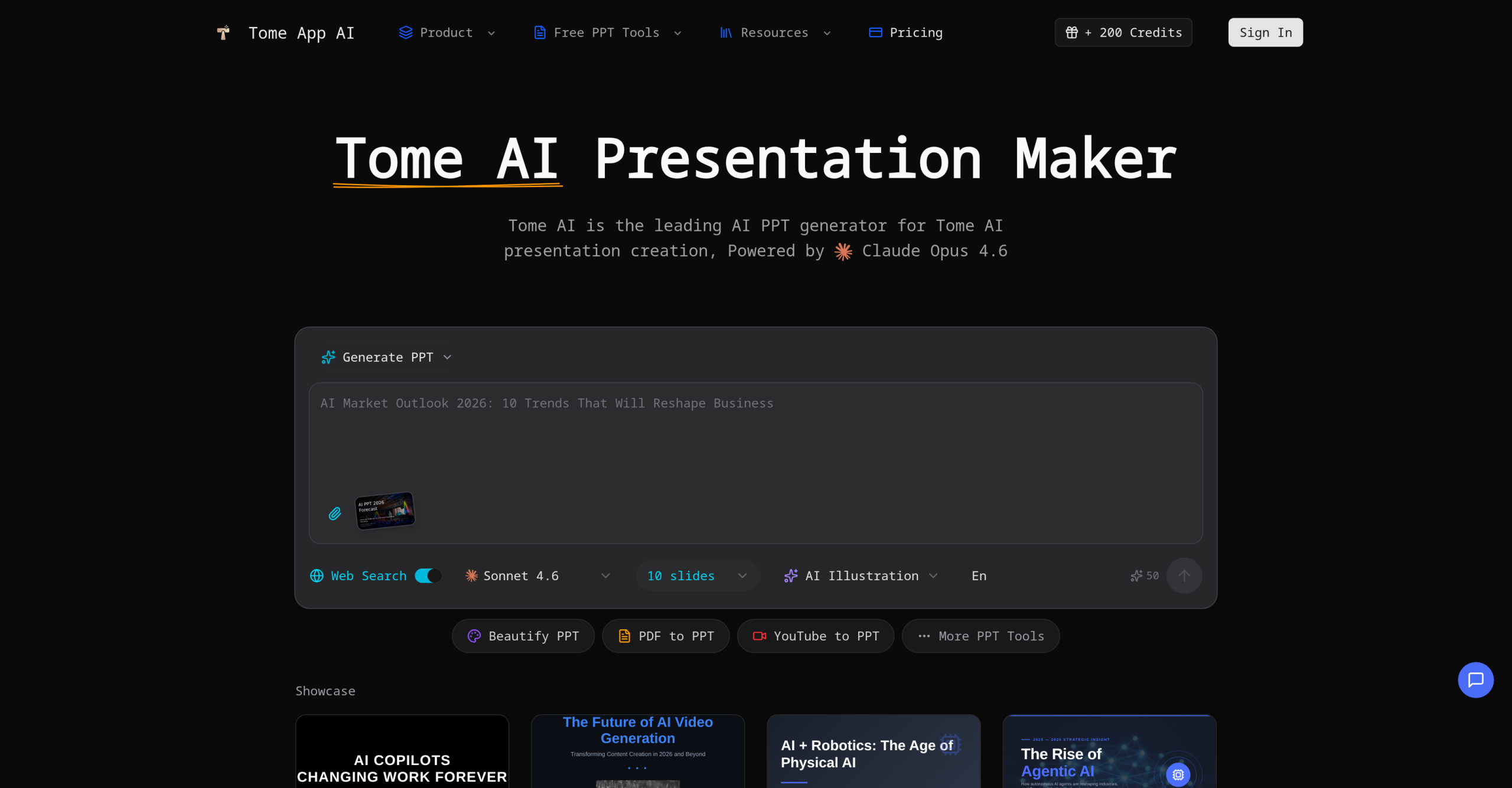
Tome App AI is an AI-powered storytelling and presentation tool focusing on enterprise sales and marketing teams, offering a Pro plan from $16/month. This approach sets it apart from conventional presentation software, focusing on narrative flow and visual storytelling. It’s a tool designed to rapidly create professional presentations, helping users overcome writer’s block and craft compelling narratives efficiently. We’re seeing it increasingly adopted by sales and marketing teams looking to quickly generate investor decks, campaign recaps, and personalized pitch materials. It’s a shift from its earlier, broader audience focus.
The Shift to Enterprise Storytelling
Initially, Tome App AI aimed at a wide audience, including students and educators. Though, a significant strategic pivot occurred around April 2024, shifting its core focus squarely onto enterprise sales enablement. In practice, it’s no longer just a general AI presentation maker; it’s now a specialized tool for business development. This pivot involved discontinuing some original presentation features and restricting AI capabilities in the free plan, a direct response to monetization challenges.
For instance, a startup founder needing an investor deck can use Tome App AI to quickly generate content and visuals, whereas previously, they might’ve spent hours manually arranging slides. Marketing teams developing campaign recaps or growth teams preparing reports also find its rapid generation capabilities useful. It’s a tool built for speed and narrative impact, not just slide creation.
Comparing Tome App AI with Gamma and Traditional Tools
When we look at AI presentation tools, Tome App AI often gets compared to Gamma. Both offer AI-assisted creation, but their philosophies differ. Tome App AI excels in narrative-driven content and visual impact, particularly with its AI image generation. Users often report that it’s faster for generating initial presentation drafts. Gamma, while also AI-driven, tends to offer more customization options for AI-generated layouts, which can be a significant factor for designers who want more granular control.
Here’s a quick comparison:
| Feature | Tome App AI | Gamma | Traditional Tools (e.g., PowerPoint) |
|---|---|---|---|
| Content Structure | Tile-based, web-page format | Card-based, web-page format | Slide-based, presentation file |
| AI Image Generation | Superior quality, integrates DALL-E | Good, but often less visually striking | Manual insertion, no native AI generation |
| Speed of Creation | Very fast for initial drafts | Fast, but can require more tweaking | Slow, manual content and design |
| Customization | Less flexible for AI layouts | More flexible for AI layouts | Full control, but time-consuming |
| Export Options | Web-based, PDF (paid tiers) | Web-based, PDF, some image export | PPTX, PDF, various image formats |
| Primary Focus | Narrative storytelling, enterprise sales | General purpose, quick visual documents | Detailed, structured presentations |
One key limitation for Tome App AI is its lack of native PowerPoint export. This isn’t a minor detail; it’s a significant drawback for corporate users whose workflows are deeply embedded in Microsoft Office. While it publishes content as read-only web pages, that’s not always suitable for internal sharing or situations requiring editable files. Gamma, while also web-based, often provides more versatile export options, making it a bit more adaptable in mixed environments.
Pricing and Access Considerations
Tome App AI provides free access with premium upgrades, which isn’t uncommon in this space. The free plan offers 500 free AI credits per month and includes Tome branding on all outputs. That’s a decent starting point for evaluation, but it’s clearly designed to push users towards paid plans. Paid options for the Pro plan start from $16/month when billed annually, or $20/month when billed monthly. There’s also an Enterprise plan available with custom pricing, which makes sense given its pivot to larger organizations.
Paid plans release unlimited creations, custom branding, engagement analytics, AI image generation, and PDF export. It’s worth noting that the free version has become more restricted compared to some alternatives, reflecting the company’s focus on monetization. Hidden costs aren’t really hidden; they’re the limitations of the free plan, like watermarks and restricted export options. You’ll need a paid plan for serious use, especially if you want to remove branding and export to PDF.
Data Security and Integrations for Enterprise Use
For enterprise clients, data security goes beyond being just a nice-to-have; it’s a necessity. Tome App AI addresses this with industry-standard security measures, storing presentations and personal information on secure servers. It’s stated to be SOC2 and ISO27001 compliant, which provides a strong baseline for data protection. While specific details on data retention or explicit GDPR compliance weren’t provided in the search results, these certifications generally imply reliable practices. It’s a good sign for businesses concerned about their intellectual property.
Integrations are also crucial for workflow. Tome App AI can synchronize data in real-time with external applications. It’s got integrations with design tools like Figma and Spline for interactive 3D experiences, which can add a lot of polish to presentations. On the AI front, it currently uses models like ChatGPT and DALL-E for content and image generation, but its enterprise version is exploring a move to Anthropic and Stability AI models. For sales and marketing teams, integrations with Salesforce and Slack are particularly valuable, allowing for smoother data flow and communication within existing ecosystems. This connectivity helps it fit into existing business processes, rather than becoming another siloed tool.
The Future of AI-Powered Presentations
Tome App AI’s evolution from a general presentation tool to an enterprise-focused sales enablement platform highlights a broader trend in AI applications. It’s not just about generating slides anymore; it’s about generating narratives that convert. Its tile-based system and web-based output represent a departure from traditional slide formats, emphasizing a more dynamic, read-only experience. This isn’t for everyone, especially those tied to PowerPoint, but it’s a compelling vision for quick, visually rich storytelling.
If you’re considering Tome App AI, your first action should be to explore the free plan to understand its tile-based interface and AI generation capabilities. You’ll get 500 free AI credits per month, which is enough to create a few initial drafts and see if its narrative-first approach aligns with your team’s communication style. This will give you a practical feel for its strengths before committing to a paid tier.