

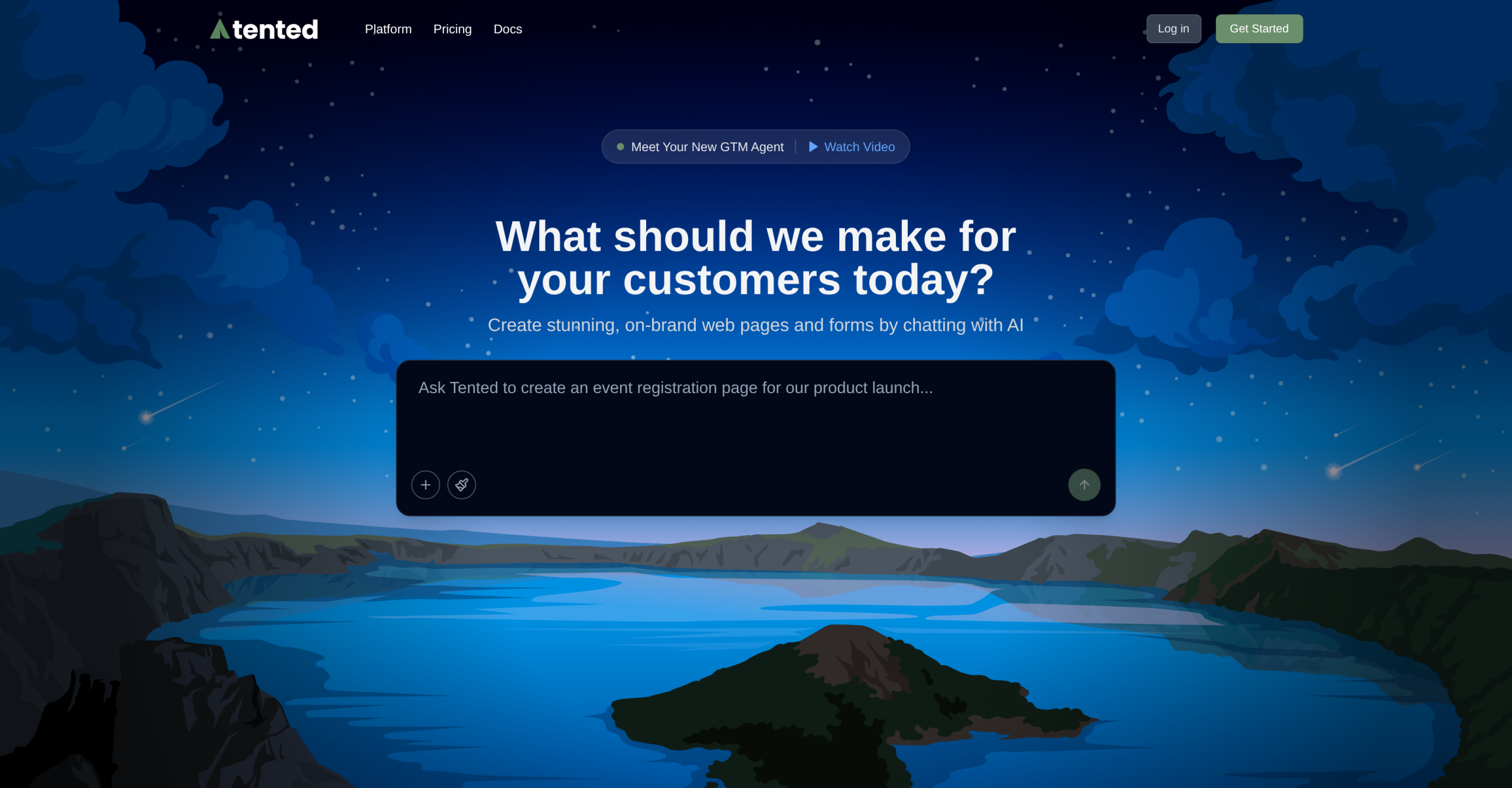
Many people think AI tools for content creation are inherently complex, requiring extensive setup or a steep learning curve. Tented.ai, Though, challenges this notion by promising to take an idea to a live website in minutes, using only natural language. This isn’t limited to just speed — it also shifting the entire paradigm of web page and form generation for go-to-market (GTM) teams, though one might question how much nuance an AI can truly grasp from a "vibe." It’s a bold claim, and we’ll examine what value it actually delivers.
The Cost of Creation: Free Access vs. Paid Capabilities
Many AI tools lure users with a free tier, only to gate essential functionality behind a paywall. Tented.ai isn’t an exception, but Note that understand what you’re truly getting without spending a dime versus what a subscription releases. The platform offers a "Free Forever" tier, which includes its core features. In effect, you’re able to generate web pages, microsites, landing pages, forms, and even AI avatar videos by simply describing your needs. It’s a compelling offer for individuals or small teams just starting out, letting them test the waters of "vibe coding" without financial commitment. You’ll get to experience the instant content generation and the promise of reduced manual design and copywriting efforts. This free access is crucial for validating if the AI’s interpretation of your "vibe" aligns with your actual brand aesthetics and messaging.
That said, the free version likely comes with inherent limitations, even if they aren’t explicitly detailed as watermarks or export fees. Most freemium AI models impose usage caps, such as a limited number of generated pages, monthly views, or perhaps a restricted set of AI avatar video options. Once your team starts scaling its content production or requires more advanced control, you’ll probably hit these invisible walls. This isn’t a flaw; it’s a standard business model. The real question is whether the free experience is compelling enough to justify the jump to a paid plan.
Paid plans for Tented.ai begin at $19/month, as of March 2026. This isn’t an insignificant sum for a tool that, according to some users, can have "vague vibe coding" and "potential inconsistencies in interpretation by the AI." What does this monthly fee actually buy you? It’s stated to provide access to "advanced capabilities." While the specifics aren’t fully laid out, it’s reasonable to expect features like higher usage limits, more advanced customization options, potentially better AI models for content generation, and crucial team management functionalities. For instance, the ability to invite new users, manage existing ones, and set permissions becomes vital for GTM teams beyond a single user. Without these, a team can’t truly collaborate effectively, making the free version more of a personal sandbox than a team solution.
The Value of Team Features and API Access
For GTM teams, the ability to scale and collaborate is paramount. Tented.ai addresses this by including features for team management in its paid offerings. options for inviting new users and managing permissions, which is essential for maintaining brand consistency and workflow efficiency across a marketing or sales department. It’s not just about generating pages; it’s about doing so in a controlled, coordinated environment. A lean marketing team scaling personalization won’t get far if every member is operating in their own silo. The paid tier aims to solve this, but note verify how granular these permissions are and how easily new team members can onboard.
Also, Tented.ai offers a "Vibe Coding API." This isn’t a feature for casual users; it’s Anyone who need to integrate Tented.ai’s generation capabilities into their existing tech stack or automate content creation at a much larger scale. For Sales & Marketing Operations professionals, an API can be a notable development, allowing agents to generate customer-facing content programmatically. That said, the cost of API access isn’t detailed, and it’s often tiered based on usage, which could add another layer of expense. While the API suggests support for high-volume automation, it’s unclear what the rate limits are or what kind of technical expertise is required to implement it effectively. It’s a powerful addition, but it’s not a feature everyone will need or even understand.
The Promise of Speed: Setup and Iteration
Tented.ai champions an "AI-First Approach" and "Real-Time Iteration," promising to take an idea to a live website in minutes. This isn’t a small claim; it suggests a significant departure from traditional web development cycles. Upon signing up, the process is designed to be intuitive. You’ll start by describing your desired content in natural language. The AI then instantly generates the page. This initial generation is just the beginning; the platform emphasizes a conversational approach to refinement. Users can iterate through chat to adjust copy, design, and layout, aiming for a single-click publication.
This workflow, broken into "Ideate," "Vibe Code," and "Publish," sounds incredibly efficient. the idea behind it is to bypass the need for extensive coding knowledge or even a deep understanding of design principles. For marketers and sales professionals who need to react quickly to market changes or personalize outreach, this speed is a definite advantage. Users praise its capacity to simplify landing page creation and offer instant form building. It’s genuinely impressive that it automatically generates on-brand pages, significantly reducing design time. One user noted it’s a "solid AI marketing tool that delivers on its core promise," offering a "well-designed, thorough feature set, and competitive pricing" that provides "genuine value."
That said, the skepticism here lies in the "vague vibe coding" itself. How well does the AI truly interpret nuanced branding guidelines or specific campaign messaging? While it reduces design time, it might introduce a new kind of iteration: refining the AI’s output to match human intent. If the AI consistently misinterprets the "vibe," the time saved in design could be lost in endless chat-based revisions. The lack of explicit template designs, as noted by some, means you’re entirely reliant on the AI’s interpretation, which might not always align with best practices or established design patterns. It’s a trade-off: speed for potentially less direct control over the final aesthetic.
Support and the Unanswered Questions of Control
Even with an intuitive interface, questions will arise. Tented.ai provides a "Tented Help Center" with documentation covering various aspects, from creating "Tents" (pages) to billing and domain configuration. This is standard practice, and it’s good that an API Reference is also available for developers. For free users, support is community-based, which can be hit-or-miss depending on the community’s activity and expertise. Paid plans, Though, include "priority support," promising faster response times. While this sounds reassuring, the actual response times aren’t publicly detailed, leaving a question mark over how truly responsive this priority support is when you’re facing a critical issue.
The biggest lingering question, despite its promises of efficiency, is about the level of creative control. If the AI’s "vibe coding" is sometimes vague, and there’s a lack of traditional coding options or explicit template designs, how much artistic freedom does a user truly retain? It’s a tool built for speed and automation, but at what point does that automation become a limitation? While it’s noted that "while not perfect, it earns its place as a solid option," one has to wonder: how does Tented.ai plan to evolve its "vibe coding" to offer more precise, granular control over design and content without sacrificing its core promise of instant generation?