

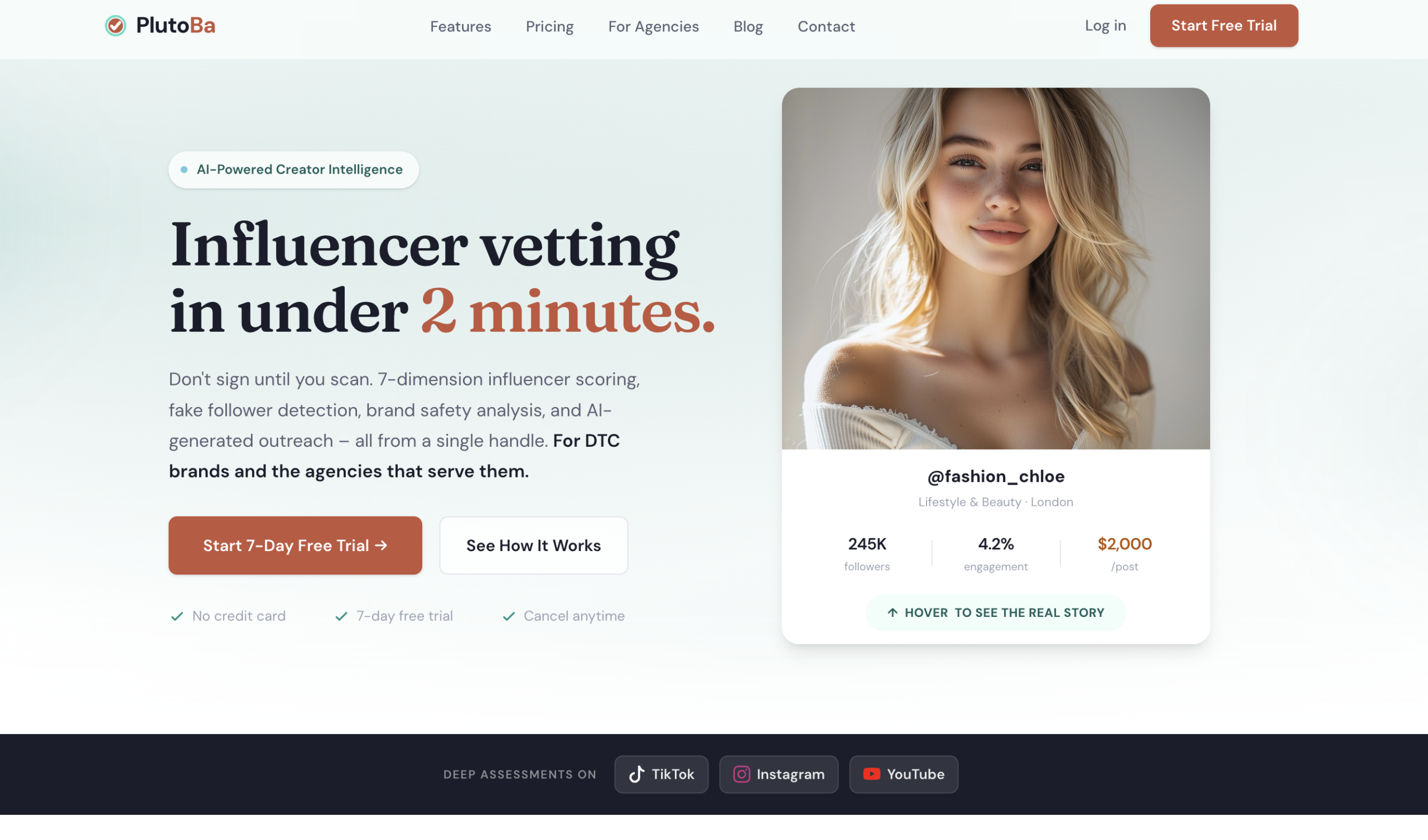
How can brands and agencies confidently select influencers on TikTok, Instagram, and YouTube, ensuring genuine engagement and brand safety? PlutoBa addresses this critical challenge by offering a vetting solution, providing a structured, data-driven approach to evaluating potential collaborators. the tool exists to mitigate the risks associated with influencer marketing, helping users make informed decisions. We’ll examine its capabilities and how it stacks up against established competitors like Modash and CreatorIQ.
AI-Driven Influencer Evaluation and Risk Mitigation
PlutoBa’s core function is to provide thorough influencer vetting, generating a "PlutoBa Score" (0-100) for each profile. This score goes beyond being just a number; it’s derived from a seven-dimension scoring system that includes engagement quality, audience authenticity, comment quality, content quality, brand safety, follow ratio, and view consistency. This goes beyond just follower counts — it also the integrity of those followers and their interactions. For instance, it’ll detect fake followers, engagement pods, bot comments, and unusual follower spikes, which is crucial for effective marketing spend.
Assessing Authenticity and Brand Fit
One of PlutoBa’s key differentiators is its focus on deep analysis. It offers two assessment types: "Standard" assessments, which analyze 30 posts, and more in-depth "Deep" assessments, which scrutinize 100 posts and 300 comments. This level of detail helps identify subtle patterns of inauthentic engagement that simpler tools might miss. It’s also analyzing brand safety by reviewing content for profanity, controversial topics, and competitor mentions. This proactive approach helps brands avoid associations that could damage their reputation. Also, it benchmarks partnership rates against fair market value, giving users a negotiation advantage.
PlutoBa vs. Competitors: A Comparative Look
When we compare PlutoBa to other tools in the influencer vetting space, its AI-powered, multi-dimensional scoring stands out. Competitors like Modash and CreatorIQ offer broad databases and discovery features, but PlutoBa’s strength lies in its specialized vetting depth. It’s not just about finding influencers; it’s about thoroughly scrutinizing them. Here’s a quick comparison:
| Feature | PlutoBa | Modash | CreatorIQ |
|---|---|---|---|
| Core Focus | Deep AI Vetting & Risk Mitigation | Influencer Discovery & Analytics | End-to-End Influencer Marketing Platform |
| Key Metric | PlutoBa Score (0-100, 7 dimensions) | Audience Demographics, Performance Metrics | Campaign Management, ROI Tracking |
| Fake Follower Detection | Reliable, AI-powered | Yes, with audience authenticity scores | Yes, with fraud detection |
| Brand Safety Analysis | Yes, content review for profanity/controversy | Limited explicit mention | Yes, brand suitability filters |
| Rate Benchmarking | Yes, against fair market value | Yes, estimated rates | Yes, negotiation support |
| AI-Generated Outreach | Yes | No explicit mention | Yes, messaging tools |
| Assessment Depth | 30-100 posts, 300 comments | Varies by plan, general analytics | Varies by plan, detailed reporting |
PlutoBa’s ability to provide quick assessments (under 2 minutes) while still offering deep analysis of numerous posts and comments is a significant advantage. it serves users who need to make rapid, data-backed decisions. While Modash boasts a database of over 250 million creators, PlutoBa’s focus is clearly on the quality of the vetting process for a selected pool, rather than sheer discovery volume. It’s a tool Anyone who’ve identified potential partners and now need to verify their suitability.
Accessing PlutoBa: Pricing and System Requirements
PlutoBa isn’t a free tool, but it does offer a free 7-day trial that doesn’t require a credit card, which is a user-friendly approach. Paid plans start at $69 per month. These plans include varying allowances for "Standard" and "Deep" assessments, profile fetches, creators in CRM, team members, and active campaigns. note that there’s a credit system in place; some plans offer a "1-month quota rollover" for unused credits, while others don’t. This suggests that assessments and profile fetches consume credits, so users’ll need to monitor their usage to avoid unexpected costs.
As a cloud-based platform, PlutoBa is accessed via a web browser. While specific system requirements aren’t detailed, it’s safe to assume it’ll perform best on modern web browsers like Chrome, Firefox, Safari, or Edge. Users will need a computer with sufficient hardware to handle JavaScript-heavy web pages, likely at least 1GB RAM and a machine no older than five years. A broadband internet connection is also essential, as real-time data processing is central to its functionality. There isn’t a dedicated mobile application or offline capability mentioned, which isn’t uncommon for such specialized AI tools.
The Challenge of Early Adoption and Data Availability
PlutoBa is a relatively new entrant to the market, having had its initial release on March 4, 2026. This recent launch means there isn’t much public feedback available yet. Platforms like Capterra and SourceForge currently show an overall rating of 0.0 because there are no user reviews. This lack of user-generated data means that while its feature set appears strong on paper, we can’t yet confirm common complaints or praise from actual users. It’s a limitation inherent to any new product; it’ll take time for a user base to form and share their experiences.
The Developer’s Ceiling: API Access and Custom Integrations
For power users and developers, a significant technical limitation might be the current lack of explicit documentation regarding API access or custom integration capabilities. While PlutoBa offers AI-generated outreach, the ability to programmatically integrate its vetting scores or analysis into existing CRM systems, campaign management platforms, or custom data pipelines isn’t detailed. This could present a ceiling for organizations looking to deeply embed PlutoBa’s intelligence within their proprietary workflows, potentially requiring manual data export and import processes for advanced use cases.