

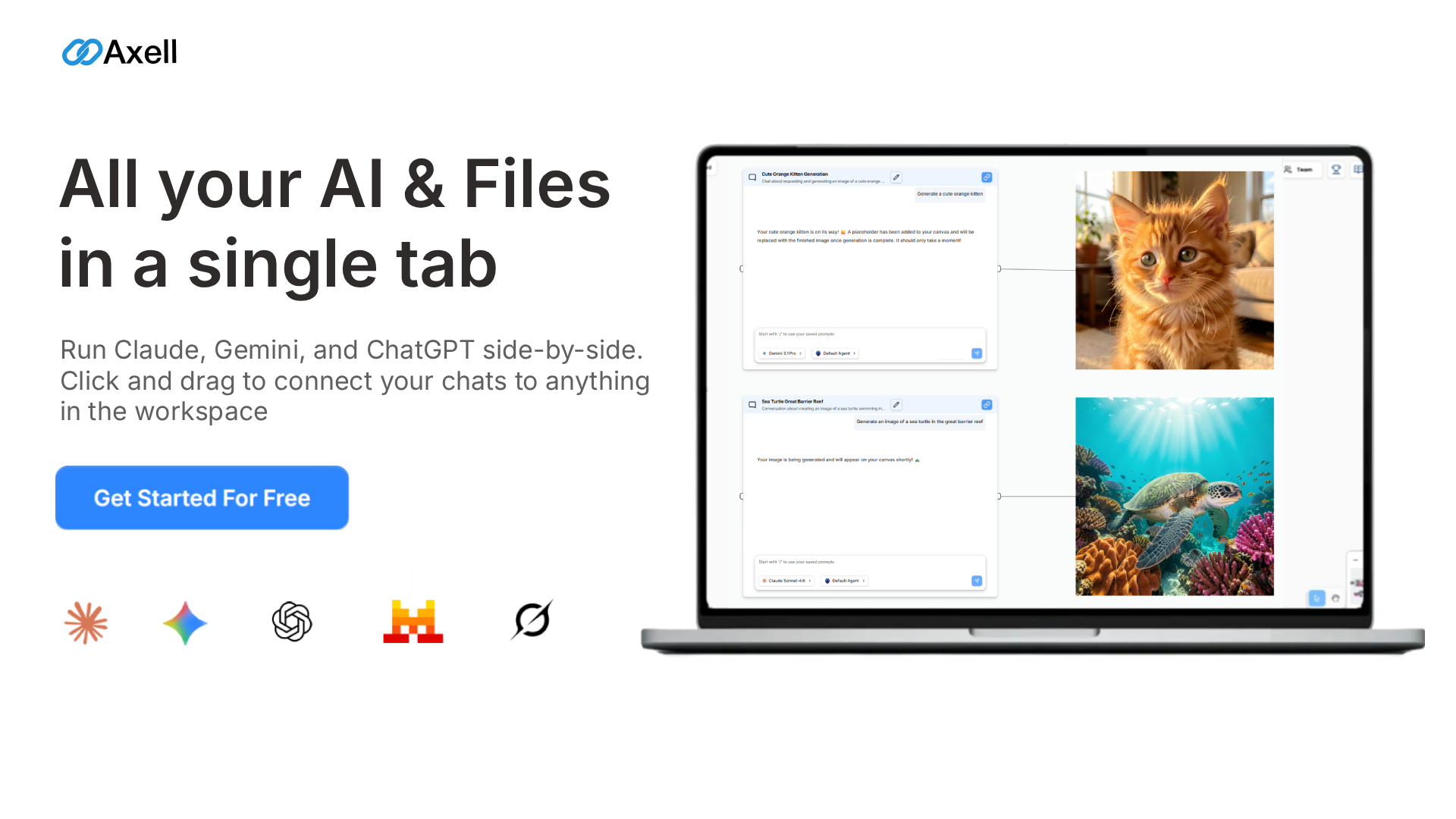
Axell is a free AI workspace that unifies multiple AI tools like ChatGPT and Claude in a single tab, supporting real-time collaboration for up to 20 users. It’s built to address the common problem of juggling multiple AI chats and tools across different tabs, offering a single environment for various AI-driven tasks. This platform aims to simplify how individuals and teams manage their AI workflows, integrating tools like Claude, Gemini, and ChatGPT into one collaborative space.
The Value Proposition: A Free Collaborative AI Hub
Axell’s most compelling aspect is its pricing model: it’s advertised as 100% Free. This isn’t a freemium model; there aren’t paid tiers or subscription upgrades for the core Axell platform itself. This approach immediately sets it apart from competitors like Liminary, Nya AI, and Dock, which typically offer free tiers but then push users towards paid plans starting from $9/month to $29/month for advanced features or higher usage limits. For users who need a centralized AI workspace without direct platform costs, Axell presents a strong value.
What You Get Without Paying a Dime
Even without a price tag, Axell provides a substantial feature set. It’s lets you run multiple AI chats simultaneously within a single browser tab. It’s not just about parallel conversations; you can easily connect chat items, files, and AI agents, creating a visual canvas for tasks and discussions. The platform supports versatile file processing, handling formats like PDF, image, video, docx, md, and txt. In practice, your AI chats can read, analyze, and even edit connected files, which isn’t something every free tool offers.
Collaboration is another key area where Axell delivers significant value at no cost. It’s touted as the "world’s first fully multiplayer generative AI tool," supporting up to 20 people working together in the same workspace. Real-time synchronization ensures that every chat, file, and agent updates instantly for everyone involved. You can invite collaborators instantly and share contextual information, which is a big win for team-based AI projects. This level of real-time, multi-user functionality is often reserved for paid enterprise solutions, so its inclusion in a free tool is quite notable.
The Hidden Costs: Third-Party API Reliance
While Axell itself is free, it’s crucial to understand its reliance on third-party API services. This isn’t a hidden cost from Axell, but it’s a potential cost for you. If you’re using underlying AI models like ChatGPT, Claude, or Gemini through Axell, you might incur charges if you exceed their respective free tiers or if you need to provide your own API keys for those services. Axell doesn’t charge for its platform, but it doesn’t subsidize the usage of the AI models it integrates. Simply put, while you won’t pay Axell, you might still pay OpenAI, Anthropic, or Google, depending on your usage. It’s a trade-off: you get the integration for free, but the underlying AI compute isn’t necessarily free forever. This isn’t a drawback of Axell specifically, but it’s an important consideration for your overall budget.
Comparing Axell’s Offerings Against Expectations
Axell’s promise of a free, collaborative AI workspace is largely met, especially concerning its core functionality. The ability to manage multiple AI chats and connect them to various files and data points within a single interface is genuinely useful. It’s a clear improvement over constantly switching tabs or copying and pasting between different AI tools. The real-time collaboration for up to 20 users is a standout feature; it’s something you’d typically expect to pay for in a team-oriented tool. Users on various platforms would likely praise its user-friendly workspace and the instant synchronization capabilities.
Where Axell Doesn’t Quite Measure Up
That said, Axell isn’t without its limitations, which are important to consider. One significant drawback is the lack of a mobile app. In an increasingly mobile-first world, not having a dedicated application for smartphones or tablets can be a deal-breaker for some users. Put differently, you’re tied to a desktop or laptop browser for your AI workspace needs. Similarly, there’s no offline mode, so an ongoing internet connection is always required. If your work often takes you to areas with unreliable connectivity, this could be a problem. There’s also a reported learning curve, which isn’t uncommon for tools that offer this much functionality, but it’s something to be aware of if you’re looking for an immediate plug-and-play experience. Specific details on support options, like documentation quality or community size, aren’t widely available yet, which isn’t ideal if you’re someone who relies heavily on reliable support resources.
Axell’s Edge in Integration and Collaboration
Axell’s strength lies in one thing it does well is act as a central nervous system for your AI interactions. It isn’t limited to just host chats; it allows those chats to interact with files, APIs, databases, and other third-party applications. This deep integration means you can have an AI analyze a PDF, then use that analysis in another chat, and finally connect the output to an external service, all within the same workspace. This level of interconnectedness is a significant advantage, especially for complex projects that involve multiple data sources and AI models. It’s a more cohesive experience than simply having separate browser tabs for each AI.
When to Look Elsewhere
While Axell offers substantial value as a free, collaborative AI workspace, it isn’t the right fit for everyone. If you absolutely need a dedicated mobile application for AI work on the go, or if your workflow frequently requires offline access, Axell’s current offerings insufficient. In those situations, a competitor that provides mobile apps or offline capabilities, even if it comes with a subscription cost, would likely be a better choice. Similarly, if you require extensive, guaranteed customer support with clear escalation paths, you might want to consider tools with established paid tiers that typically include such services. That level of dedicated support with a free platform like Axell, at least not yet aren’t available. If you’re looking for a fully self-contained AI solution that doesn’t rely on external API keys or services, Axell’s dependency on third-party AI models means it won’t meet that specific need either. For those scenarios, a different tool would be more appropriate.