

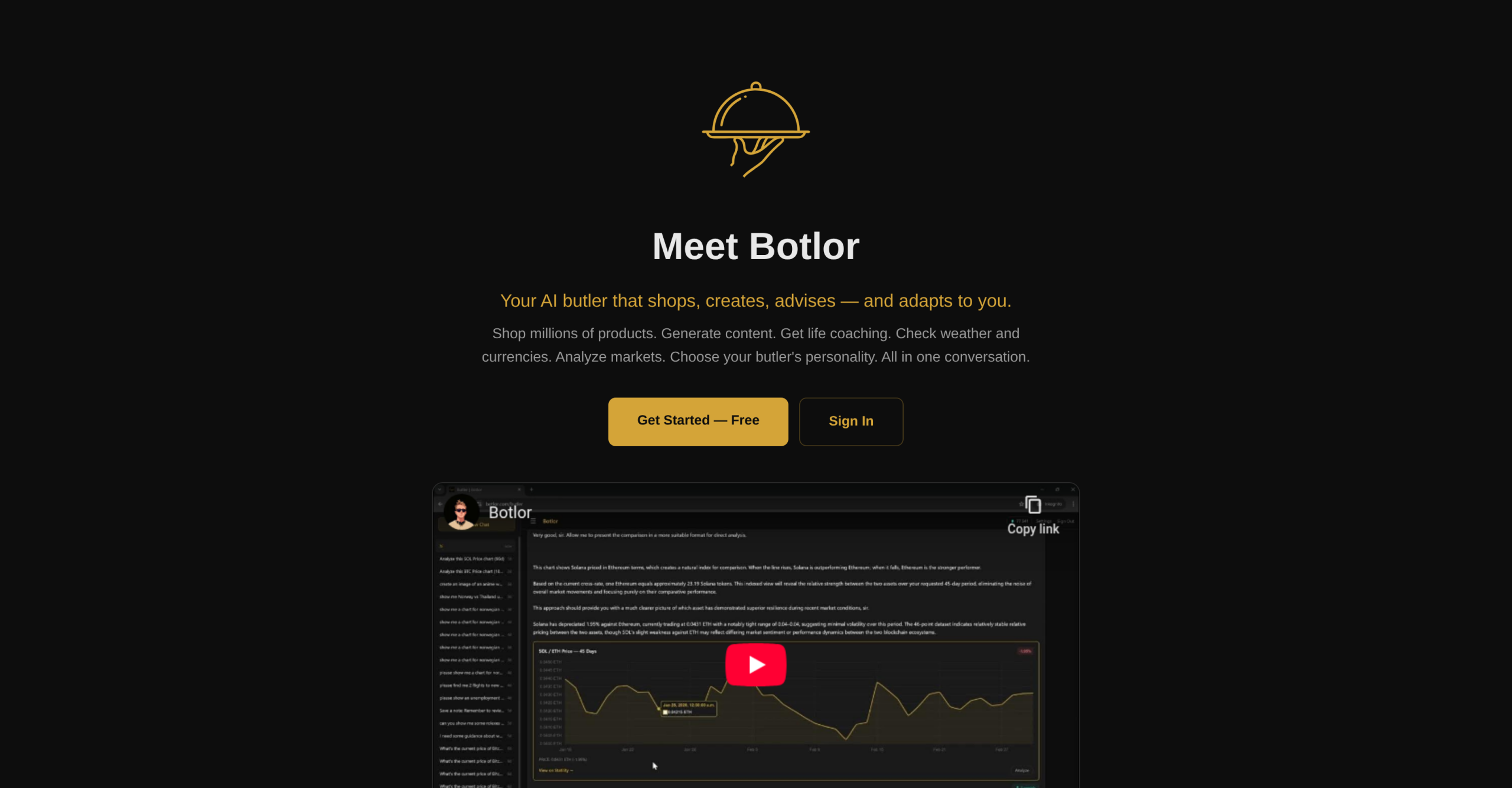
You’re trying to book a hotel, compare prices on a new gadget, and draft a social media post, all while keeping an eye on cryptocurrency trends. Instead of opening three different apps and two browser tabs, Botlor aims to consolidate these disparate digital activities into a single conversational interface. it was created to act as an AI butler, routing your natural language requests to the appropriate underlying service, thereby simplifying task management. On the other hand, its recent launch means that thorough user feedback and a full understanding of its long-term performance aren’t yet available. That’s a significant consideration for potential users. It’s a new entrant in a crowded field, and its long-term stability and feature evolution remain to be seen. Years of community discussions or extensive third-party reviews aren’t available just yet.
Consolidating Digital Tasks with Conversational AI
Botlor positions itself as a central hub for various AI-driven functionalities, aiming to reduce the friction of switching between specialized applications. It’s built to understand natural language commands and then direct those requests to specific integrated services. For instance, if you’re planning a trip, you can instruct Botlor to "book a hotel in Paris for three nights next month," and it’ll interface with platforms like Trip.com to fulfill that request. Similarly, for shopping, it does more than just search; it can compare products across retailers such as Amazon, eBay, The Luxury Closet, and StrawberryNet, helping users find deals or specific items. It creates a more fluid interaction model where the user’s intent drives the action, not the specific app. It’s a compelling proposition for anyone feeling overwhelmed by app sprawl.
Beyond transactional tasks, Botlor extends its capabilities to content creation and personal development. It offers access to over 100 AI generators for diverse content types, including blog posts, stories, poems, product descriptions, and social media updates. This includes AI image generation, which typically costs around 6 credits per instance. For personal guidance, it draws upon over 125,000 wisdom passages from various traditions to provide life coaching on topics like career, relationships, and decision-making. Financial monitoring is also integrated, providing real-time crypto prices, stock data, correlations, and projections. It’s a broad set of capabilities, and it’s clear Botlor isn’t only a niche tool; it’s trying to be a general-purpose digital assistant. Users can also manage smart notes with AI-powered semantic search, allowing for efficient saving and retrieval of thoughts. This wide functional scope suggests it’s targeting individuals who want a single point of contact for many daily digital needs.
Accessing Botlor’s Services and Credit System
Botlor uses a "Free to use" model, which includes a free trial. Users receive 25 free credits every week, which cover a significant portion of its functionalities. These credits can be used for weather checks, currency conversions, knowledge lookups, shopping, hotel searches, tours, market analytics, and content generation. For example, text generation generally consumes about 5 credits. This credit system means that while basic usage is free, more intensive activities, particularly content generation, will eventually incur costs.
For users requiring more than the weekly free allocation, paid options are available. These start from $15 per unit, following a pay-as-you-go billing frequency. There aren’t any subscriptions or recurring monthly fees; users only pay for what they consume beyond the free version. This model offers flexibility, as you’re not locked into a fixed plan. Additionally, users can connect their Generor account to access further content generation credits. note the platform maintains a "No Refunds" policy, so it’s wise to manage credit usage carefully. While the credit system provides transparency on usage costs, it also means that heavy users will need to monitor their credit consumption to avoid unexpected expenses. It’s a common model for AI services, but it’s one that requires user vigilance.
Technical Underpinnings and Future Development
Botlor functions as a web-based AI butler, meaning it doesn’t require specific local system requirements beyond a compatible web browser and an internet connection. it was created to be accessible, with the option to "Add Botlor to their home screen for instant access," suggesting it behaves like a Progressive Web App (PWA). The tool’s strength lies in one thing it does well is act as an intermediary, connecting to various specialized AI services. For instance, it uses Generor for content generation, Darobodo for life coaching, Naited for smart notes, and Statility for crypto/financial analytics. This architecture allows Botlor to offer a broad range of features without developing every capability in-house.
On the other hand, this reliance on external services also introduces a potential technical limitation: Botlor’s performance and feature set are inherently tied to the APIs and capabilities of its integrated partners. If an underlying service experiences downtime, changes its API, or alters its pricing, it could directly impact Botlor’s functionality or cost structure. The available information doesn’t explicitly state whether Botlor itself offers a public API for external integration, which could be a constraint for power users or developers looking to build custom workflows around it. Its "Coming Soon" section, which lists features like flight and hotel booking and calendar management, indicates that while it was created to be a complete butler, certain core functionalities are still under development. The lack of a publicly documented API for Botlor itself means that advanced users can’t programmatically extend its capabilities or integrate it into their own applications, which might be a significant hurdle for those seeking deeper customization.