

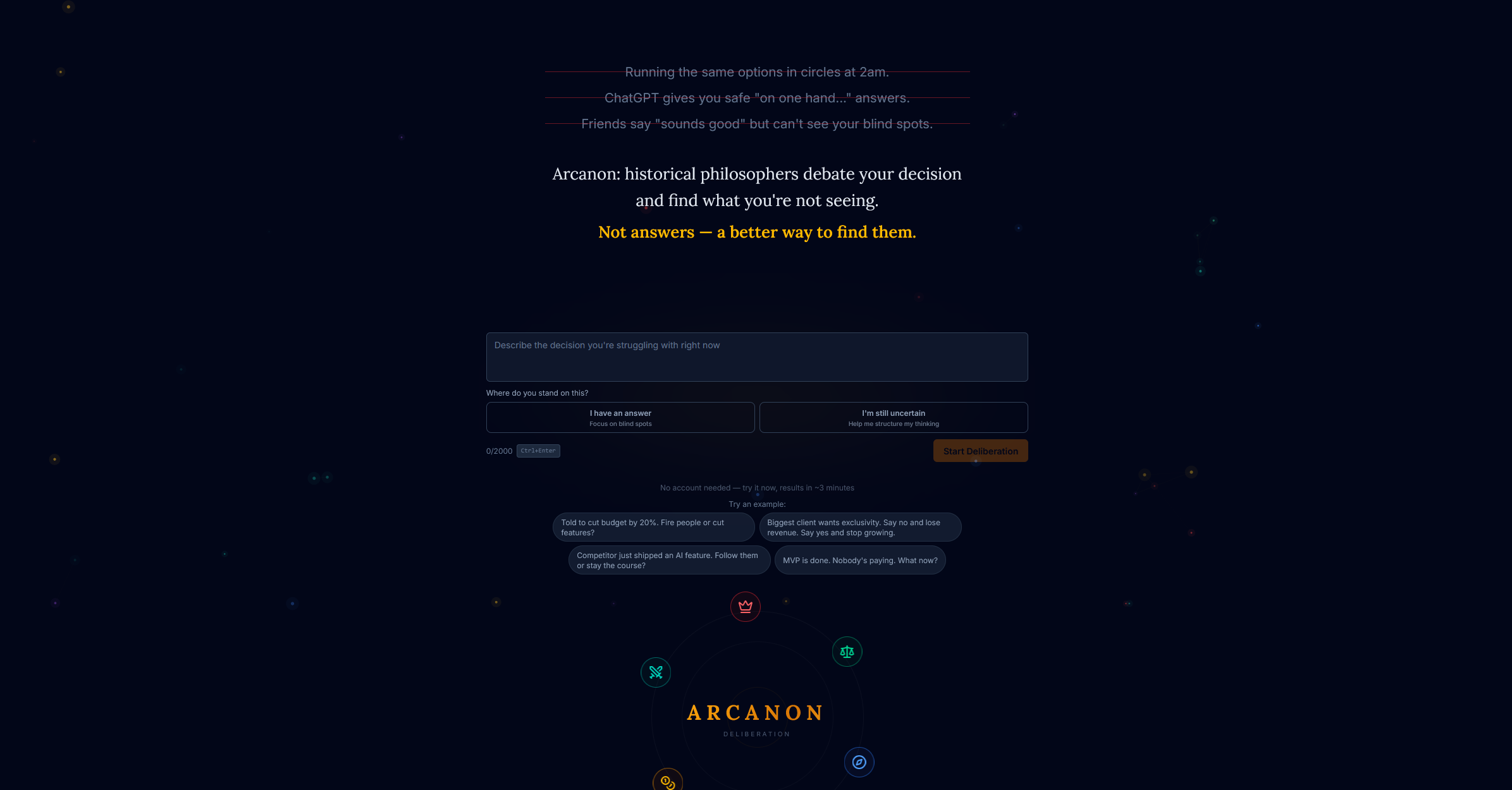
You’re a solo founder, staring at a critical business decision that feels like a Gordian knot. You’ve already tried asking a standard AI chatbot, but its balanced, non-committal answers didn’t really help. You need something more, something that challenges your assumptions and offers a different lens. That’s where Arcanon steps in; it’s a deliberation engine designed to help guide you through these complex choices by simulating debates among historical philosophers. It’s not going to give you a direct answer, but it’ll certainly give you a better way to find one.
Simulating Philosophical Councils for Business Dilemmas
Arcanon’s standout capability lies in its unique approach to decision support: it creates a virtual council of historical thinkers to dissect your business problems. Imagine Machiavelli, Han Fei, Descartes, Aristotle, Adam Smith, and Sun Tzu all weighing in on your latest product strategy or market entry dilemma. It’s a compelling concept. This goes beyond being just a gimmick; it’s a structured process that applies established philosophical frameworks to contemporary business challenges. It’s incredibly useful for uncovering hidden premises and identifying blind spots you might’ve missed.
The Deliberation Process
When you present Arcanon with a dilemma, it goes beyond just offer a single perspective. Instead, it orchestrates a multi-round debate among its chosen philosophers. Each philosopher independently analyzes your problem through their specific lens—Machiavelli might focus on power dynamics, while Adam Smith considers market forces. They then argue with each other, pushing back on assumptions and exploring different facets of the problem. This goes beyond being just a superficial exchange; its purpose is to go deep, often revealing what you didn’t even know you needed to consider. The basic access allows for 3 rounds of deliberation, while paid plans extend this to 4 rounds, providing a more exhaustive exploration.
Uncovering Hidden Premises and Blind Spots
One of the most valuable outcomes of Arcanon’s deliberation process is one thing it does well is reframe your question. Users often report that this reframing alone is incredibly insightful. The philosophers, through their simulated debate, will challenge the underlying assumptions you’ve made, forcing you to confront potential biases. It’s like having a team of seasoned strategists who aren’t afraid to tell you where you’re wrong, but in a structured, analytical way. This helps you move beyond generic advice and truly understand the nuances of your situation. You’ll get a clearer picture of decision variables and potential red flags.
The "Push Your Back" Mode
What if you’ve already made a decision, but you’re looking for a final check or philosophical endorsement? Arcanon has a "Push Your Back" mode specifically for this. It’s a unique feature that challenges your pre-existing decision, forcing you to defend it against the simulated critiques of the philosophers. This can be incredibly helpful for preempting rebuttals from board members or simply solidifying your conviction. It’s a way to stress-test your thinking before committing fully, and it’s something you won’t typically find in other AI decision tools.
Who Arcanon Serves and How They Use It
Arcanon isn’t for everyone; it’s specifically tailored for individuals grappling with complex, high-stakes decisions where conventional AI tools fall short. It’s particularly useful for solo founders, product managers, team leads, and mid-level decision-makers within technology organizations. These aren’t folks looking for quick answers; they’re seeking structured thinking and diverse perspectives to avoid overthinking and gain clarity.
Users use Arcanon for tasks like analyzing detailed business dilemmas, generating reliable decision frameworks, and identifying potential risks. It’s a tool for structuring strategic thinking, helping you to consider various scenarios and their implications. It’s invaluable when you need to "role-play" potential ideas to anticipate objections or refine your arguments.
Accessing Arcanon: Free vs. Paid Tiers
Arcanon offers both free and paid tiers, so you can try it out before committing. It’s a good way to see if its unique approach resonates with your decision-making style.
| Tier | Monthly Cost | Included Features |
|---|---|---|
| Free | $0 | Access to 2 philosophers, 3 rounds of deliberation, 3 sessions, 5 deliberations per month |
| Pro | From $19.80 | Access to 4 philosophers, 4 rounds of deliberation, decision history, business context memory, "Deep Dive" feature (up to 3 follow-up questions) |
The paid Pro tier, starting at $19.80/month (billed monthly), significantly expands your capabilities. It provides access to more philosophers and rounds, along with crucial features like decision history and business context memory. The "Deep Dive" feature, which allows for up to three follow-up questions after the initial synthesis, is exclusive to paid plans. It’s a valuable addition if you need to explore specific aspects of the deliberation in more detail. The basic access gives you a good taste, but the Pro tier offers the depth needed for truly complex problems.
Technical Considerations and Limitations
Arcanon is a web-based application, meaning you’ll access it through your standard web browser. It doesn’t require any specific local system requirements beyond an internet connection. While its purpose is to handle complex textual input for your dilemmas, specific input/output formats aren’t detailed beyond that.
One important technical limitation to be aware of is the absence of an API. That means you won’t be able to integrate Arcanon directly into your existing workflows or other applications. It’s a standalone tool, which might be a drawback if you’re looking for smooth automation. The usage limits on the no-cost plan—3 sessions and 5 deliberations per month—are internal constraints, not traditional API rate limits, since there isn’t a public API to begin with.
The Most Important Caveat
While Arcanon offers an incredibly unique and powerful approach to decision-making, it’s crucial to understand its fundamental limitation: it provides frameworks and exposes blind spots, but it doesn’t guarantee the accuracy or fitness of its AI-generated outputs for your specific business challenges. The terms of service explicitly state that Arcanon isn’t liable for damages resulting from decisions made based on its service. You’re still the ultimate decision-maker, and it’s your responsibility to critically evaluate the insights provided. It’s a powerful guide, but it isn’t a crystal ball that absolves you of accountability.