

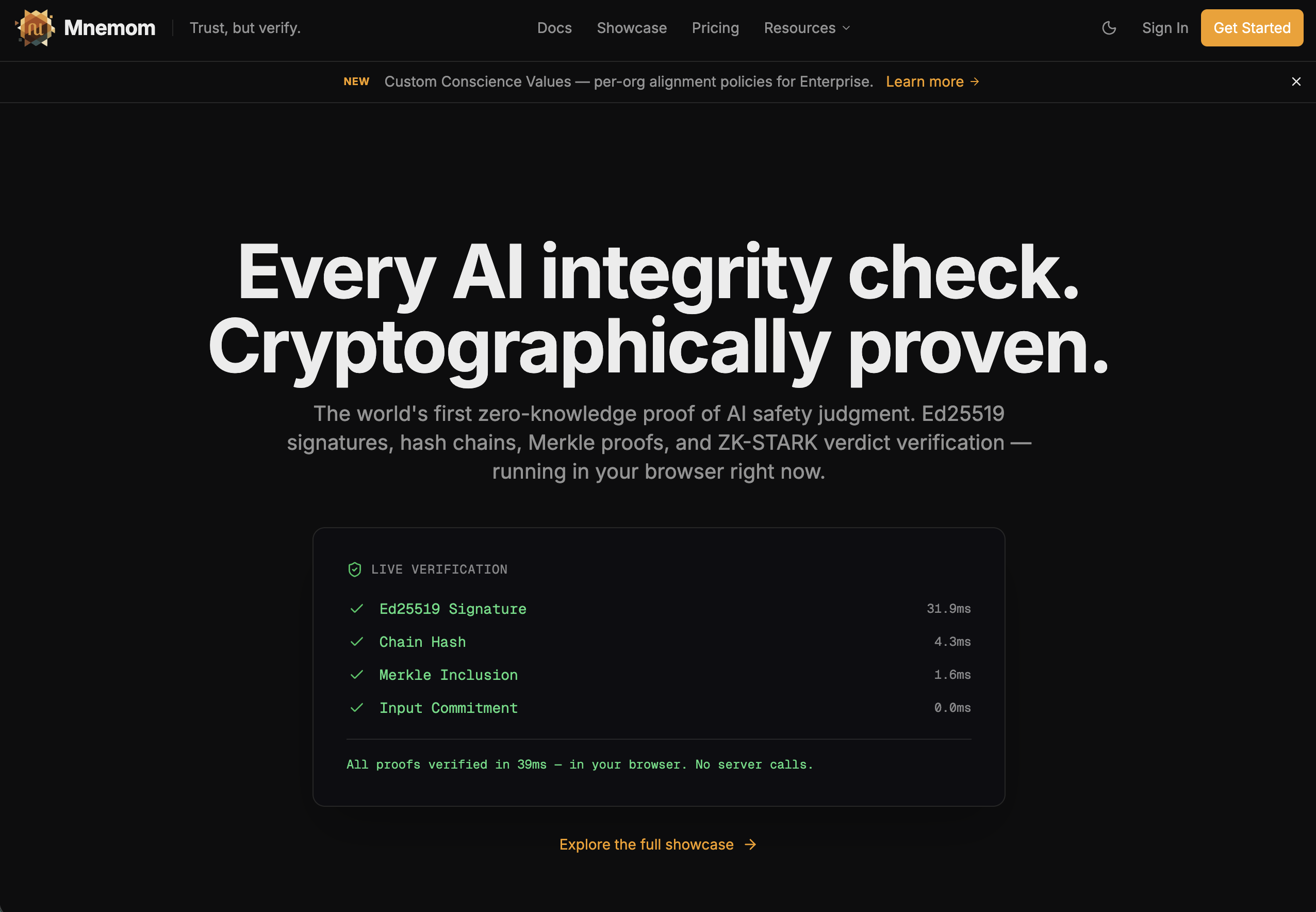
As AI agents handle more critical decisions — from financial transactions to healthcare recommendations — verifying their behavior becomes essential. Mnemom provides cryptographic trust scores (0-1000), Ed25519-signed verdicts, and ZK-STARK proofs for AI agent actions on Base L2, detecting threats like prompt injection, PII leakage, and supply-chain compromises. The platform is Apache 2.0 licensed and installs in under 5 minutes.
Learn more at mnemom.ai — freemium pricing starts at $0.01/month per agent.
Traditional AI Monitoring vs. Mnemom
| Capability | Traditional Observability (Langfuse, Datadog) | Mnemom |
|---|---|---|
| Threat detection | Manual rule setup, no cryptographic proof | Built-in detection: prompt injection, PII leakage, CEO fraud, supply-chain attacks |
| Trust scoring | No standardized scoring | Cryptographic trust rating (0-1000), bond-rated AAA-CCC, public on Base L2 |
| Audit trail | Logs stored in database, tamper-editable | Ed25519-signed verdicts, hash-chained, Merkle-anchored, append-only audit chain |
| Cross-tenant defense | Per-tenant isolation only | AEGIS network shares signed threat intel across all customers in under 30 seconds |
| Compliance | Manual report generation | EU AI Act Article 50 SDK preset, SOC 2 Type II readiness, ISO 42001 mapping |
The core distinction: traditional tools observe AI behavior, while Mnemom provides cryptographic proof of it. Every agent decision is signed, chain-linked, and exportable as an audit bundle for regulators.
The Five-Layer Stack
Mnemom runs a five-layer architecture built around "cards" — signed, versioned declarations that govern agent behavior:
- Alignment Cards declare what an agent is intended to do, its autonomy limits, and audit requirements. The Agent Alignment Protocol (AAP) verifies decisions post-hoc against these declarations.
- Protection Cards define permissible inbound and outbound message perimeters — what data gets in, what gets out. Think of this as a firewall policy for each agent.
- Agent Integrity Protocol (AIP) checks every thinking block mid-turn, catching drift or manipulation during the reasoning process itself, not just at the output stage.
- Safe House screens messages for threats including prompt injection, indirect tool injection, and social engineering before they reach the agent.
- AEGIS Protection Network is the cross-tenant defensive layer. When one customer’s substrate fingerprint shows behavioral deviation, every customer on that substrate is auto-flagged and a signed Managed Rule propagates across all gateways within 30 seconds.
Supply-Chain Detection
Mnemom stamps every evaluation with a substrate fingerprint — provider, model, SDK version, and optional lockfile hash. This catches supply-chain attacks that bypass package-level provenance verification. The platform specifically references the Mini Shai-Hulud worm of May 2026, which compromised 170+ npm packages including Mistral AI’s SDK suite with valid SLSA-3 attestations. AEGIS attributes anomalies across customers running the same substrate and propagates defensive rules before the next agent is hit.
Compliance and Regulation
| Framework | Status | What Mnemom Provides |
|---|---|---|
| EU AI Act Article 50 | SDK preset available (enforcement Aug 2, 2026) | Transparency disclosures, logging, machine-readable content marking |
| SOC 2 Type II | Readiness program in flight | Controls aligned with AEGIS pipeline and audit chain |
| ISO 42001 | Controls mapped | AI management system mapped to alignment-card lifecycle |
| HIPAA | Readiness | Healthcare agent compliance support |
| GDPR | Readiness | Data handling aligned with EU requirements |
Where It Struggles
- Early-stage product — AEGIS propagation targets (sub-30s P95) are measured goals, not yet guaranteed; first measurements planned 30 days post-GA
- Base L2 dependency — the trust rating and audit trail rely on Base L2 blockchain; organizations uncomfortable with on-chain infrastructure may find this a barrier
- No direct reasoning analysis — Mnemom monitors the execution surface and decision outputs, not the internal reasoning process of AI models
- Niche use case — designed for organizations running AI agents in regulated industries; not relevant for simple chatbot or content-generation deployments
- Opaque pricing — the $0.01/month starting price is likely per-agent; total cost for fleets of agents hasn’t been clearly published
Visit Mnemomv2 — https://mnemom.ai/