

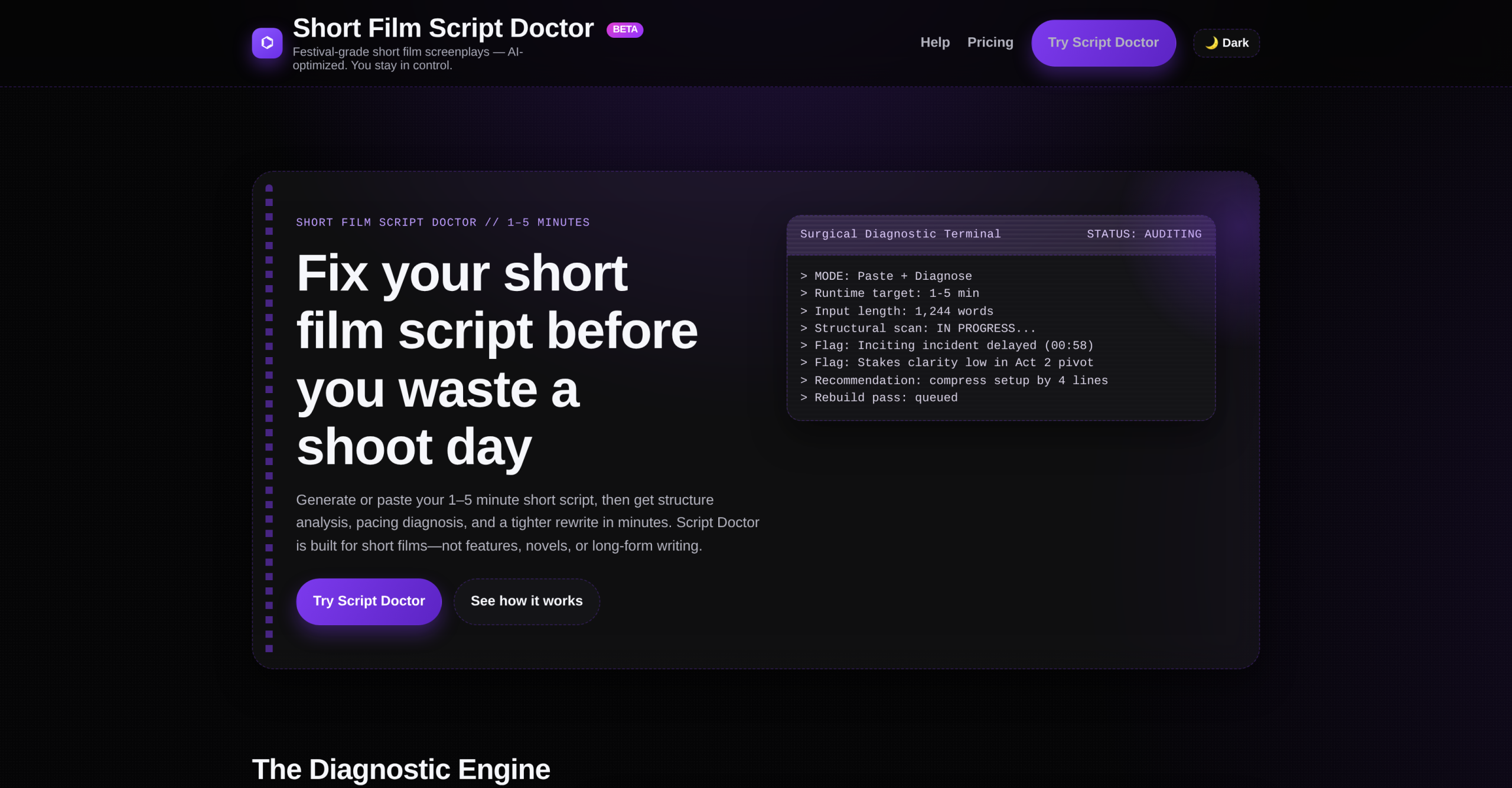
Short film scripts under 5 minutes are harder to write than feature-length screenplays because there’s almost no room for narrative recovery when a scene falls flat. Script Doctor analyzes 1-5 minute scripts for structural weaknesses, pacing problems, and dialogue quality, then delivers targeted rewrite suggestions rather than generic feedback.
The tool uses rule-based analysis — not a generic large language model — to enforce compressed 3-act beats and modified Hero’s Process logic specific to short films. This means it flags specific issues like "inciting incident delayed to 00:58" or "stakes clarity low in Act 2 pivot" instead of offering vague commentary.
Two Workflows: Generate or Diagnose
| Mode | Input | Process | Output |
|---|---|---|---|
| Generate + Refine | Genre, tone, runtime, logline | AI generates first draft → analysis → rewrite loops | Iteratively refined script |
| Paste + Diagnose | Existing script (up to ~2,000 words) | Structural scan → pacing diagnosis → targeted rewrite | Tighter version of your script |
In Generate mode, filmmakers start from a logline and iterate through analysis-driven rewrite loops until the script reaches production quality. In Diagnose mode, they paste an existing script and receive specific notes on structure, pacing, stakes, and clarity — then tell the tool exactly what to change. The auto-rewrite produces a tighter, more shootable draft.
What the Diagnostic Engine Checks
The analysis covers six areas:
- Structure enforcement — built-in rules keep scripts aligned to compressed short-film storytelling
- Beat and pacing diagnosis — identifies slow openings, late turns, and overloaded scenes
- Stakes and clarity checks — flags fuzzy motivations and unclear outcomes that weaken endings
- Dialogue tightening — cuts exposition, sharpens intent, keeps lines performable
- Production-ready focus — prioritizes practical clarity so pages translate cleanly to set
- Custom fix instructions — users specify what to change rather than accepting automated rewrites
The tool presents input and diagnosis side by side, making it easy to compare the original script against the flagged issues and suggested rewrites without switching between views. A sample diagnosis might flag: "Inciting turn arrives at 1:40 (too late)" and "Stakes unclear in opening lines," then suggest moving the midpoint conflict earlier and sharpening the ending image for emotional payoff.
Plan Comparison
| Plan | Price | Generations/Month | Diagnose Runs | Key Addition |
|---|---|---|---|---|
| Free | $0 | 2 | 2 | 2 regenerations per script |
| Starter | $7/mo | 15 | Included | Script history saved |
| Pro | $17/mo | 40 | Included | Priority support, early access |
Each output counts as one run. The free tier allows enough usage to evaluate the tool on a couple of scripts. All plans support all genres and runtimes between 1-5 minutes, with copy-and-paste export available at film-ai.io.
Roadmap Features (Not Yet Available)
The developer has announced several upcoming features currently on the waitlist: a structural score from 0-100, beat breakdown visualization, runtime pacing map, commercial viability indicator, emotional arc graph, and dialogue density check tuned for short films.
Shortcomings
The tool is built exclusively for 1-5 minute short films. It doesn’t handle feature-length screenplays, novels, or any long-form writing. Filmmakers working on longer formats like 10-minute shorts, web series episodes, or feature films need different tools — the structural rules enforced here don’t scale to extended runtimes.
The free tier’s 2-generation limit provides minimal evaluation capacity. Filmmakers testing multiple script concepts should budget for the Starter plan at minimum. The roadmap features listed above aren’t yet available, so users evaluating the tool today should focus on what currently ships rather than planned additions.
Visit Short Film Script Doctor — https://www.film-ai.io/