

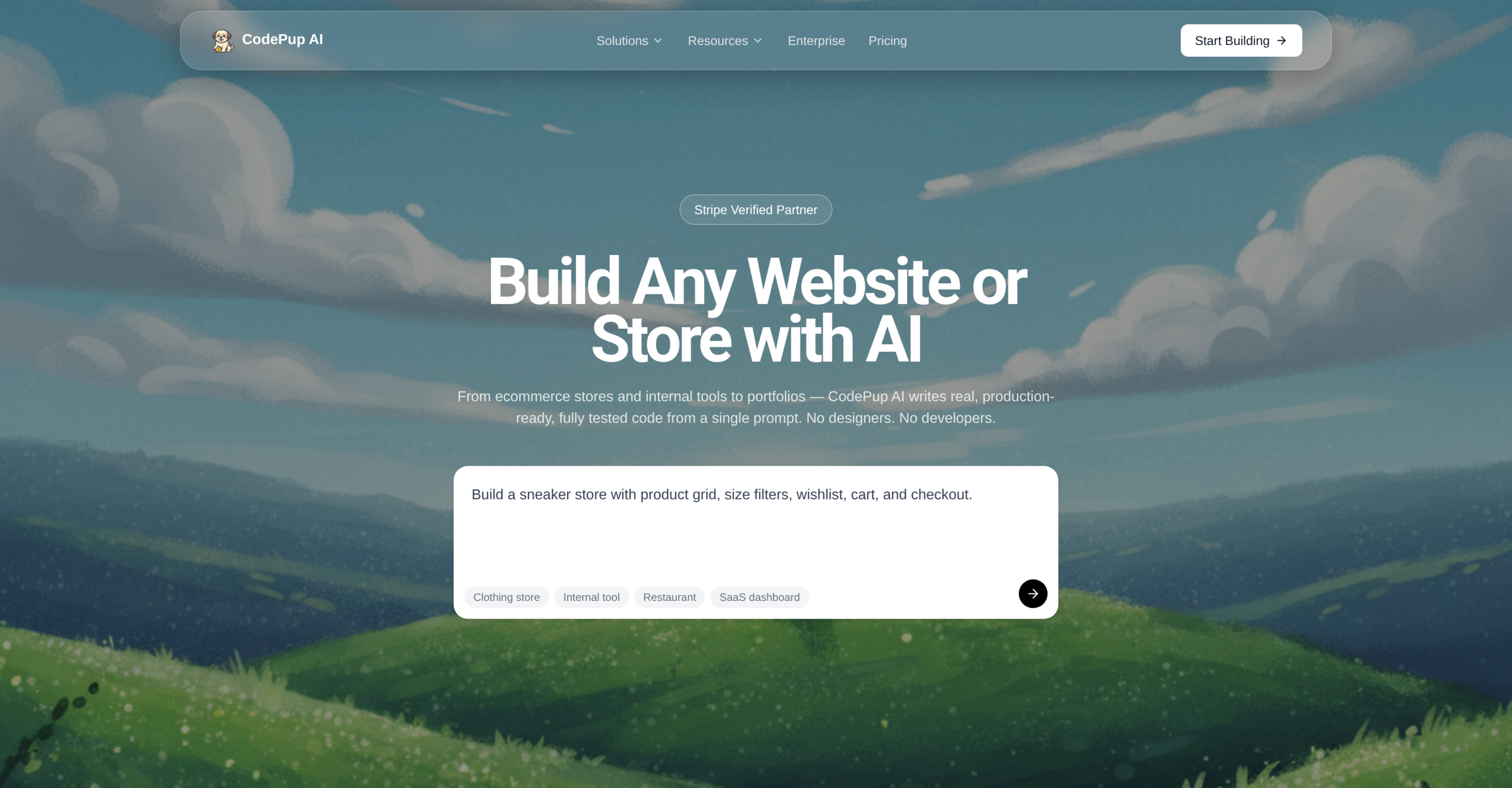
A non-technical founder needs an e-commerce store with product listings, Stripe checkout, and email workflows — usually that means hiring a developer or wrestling with page builders. CodePup AI generates the entire site from a single natural language prompt, including automated testing that verifies every flow works before the user sees it.
CodePup AI outputs production-ready websites using React, Next.js, and Tailwind. Each generated site includes unit, integration, and end-to-end tests that re-run automatically on every edit or code regeneration cycle. The platform handles UI design, backend configuration, and hosting in one pass. Users describe what they need in plain English, and the system generates a complete working website — not a mockup or wireframe, but a deployable application with functional forms, payment processing, and database connections.
What Can Be Built
| Category | What Gets Generated |
|---|---|
| E-commerce Store | Product listings, cart, Stripe checkout, SEO, mobile-responsive |
| Dropshipping Store | Supplier integrations, zero inventory model, fast launch |
| Internal Tools | Admin panels, dashboards, CRM interfaces on custom data |
| Portfolio | Project showcase, case studies, contact forms, skills section |
| Landing Pages | Static or dynamic single-page sites for campaigns |
| Client Portals | Authenticated access areas with user accounts via Supabase Auth |
Full-stack applications include backend services, a PostgreSQL database through Supabase, and user authentication with Supabase Auth handling registration, login, and session management out of the box. The generated code is fully exportable to GitHub, preventing vendor lock-in and allowing deployment on any external hosting provider of the user’s choice.
Automated Testing and Self-Fixing
The testing pipeline distinguishes CodePup from AI builders that produce visually appealing but non-functional output. Every generated website goes through three testing layers:
- Unit tests verify individual components function correctly
- Integration tests confirm components work together as expected
- End-to-end tests validate complete user flows like checkout and registration
When tests fail, the platform’s self-fixing mechanisms attempt to correct the issue automatically. Tests re-run on every regeneration, so edits don’t introduce regressions. This approach targets the common problem of AI-generated code that looks correct but breaks under actual use. Users can browse community-built templates as starting points, then customize the generated code to match their specific brand requirements. The template gallery covers common categories, reducing the prompt engineering needed to get a usable result.
Pricing and Credit System
| Plan | Price | Credits/Month | Key Additions |
|---|---|---|---|
| Starter | $25/mo | 100 | Publishing, GitHub export, CodePup Cloud, custom domain |
| Premium | $50/mo | 220 | Built-in analytics, AI Catalog Management |
| Pro | $200/mo | 1,100 | Dedicated support, all features |
Credits are consumed based on prompt complexity and the number of pages generated. There’re no hidden fees, revenue cuts, or per-seat charges. The free trial allows evaluation before subscribing. Code is owned by the user and can be exported at any time via GitHub integration.
What to Watch Out For
Complex applications with custom business logic beyond what the prompt describes may require manual code edits after generation. The platform works best for well-defined website categories (stores, portfolios, dashboards) rather than highly specialized software.
No refund policy is listed, so users should evaluate output quality during the trial period before purchasing. The credit-based pricing model means that heavy users generating multiple complex sites each month should budget for the Premium or Pro plans to avoid running out of credits mid-project. Generated code uses a specific tech stack (React/Next.js/Tailwind), which may not align with teams already committed to different frameworks like Vue or Svelte.
Visit CodePup AI — https://codepup.ai/