

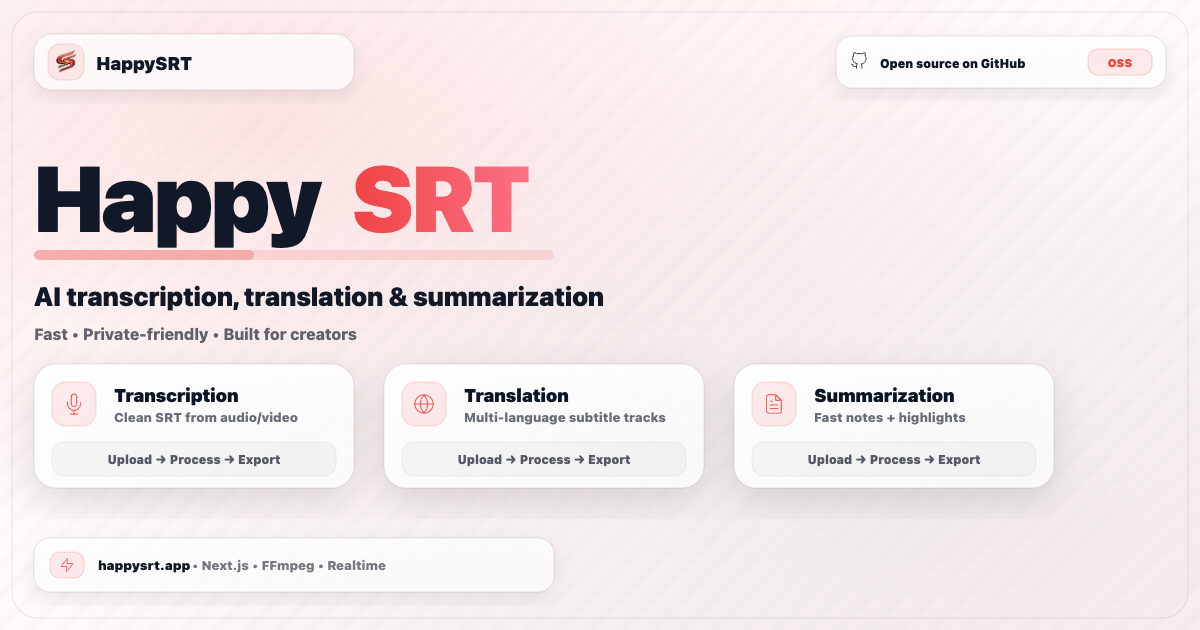
HappySRT is an open-source web application that provides AI-driven transcription, translation, and summarization for audio and video files. Users upload media or paste YouTube URLs, then run one or more actions to generate timestamped subtitles, translated tracks, or content summaries — all within a thread-based workspace.
How It Compares to Dedicated Transcription Services
Unlike full-featured transcription platforms like Otter.ai or HappyScribe (a separate product), HappySRT focuses on a narrow workflow: upload, process, and export. There’re no live meeting recording features, no speaker diarization, and no team collaboration tools. What it offers instead is a lightweight, open-source alternative for individual creators who need quick SRT files without committing to a heavy subscription. According to the HappySRT website, the app is built for creators who want speed, control, and clean exports.
The Three-Action Workflow
The interface organizes work into threads — one per project (podcast episode, client deliverable, course module). Within a thread, users can chain up to three actions:
Transcription converts speech into timestamped text, producing SRT-ready output with millisecond timing. Translation generates subtitle tracks in a target language from the transcribed text. Summarization produces highlights, bullet points, and key takeaways from the audio content. Users can run a single action or chain all three (Transcribe, then Translate, then Summarize) in sequence. Results appear in separate tabs within each thread and can be downloaded as SRT files or copied as plain text.
Supported Input Formats and YouTube Integration
HappySRT accepts MP4, MOV, MP3, and MPEG files for direct upload. It also supports pasting YouTube URLs directly — the platform extracts the audio and processes it without requiring a separate download step. This is useful for content creators who repurpose YouTube videos into subtitled content for other platforms.
Media Token Billing System
| Tier | Price | AI Minutes/month |
|---|---|---|
| Free | $0 | 3 minutes |
| Starter | $0.99/month | 5 minutes |
| Basic | $9.99/month | 120 minutes |
HappySRT uses a media token system rather than flat-rate billing. Each transcription, translation, or summarization run consumes tokens based on the media duration. The free tier includes only 3 minutes per month, which is enough to test the tool but insufficient for regular use. The Basic plan at $9.99/month provides 120 minutes, which covers roughly 2 hours of content — adequate for a podcaster processing one or two episodes per week. Users who exceed their monthly allocation must wait for the next cycle or upgrade. The token balance is visible in the sidebar, and tokens show as "in use" while a job is processing.
Guest Mode and Google Sign-In
Users can try HappySRT as a guest without creating an account. Guest mode allows exploration of the interface and basic processing. To persist threads across sessions and manage billing, users sign in with Google. The platform doesn’t require email-based registration.
Potential Drawbacks
The 3-minute free tier is one of the most restrictive in the transcription market — most competitors offer at least 30-60 free minutes. The tool doesn’t support speaker identification (diarization), so multi-speaker recordings produce a single undifferentiated transcript. There’s no live transcription capability; all processing is file-based. Being a Single Page Application (SPA), it requires a stable internet connection and may have performance limitations with very large media files. And while the platform claims "99.86% native language coverage" for translation, this figure is self-reported and not independently verified. Users who need enterprise-grade features like team workspaces, API access, or batch processing, HappySRT isn’t the right tool.
Visit HappySRTv2 — https://www.happysrt.com/