

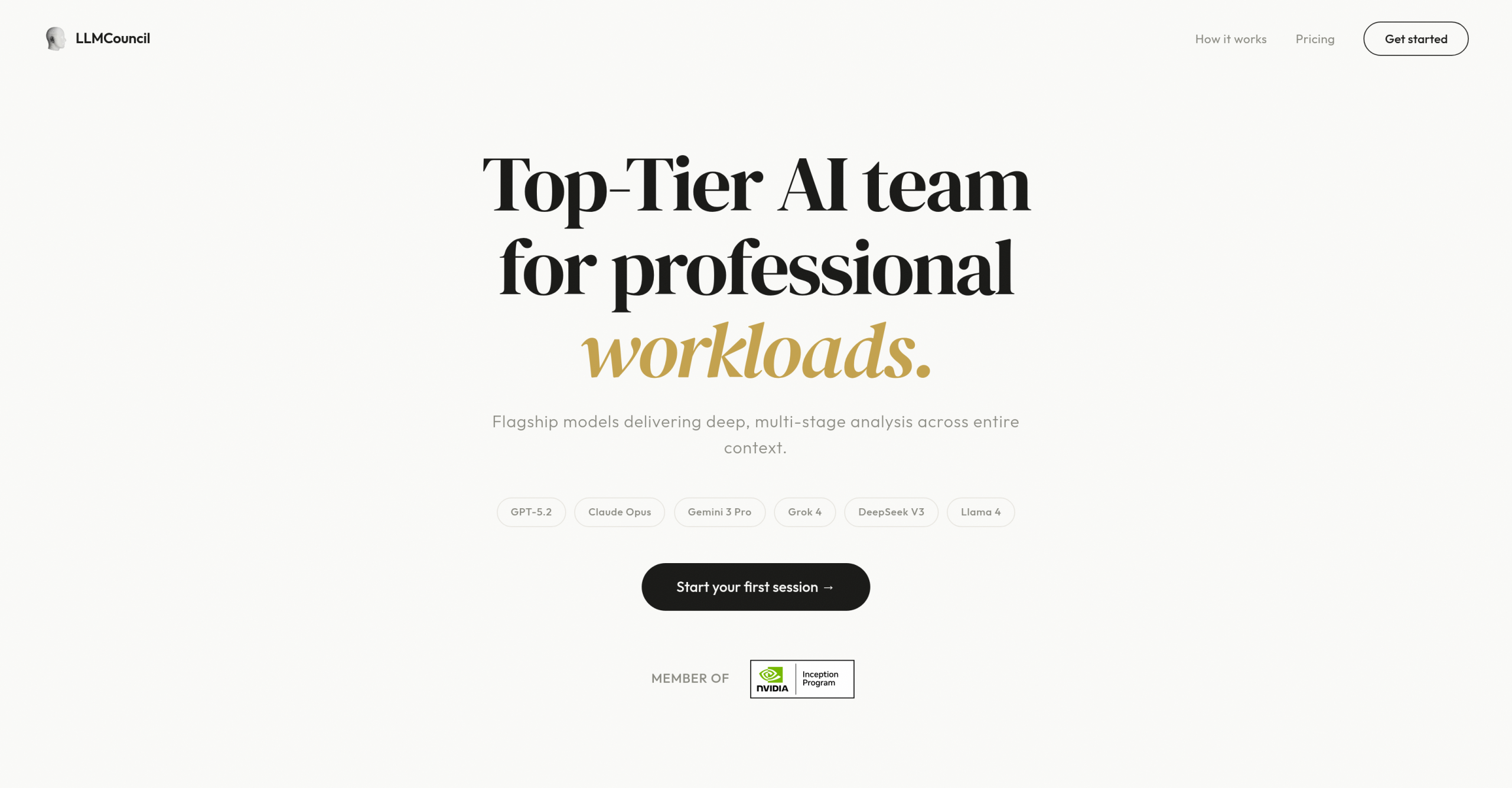
LLM Council runs a deliberation process among multiple AI models to produce more reliable answers. Instead of trusting a single model, it collects responses from several LLMs, compares them, and surfaces consensus or flags disagreements. According to the LLM Council website, the platform draws from a pool of 25 live models across economy, professional, and frontier tiers.
Why Single-Model AI Outputs Carry Risk
Relying on a single Large Language Model (LLM) for critical applications presents risks. Issues like inherent biases, inconsistent outputs, and the persistent problem of hallucination undermine the reliability of AI-generated content. For decisions where accuracy and factual integrity are paramount, a solo LLM’s response often lacks the necessary validation and diverse perspectives.
This limitation highlights why a multi-model approach becomes essential. A single point of failure in AI decision-making can lead to significant errors, making it unsuitable for high-stakes environments.
A Three-Stage Deliberation Process
LLM Council orchestrates a three-stage multi-model deliberation process to enhance output reliability and combat issues like hallucination directly.
- Simultaneous Querying: A user’s prompt is initially sent to multiple LLMs. Each model independently generates a response, ensuring a diverse range of initial perspectives without prior influence.
- Anonymous Peer Review: These initial responses are then anonymized and distributed among the other council members for peer review. Each model critiques and ranks the others’ answers based on perceived accuracy and logical coherence, encouraging a critical evaluation step.
- Chairman Synthesis: Finally, a designated "Chairman" model synthesizes all original responses and the peer critiques. This process filters out weaker answers and uses the collective intelligence to produce a single, more reliable final answer.
Where Multi-Model Deliberation Adds Value
- Code review and architectural decisions: The tool identifies subtle bugs or suboptimal design choices by leveraging diverse programming LLMs.
- Legal research and medical literature review: For tasks demanding high factual accuracy, its deliberation validates information and reduces the risk of critical errors.
- Content validation: This is particularly useful for verifying facts in generated content, ensuring higher quality and trustworthiness.
- Complex problem-solving: Scenarios where multiple expert opinions are valuable benefit from the enhanced accuracy and bias mitigation.
- Subjective tasks: When there isn’t one definitive right answer, the tool helps converge on a more balanced and thorough perspective.
Latency and Cost Trade-offs
Using LLM Council inherently introduces trade-offs regarding both latency and cost. The multi-stage deliberation process, involving simultaneous queries, peer review, and synthesis, means responses aren’t instantaneous; there’s an increased latency compared to single-model interactions. Also, querying multiple LLMs for each interaction significantly increases API costs. The freemium model offers 3 council runs per day, but the "Pro" and "Fox" tiers involve higher expenses. These costs are multiplied by the number of models involved, and users face hidden costs through individual LLM provider usage limits, leading to potential "burnout" if not managed carefully. The value proposition hinges on whether the enhanced accuracy and reliability justify these increased operational expenditures.
Three Pricing Breakdown
| Feature/Aspect | Original Open-Source Project | Commercial Offering (LLM Council) |
|---|---|---|
| Origin & Goal | Described as a "weekend hack" or "vibe coded" by Andrej Karpathy; focus on proving concept. | Aims for a more polished, user-friendly experience; commercialization. |
| Complexity | Requires manual setup of Python backend and React frontend; local storage of conversations as JSON files. | Tuned access via web application; handles underlying infrastructure complexity. |
| User Management | Lacks enterprise features like user authentication or access controls. | Features like user accounts and team management for "Fox" tier. |
| Maintenance | Limited ongoing maintenance; relies on community contributions. | Professional support and continuous updates by Evolo Pty Ltd. |
| Production Suitability | Not production-grade; unsuitable for enterprise deployments without significant custom development. | Designed for professional use, but users must evaluate its specific setup-time and integration needs for their workflow; offers a Python SDK and HTTP API for automation. |
Visit LLM Council — https://llmcouncil.ai/