

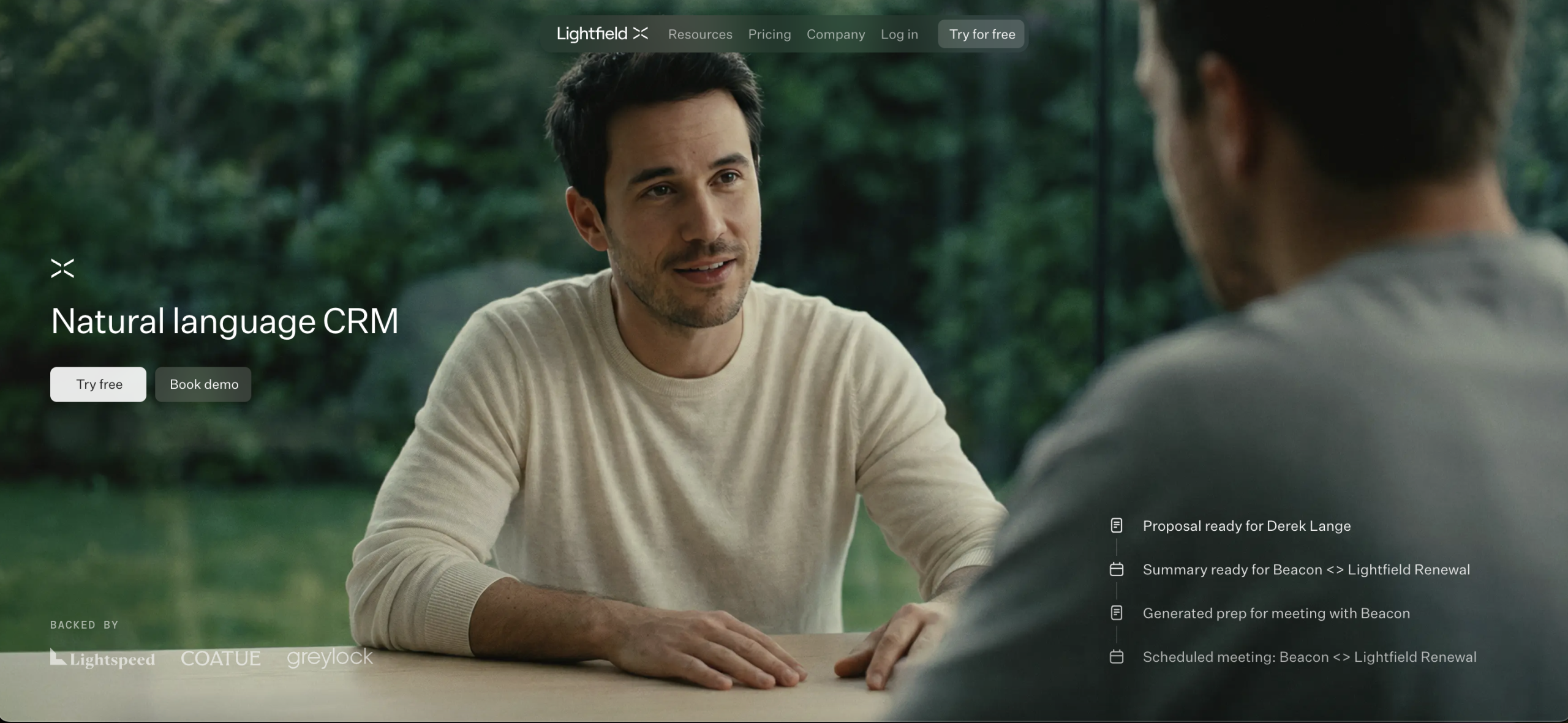
Lightfield is an AI-native CRM built for early-stage teams that captures customer interactions automatically and builds a searchable "customer memory" from emails, calls, and meetings. Unlike traditional CRMs that require manual data entry and field updates, Lightfield ingests conversation data as it happens, organizes it into contact and deal timelines, and lets users build AI agents that handle prospecting, follow-ups, and deal coaching through natural-language prompts.
Core Capabilities
| Capability | What it does |
|---|---|
| Data capture | Automatically ingests emails, calls, and meetings; updates records without manual input |
| Pipeline generation | Outbound agents prospect into new accounts based on your CRM data |
| Meeting recorder | Records, transcribes, and summarizes calls; provides pre-meeting context |
| Sales assistant | Agent queries and actions — ask questions about your business, generate email drafts, manage tasks |
| Agent workflows | Build automations with natural-language prompts; event-triggered workflows supported |
| Data enrichment | Automatic web enrichment and continuous record updates |
| Reporting | AI-generated reports with D3 visualizations |
The platform also includes Skills and Knowledge (launched April 2026), which lets users define reusable agent behaviors, and an open API that entered public beta in March 2026. A MCP server for connecting external tools (Notion, Linear, Granola) is listed as coming soon.
Startup vs. Pro Plan
| Feature | Startup ($79/user/month) | Pro ($199/user/month) |
|---|---|---|
| Records | Up to 30,000 | Up to 100,000 |
| Workflow events | 1,000/month | 20,000/month |
| Meeting recording & transcription | Yes | Yes |
| Agent queries & actions | Yes | Yes |
| AI email drafts | Yes | Yes |
| Web enrichment | Yes | Yes |
| Custom objects | No | Yes |
| Custom dashboards | No | Yes |
| Advanced permissioning | No | Yes |
| HIPAA-ready | No | Yes |
| Migration services | No | Yes |
| Dedicated CSM | No | Yes |
| API rate limits | Standard | Higher |
The Startup plan bills monthly; the Pro plan bills annually. Both include a free tier for initial testing. Security certifications include SOC 2 Type II (certified) and HIPAA readiness (Pro plan). The company is based in San Francisco.
How Agent-Driven CRM Differs from Traditional CRMs
Traditional CRMs (Salesforce, HubSpot, Pipedrive) are record-keeping systems — you define fields, fill them in, and run reports. Lightfield flips this: it captures data automatically from your conversations and builds a knowledge base that agents can query and act on.
The practical difference shows up in three areas:
-
No manual logging. Emails, calls, and meetings appear in the CRM timeline without user action. Lightfield extracts who was involved, what was discussed, and what commitments were made.
-
Natural-language interaction. Instead of building reports with filters, you ask questions like "which customers asked about pricing last month?" and get answers with citations to the original conversation.
-
Automated workflows via prompts. You describe what you want — "find stale deals from last quarter, draft revival emails for each one" — and the agent executes the task. No code required.
What to Watch Out For
Lightfield is still an early product with active development (changelog shows weekly releases). Some users report occasional auto-created records that need manual review, and the AI-generated data isn’t always perfectly accurate — human verification is still necessary, especially in the early stages of adoption.
There’s no native mobile application at the time of writing. Sales teams that rely on mobile CRM access during field work will find this a meaningful gap.
No LinkedIn Sales Navigator integration exists. Teams that depend on LinkedIn-based prospecting workflows need to operate that channel separately from Lightfield.
The platform targets early-stage and growth companies. It isn’t designed for large enterprises with hundreds of sales reps, complex hierarchical permission structures, or rigid predefined data models. Organizations requiring Salesforce-level customization depth will find Lightfield too constrained.
Custom objects and custom dashboards are restricted to the Pro plan at $199/user/month. Smaller teams on the Startup plan can’t build custom data structures, which limits flexibility as data models become more complex.
Visit Lightfield — https://lightfield.app/