

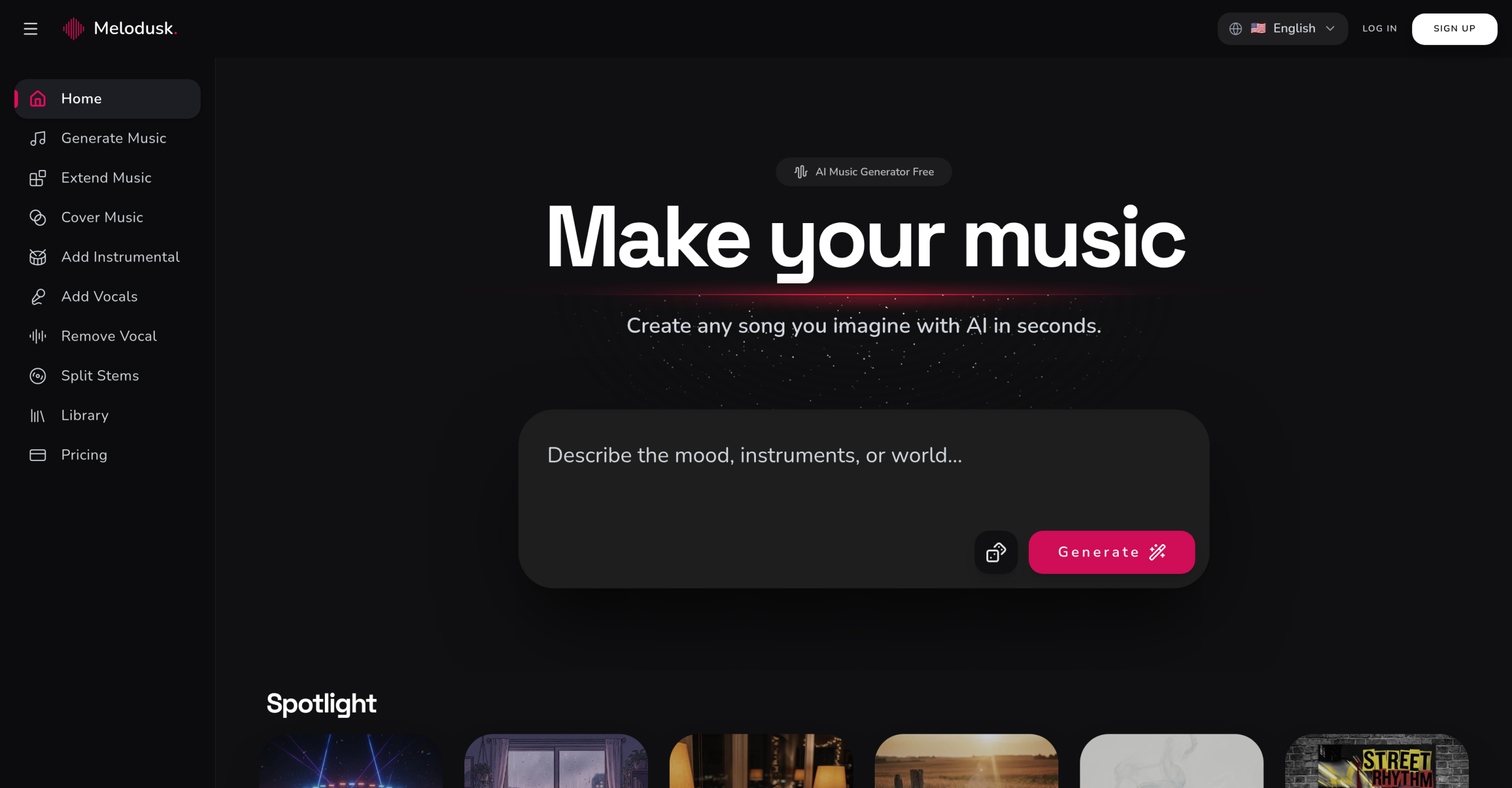
Melodusk is a text-to-music generator that creates vocal and instrumental tracks from natural language descriptions. Users type a prompt — mood, genre, tempo, instruments — and the platform produces a complete song within about two minutes. This review examines what it actually delivers, where it falls short, and how it compares to alternatives like Suno and Singify.
How Text-to-Music Generation Works
The creation process has three steps:
-
Describe. Write what you want in plain language. The AI interprets descriptions like "upbeat electronic dance with piano melodies" or "calm acoustic guitar for meditation." You specify mood, genre, instruments, tempo, or a specific scenario.
-
Customize. Choose between vocal or instrumental output. Select a style from the genre library — Melodusk claims support for 100+ genres including pop, rock, jazz, classical, hip-hop, and EDM. Adjustable settings include song length, energy level, and instrumentation.
-
Generate and download. The AI composes melody, arranges instruments, and mixes the track. Generation typically takes under two minutes. Output is downloadable in audio formats for use in projects.
Studio Tools Beyond Generation
Melodusk includes audio editing features alongside its core generation:
- Vocal remover and stem splitter. Upload an existing audio file and separate vocals from instrumentals. Useful for creating karaoke tracks or isolating specific parts for remixing.
- AI Music Extend. Lengthen existing tracks by uploading an audio file and having the AI generate additional content that continues the original’s style and mood. The free tier supports extension but doesn’t allow file uploads — paid plans unlock file-based extension.
Who Uses This Tool
The platform targets several creator groups:
Content creators. YouTubers, TikTokers, and streamers generate background music, intro themes, and outro scores. Because paid plans include royalty-free commercial licenses, tracks don’t trigger copyright claims on monetized channels.
Game developers. Indie developers produce adaptive soundtracks, menu music, and ambient tracks without hiring a composer. The tool handles genres from retro chiptunes to orchestral scores.
Podcast producers. Create show intros, transition music, and episode-specific themes. Useful for podcasts that need a consistent audio identity.
Marketing teams. Produce commercial jingles, product launch soundtracks, and brand audio. Paid plans grant commercial usage rights for all generated tracks.
Melodusk vs. Competitors
| Feature | Melodusk | Suno v5.5 | Singify | MakeBestMusic |
|---|---|---|---|---|
| Starting paid price | $9.90/mo | $10/mo | $5.99/mo | $14.90/mo |
| Free tier | 30 gen/mo (1/day) | Limited | Limited | 3 credits |
| Vocal + instrumental | Yes | Yes | Yes | Yes |
| Stem splitting | Yes | No | No | No |
| Music extension | Yes | Yes | No | Yes |
| Commercial rights | Paid plans only | Paid plans | Paid plans | Paid plans |
| Genres | 100+ claimed | Broad | Focused on covers | Broad |
| DAW integration | No | No | No | No |
Melodusk’s differentiators are its stem splitter (rare among AI music generators) and the free tier’s 30 monthly generations — more generous than most competitors. However, its generation length has historically been shorter than some rivals, and the 1-per-day limit on the free plan restricts experimentation.
Tier Comparison
| Plan | Monthly | Annual (billed yearly) | Generations | Key Details |
|---|---|---|---|---|
| Free | $0 | — | 30/month (1/day) | No commercial rights, no file upload for extension |
| Lite | $9.90/mo | $118/yr (~$9.83/mo) | 100/month, 200 songs | Commercial license, file upload extension |
| Pro | $19.90/mo | $239/yr (~$19.92/mo) | 300/month, 600 songs | Commercial license, file upload extension |
| Unlimited | $59.90/mo | $719/yr (~$59.92/mo) | 3,000 fast + unlimited slow | Commercial license, file upload extension |
The Unlimited plan distinguishes between fast credits (prioritized, queue-skipping generation) and slow generations (may involve queuing depending on system load). Credits reset monthly and don’t roll over. Annual billing offers 33-40% savings depending on the plan.
A 7-day money-back guarantee applies to monthly plans and a 14-day guarantee to yearly plans. Refund amounts are calculated based on unused credits. The refund policy on Melodusk’s own site contradicts some third-party listings that say "No Refunds" — the actual policy includes these guarantees.
Trade-offs to Consider
No DAW integration exists. Users can’t export stems directly into Ableton, Logic Pro, or other production software — a significant gap for professional producers who need to layer AI-generated tracks into existing projects.
Fine-grained control over composition is limited. While users can set mood, genre, and energy, they can’t specify chord progressions, key signatures, time signatures, or individual note sequences. Professional composers who need this level of detail will find the tool insufficient.
AI-generated tracks can lack originality. For users seeking highly unique, emotionally complex, or artistically distinct compositions, the output may sound generic or formulaic — a common limitation across all AI music generators, not specific to Melodusk.
The free plan’s 1-generation-per-day restriction makes it difficult to evaluate quality through repeated testing. Users get 30 generations per month, but spacing them out one per day slows the evaluation process. No collaboration features are available for teams working on shared music projects.
The $59.90/month Unlimited plan is expensive relative to competitors. Suno’s Pro plan costs $10/month, and while Melodusk offers more features (stem splitting, extension), the price gap is significant for budget-conscious creators.
Visit Melodusk – AI Music Maker — https://melodusk.ai/