
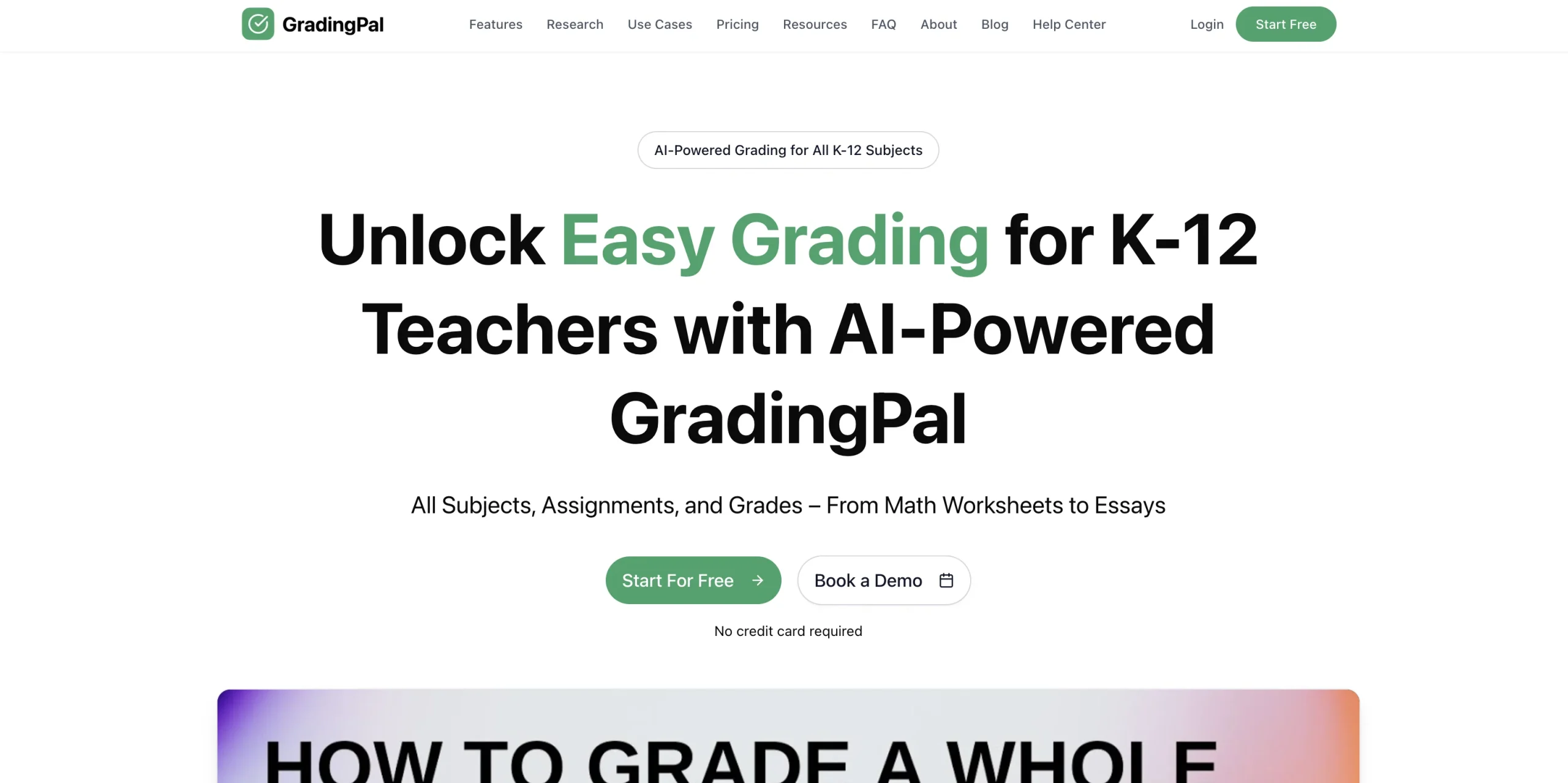
K-12 teachers in the US spend an estimated 5-8 hours per week on grading, according to multiple education surveys. GradingPal is an AI-driven grading tool built exclusively for K-12 educators that aims to reduce that time by 60-80%. The platform handles rubric-based scoring and feedback generation across all subjects and grade levels, from kindergarten through 12th grade. It’s backed by Microsoft and the Georgia Institute of Technology.
The Problem GradingPal Addresses
Manual grading creates several recurring pain points for teachers:
- Time bottleneck. Scoring 30 essays against a rubric can take 3-5 hours. GradingPal processes the same batch in minutes.
- Feedback consistency. Teachers naturally vary in energy and attention across hundreds of papers, leading to inconsistent feedback quality. AI applies rubrics uniformly.
- Missing performance patterns. Individual grading doesn’t reveal class-wide trends — which standards students struggle with, or which students are falling behind over time.
- Handwriting processing. Math worksheets and handwritten responses require manual reading. GradingPal uses OCR with claimed 95%+ accuracy for handwritten work.
GradingPal positions itself as a first-draft tool: it produces scores and feedback, and teachers review and approve before anything reaches students.
4-Step Workflow
- Upload. Submit the assignment, rubric, and student work (PDFs, documents, scans). Google Classroom integration allows direct import.
- AI scores and generates feedback. Each student receives a rubric-aligned score and personalized feedback. The system supports 8 assignment types: essays, worksheets, quizzes, video/audio, problem sets, exams, presentations, and art/design.
- Performance insights. A class-wide dashboard shows standards mastery, score distribution, and AI-detected patterns (e.g., "6 students scored below 60% on RL.8.4 — consider a mini-lesson on context clues").
- Review and share. Teachers review all AI-generated grades, adjust as needed, and share feedback with students.
Standards and Privacy
GradingPal aligns with Common Core (CCSS), NGSS, and state-specific standards including Texas STAAR/TEKS, California CAASPP, Florida BEST/FAST, and New York Regents.
Privacy compliance: FERPA, COPPA, GDPR, and CASA Tier 2 verified. Student data is encrypted (AES-256) and the company states it doesn’t sell student data or use it for AI training. The platform can generate a data privacy approval packet for school districts that block new tools.
Plan Comparison
| Plan | Price | Submissions | Key Features |
|---|---|---|---|
| Starter | Free | 150/month | 5 assignment types, OCR, Google Classroom, 5 rubric templates |
| Pro | Free for 6 months (valued at $19/month or $149/year) | Unlimited | 8 assignment types, unlimited rubrics, state standards, plagiarism detection, class dashboard |
| Team | $15/user/month | 1,000/month | All Pro features, 50 rubric templates, priority support (24hr) |
| Enterprise | Custom quote | Unlimited | Schoolwide analytics, parent reports, dedicated manager, training |
The 6-month free Pro offer requires no payment card. After the promotional period, Pro costs $19/month. The Starter plan remains free regardless.
Things to Keep in Mind
The OCR accuracy claim of 95%+ is self-reported and may not hold for all handwriting styles, especially younger students’ writing. GradingPal is built for US K-12 education — it supports US state standards and isn’t designed for international curricula (IB, Cambridge are listed but not the primary focus). The AI generates first-draft feedback that requires teacher review; it doesn’t replace professional judgment on subjective or creative assignments. Performance analytics require consistent usage across multiple assignments to surface meaningful patterns. The free Starter plan’s 150 submissions per month covers roughly one class; teachers with multiple sections will need Pro or Team.
Visit GradingPal — https://www.gradingpal.com/