

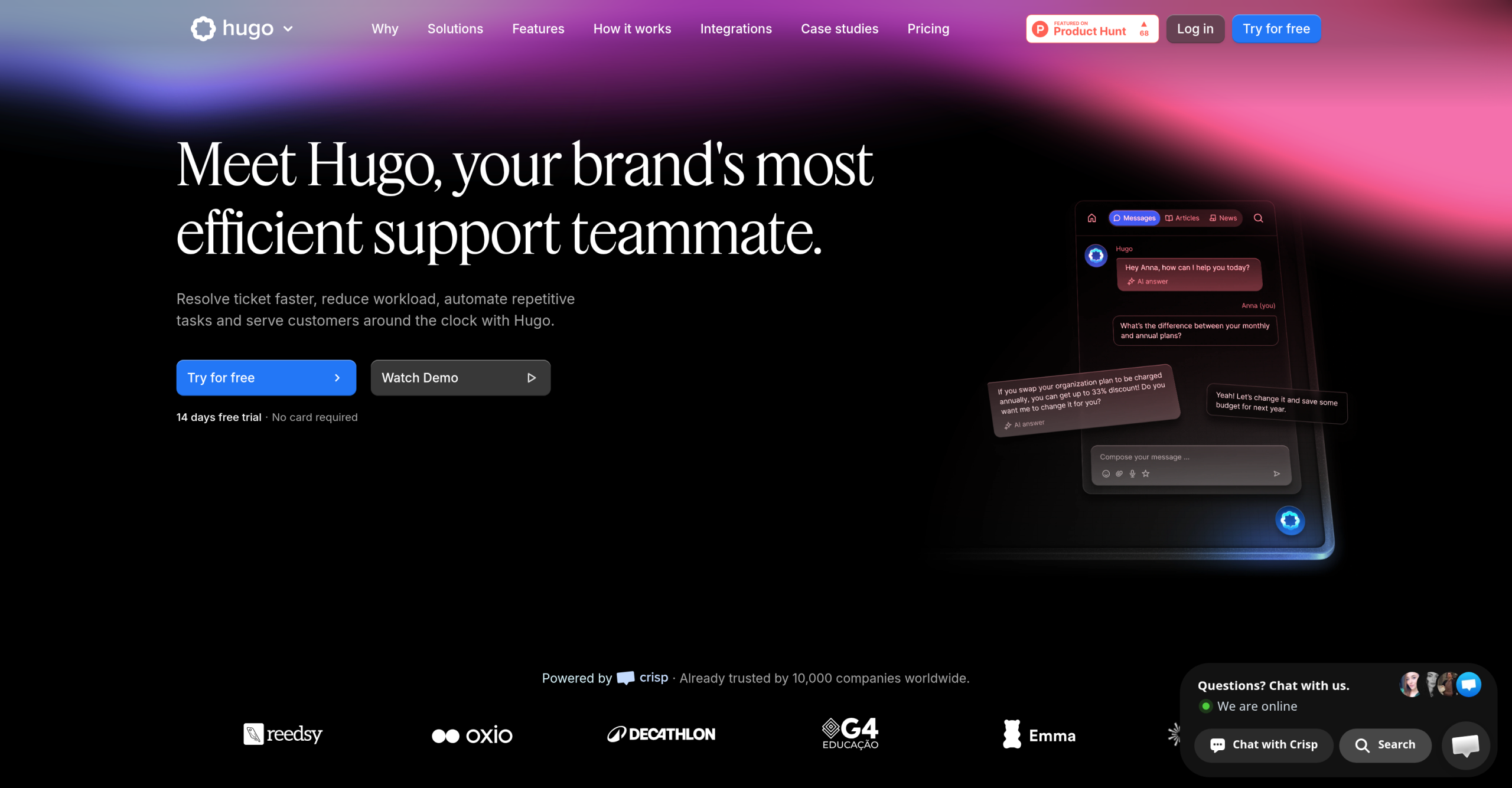
Customer support platforms usually make you choose between rule-based chatbots and full human teams. Hugo AI takes another route: an AI agent built into the Crisp support suite that resolves 40–60% of incoming tickets autonomously, with live access to CRM data, billing systems, and order management through a Model Context Protocol (MCP). Over 10,000 companies — including Decathlon and Emma — use it, and the entry price is $45/month bundled with Crisp’s Mini plan.
Hugo AI vs. Other AI Support Agents
| Hugo AI | Bika.ai | Parallel AI | |
|---|---|---|---|
| Integration | Crisp-only | Standalone | Standalone |
| Live data access | MCP (CRM, billing, orders) | Chat-based | Custom training |
| AI models | Claude, GPT, Llama, custom | Proprietary | Multiple |
| Starting price | $45/mo (with Crisp) | $16/mo | $29/mo |
| Data hosting | EU servers (GDPR) | Not specified | Not specified |
| Workflow builder | Visual drag-and-drop | No | No |
Hugo’s edge is depth rather than breadth. Bika.ai operates as a general-purpose business tool, and Parallel AI builds custom AI employees for various tasks. Hugo focuses on one domain — customer support — with deeper system-level integration than most alternatives.
How MCP Connections Work
Most AI chatbots pull answers from a knowledge base or FAQ document. Hugo’s Model Context Protocol establishes live, two-way connections to business systems. When a customer asks "Where’s my order?", Hugo queries the order management system in real time, retrieves the tracking number, and responds with the actual status — not a canned "please check your email."
Supported integrations include CRMs (HubSpot, Salesforce), billing platforms (Stripe), and helpdesk knowledge bases. The AI can also perform actions: processing a refund, updating a shipping address, or changing a subscription tier, all within the conversation thread.
Teams choose which AI model powers each workflow — Claude, ChatGPT, Llama, or Crisp’s internal models — and can route different query types to different models. A billing dispute might use Claude for nuanced reasoning, while a simple password reset goes to a faster, cheaper model.
Pricing: Bundled With Crisp
| Plan | Monthly Cost | AI Allocation | Includes |
|---|---|---|---|
| Mini | $45/mo | $5 of AI credits (≈100 conversations at $0.05 each) | Crisp Mini helpdesk + Hugo AI |
| Essentials | $95/mo | Higher credit allocation | Crisp Essentials + advanced routing |
| Plus | $295/mo | Full allocation | Crisp Plus + priority support |
| Pay-as-you-go | $0.05/conversation | Usage-based | Add-on to any plan |
All tiers include a 14-day free trial — start for free. The pricing is a bundle — you get both Crisp (the helpdesk) and Hugo (the AI agent) together. There’s no standalone Hugo product; if your team uses Zendesk, Intercom, or Freshdesk, Hugo won’t integrate.
The Catch
- Crisp-only: No standalone mode or third-party helpdesk integration. Your entire support operation needs to run on Crisp.
- Credit opacity: Plans quote "AI conversation dollars" rather than ticket counts, making it hard to estimate monthly costs without a trial run.
- No refund policy: Beyond the 14-day trial, there’re no refunds — unusual for a SaaS tool at this price point.
- Steep pricing jumps: The leap from $95 to $295 between Essentials and Plus leaves mid-size teams with an awkward choice.
- Limited multilingual documentation: The platform targets English-speaking teams primarily; multilingual capabilities aren’t well documented.
Visit Hugo AI — https://hugo.ai/en/