

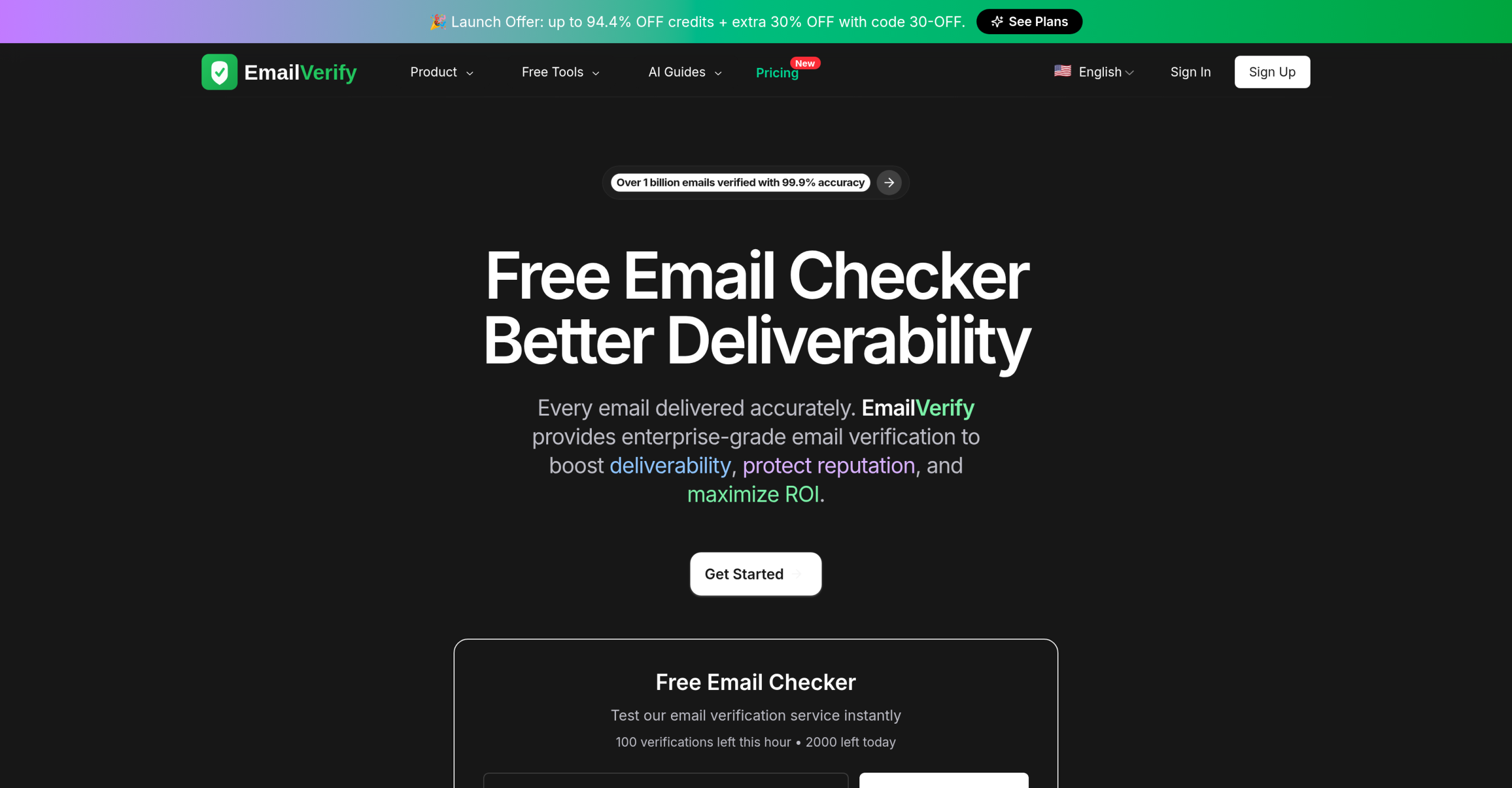
Sending emails to invalid addresses doesn’t just waste time; it damages your sender reputation and inflates bounce rates. Keeping your email lists pristine is a constant challenge, but EmailVerify offers a way to maintain high deliverability by validating addresses in real-time. The service aims for 99.9% accuracy, helping you protect your sender score and reduce bounces.
How EmailVerify Keeps Your Contacts Clean
This service focuses on ensuring your email lists are full of active, valid addresses. It can process emails in real-time or clean large lists you upload as CSV or Excel files. For developers, an Email Validation API is available. EmailVerify identifies various problematic addresses, including "catch-all" accounts, disposable emails, and other risky or invalid entries. Beyond just verification, the platform also includes an "Email Finder" to help users discover professional contact information.
Who Benefits Most from Email Verification?
Organizations that rely heavily on email for communication and outreach will find this tool useful. This includes marketing agencies looking to maintain clean promotional lists, and sales teams who need to validate contacts before launching outreach campaigns. E-commerce and retail businesses can filter out fake or mistyped addresses during sign-up processes, while SaaS and tech platforms can ensure onboarding emails reach real users and help block fraudulent accounts. Recruitment agencies can validate candidate contact details, and financial institutions can support accurate analytics and secure communication by ensuring their recipient data is correct.
The Technology Behind the Checks
EmailVerify employs several methods to confirm email validity. It claims a 99.9% accuracy rate for real-time verification and can handle large lists through bulk processing. Its smart detection systems look for disposable emails, perform domain validation, and conduct SMTP verification. It also includes a "Toxicity Check" to flag potentially harmful addresses and a "Bouncer Shield" designed to keep bad emails from entering your database. The service states it adheres to GDPR regulations for data privacy.
Connecting to Your Workflow
To simplify your operations, EmailVerify provides a strong RESTful API for instant validation and integrates with many popular platforms. This allows you to connect it directly with tools like HubSpot, Klaviyo, Pipedrive, Zoho CRM, Mailchimp, and Google Sheets. It also works with marketing automation platforms such as ActiveCampaign, and cold outreach tools like Instantly, Smartlead, and ReachInbox. For broader connectivity, it connects with Zapier, Make, Integrately, Salesforce, and SendGrid.
What Makes EmailVerify Stand Out?
One area where EmailVerify aims to differentiate itself is in its ability to validate "catch-all" emails. Many other services struggle with these, but getting them right can open up more leads and improve response rates, especially for cold email campaigns. Its direct integrations with specific cold email tools further support deliverability. The combination of email verification and the "Email Finder" feature offers a dual advantage: you can clean existing lists and generate new leads, a capability that lead generation agencies have found particularly valuable.
Understanding the Investment
EmailVerify uses a freemium model. If you need more than the free tier, paid options start at $5 per unit, billed on a pay-as-you-go basis. It’s important to be aware that the company has a strict "No Refunds" policy for all purchases.
Points to Ponder Before Using
While EmailVerify states a high accuracy figure, some user feedback mentions occasional reports of inaccuracies and a lack of spam trap detection. One review specifically noted that the tool "cannot detect spamtrap emails at all." Given its founding in 2024, some consider the service’s reliability unproven due to a limited amount of public accuracy data or extensive user reviews. It’s common for industry experts to view claims of 99% accuracy for email verification with some skepticism, as real-world tests can sometimes show lower results, particularly with complex "catch-all" domains. AI-based verification is generally seen as a helpful decision-support system rather than providing absolute confirmation. Additionally, remember the company’s "No Refunds" policy before committing to any paid services.