

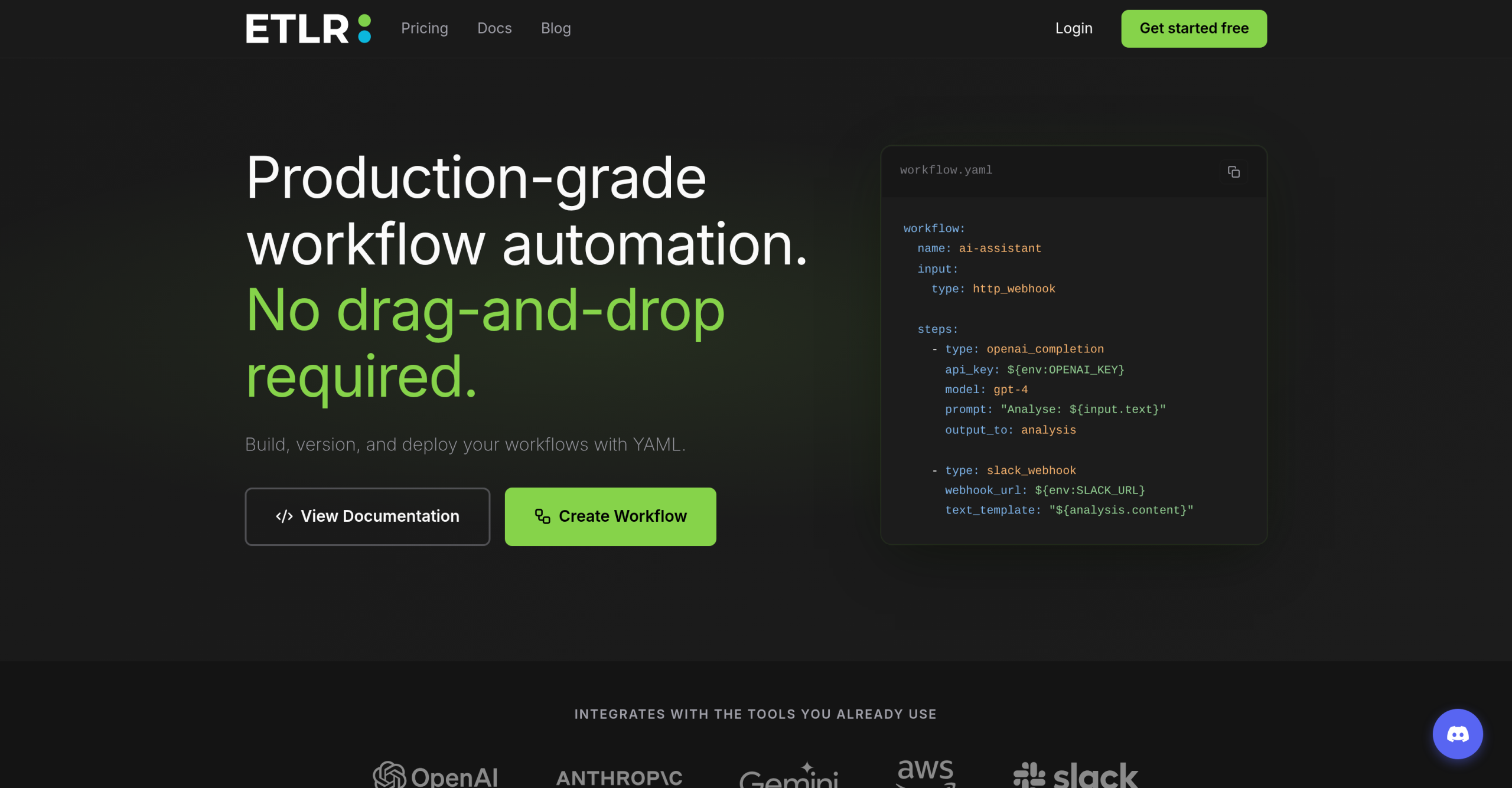
If you’re a developer who prefers writing code to clicking through visual interfaces, ETLR provides a code-centric platform for automating your AI workflows. It lets you define, version, and deploy AI processes primarily through YAML configurations, offering a direct, developer-first method for managing complex automation tasks without relying on drag-and-drop tools.
Crafting Your AI Workflows
ETLR allows you to specify your AI workflows using YAML files, then deploy them with a single command. This approach abstracts away the need to set up and configure underlying infrastructure. Your workflows can receive webhook events, add custom metadata, transform data using your own Python code, and then send the processed information to various external services.
Keeping Track: Observability and Version Control
The platform includes several features to help you monitor and manage your automated processes:
- Real-time performance metrics offer immediate insights into how your workflows are running.
- Structured logs provide detailed records for later analysis and auditing.
- Step-by-step execution traces give you a clear view of each stage of your workflow’s progression.
- Error tracking helps pinpoint and resolve issues quickly.
- Built-in version control allows you to track changes, review them through standard pull requests, and perform one-click rollbacks if needed. This system is designed to be Git-friendly, making it easy to manage your YAML definitions.
Who Benefits from a Code-First Approach?
ETLR is built for developers and technical teams who value a code-based workflow automation method. It’s particularly useful for those who need integrated version control and smooth integration into existing CI/CD pipelines.
Consider these practical applications:
- Data Processing and Enrichment: Set up workflows to receive data via webhooks, enrich it with additional metadata, and transform it using custom Python scripts before forwarding it to other services.
- AI Model Integration: Process data with advanced AI models, such as OpenAI’s GPT series or Google Gemini, and then automatically send the results to platforms like Slack.
- Real-time System Monitoring: Configure cron-based workflows to periodically check endpoints and send alerts if they return non-200 responses, helping you stay on top of system health.
How Does ETLR Handle the Technical Side?
Workflows are defined using YAML, and you can include custom Python transformations directly within them. Deployment is straightforward, executed via a single command from either a command-line interface (CLI) or a web interface. ETLR integrates with a variety of services, including OpenAI, AWS, Slack, Python, Anthropic, Google Gemini, and HubSpot.
Why Choose Code Over Clicks?
ETLR stands apart from visual drag-and-drop builders like Zapier, Make.com, or n8n by emphasizing a "workflows as code" philosophy. This approach offers distinct advantages:
- Better Version Control: Workflows can be stored in Git repositories, allowing for standard code reviews, detailed change tracking, and straightforward rollbacks. This level of control is often less developed in visual tools.
- Developer-Centric Experience: It caters directly to developers by supporting custom Python code for data transformations and providing CLI deployment options, avoiding the limitations and repetitive UI actions found in less customizable platforms.
- Simplified Infrastructure Management: The tool abstracts away the complexities of infrastructure setup, enabling quick deployment and scaling without manual configuration.
- Enhanced Observability and Debugging: Real-time metrics, structured logs, and execution traces provide the detailed visibility necessary for debugging even the most complex AI workflows.
Understanding the Cost
ETLR operates on a freemium model. Paid options start at $27 per month, billed monthly. The pricing is credit-based, where one credit corresponds to one workflow execution. It’s important to note their strict "No Refunds" policy.
Before You Get Started
Because ETLR uses a code-first approach, users will need coding knowledge, specifically with YAML and Python, to fully use its capabilities. This might mean a steeper learning curve if you’re used to purely visual workflow builders. Remember the credit-based pricing and the "No Refunds" policy when considering your subscription.
Learn more at etlr.io.