

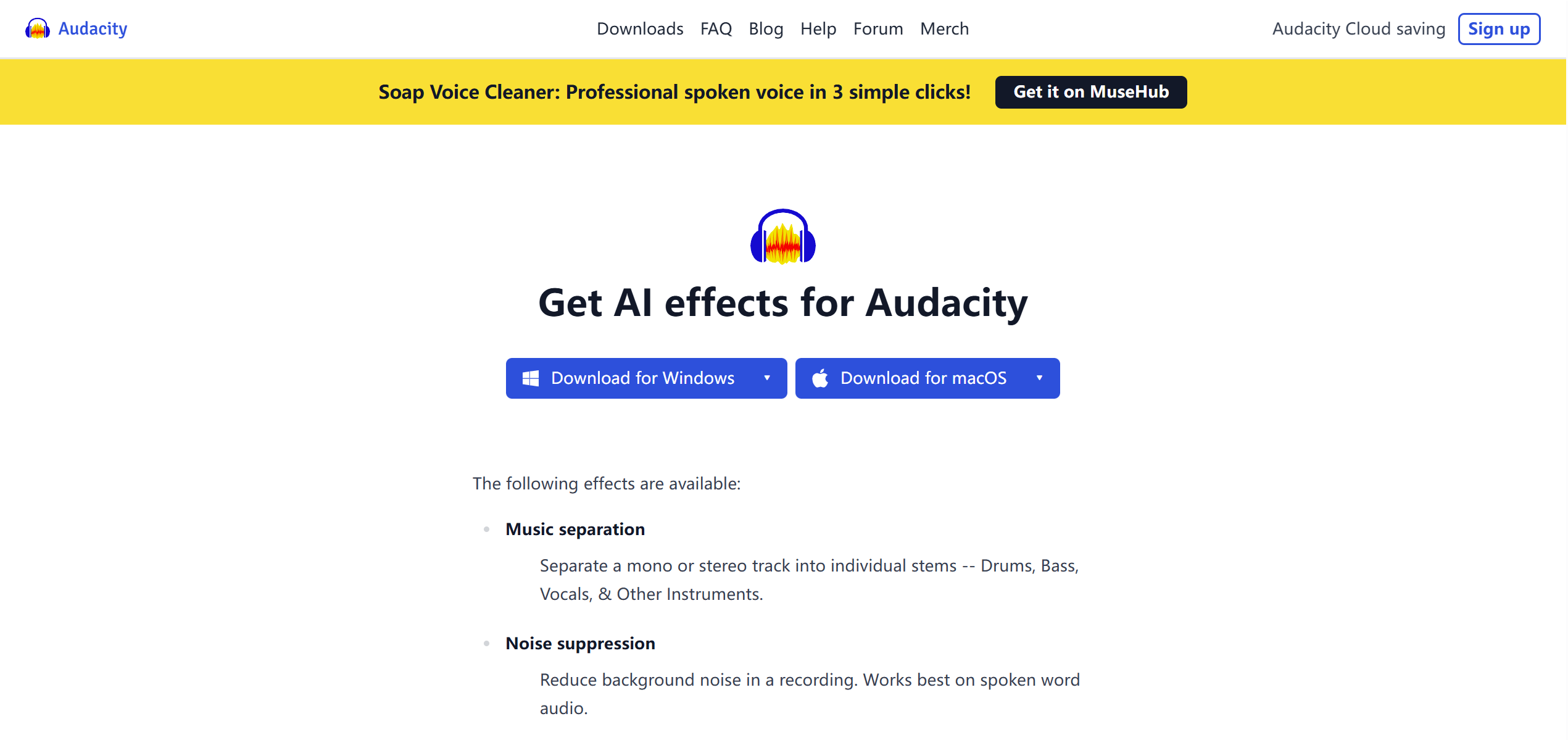
Audacity OpenVINO brings AI-powered audio processing capabilities directly into the free Audacity editor, running entirely on local hardware through Intel’s OpenVINO toolkit. Musicians, podcasters, and audio enthusiasts get access to AI noise reduction, music separation, and transcription without sending audio data to cloud services or paying for premium plugins.
Audacity + OpenVINO: Local AI Audio Effects Plugin
This suite of AI-powered plugins extends Audacity’s functionality with several advanced features:
- Music Separation: Splits audio tracks into individual stems like vocals, drums, bass, and other instruments using Meta’s Demucs v4 model. This is useful for remixing, creating karaoke versions, or isolating instrument parts.
- Noise Suppression: Optimizes for speech, effectively reducing background noise in spoken word recordings. This is particularly beneficial for podcasts and interviews.
- Music Generation and Continuation: Creates new music snippets or extends existing ones, leveraging the MusicGen LLM, which is based on Stable Diffusion and Riffusion.
- Whisper Transcription: Converts spoken audio to text, powered by Whisper.cpp (based on OpenAI’s Whisper model). It also includes translation capabilities and can export timestamped label tracks.
- Audio Super-Resolution: Upscales and enriches audio, aiming to improve clarity and detail in recordings.
Podcasters, Musicians, and Privacy-Conscious Audio Editors
Audacity OpenVINO caters to a wide range of users:
- Musicians: Ideal for remixing, creating backing tracks, learning instrument parts, or generating new musical ideas.
- Podcasters and Audio Editors: Enhances spoken word clarity with advanced noise suppression and provides local, private transcription for interviews and show notes.
- Hobbyists: Offers tools to upgrade old recordings or experiment with AI audio processing without financial commitment.
- Privacy-Conscious Users: All processing happens offline, ensuring data privacy and eliminating the need for an internet connection.
OpenVINO Backend, Runs on CPU or Intel GPU
The plugins use Intel’s OpenVINO toolkit, allowing AI models to run efficiently on a user’s local CPU, GPU, or NPU. It supports importing various audio formats, including MP3, WAV, FLAC, OGG, AIFF, M4A, WMA, and AC3, and exporting to common formats like MP3, WAV, FLAC, OGG, and AIFF. Processing times can vary significantly based on hardware; a 4-minute track might take 90 seconds on a modern CPU but up to 10 minutes on older systems.
Free Plugin, Requires Audacity 3.x
Audacity OpenVINO is completely free and open-source. There are no subscription fees, limits, or credits required to use its features. The plugin is available for Windows and Linux, with macOS support added in Audacity 3.7.4 (as of June 2025). To get started, download the OpenVINO plugins from the official Audacity website and install them into your Audacity application.
Intel Hardware Recommended, Limited Effect Types vs Commercial
Audacity OpenVINO has stability concerns users should know about:
- Hardware Compatibility: GPU and NPU acceleration aren’t supported on ARM devices, including Apple Silicon Macs, where the plugin will run significantly slower on the CPU.
- Noise Suppression Artifacts: The noise suppression, while effective for speech, can introduce a "gating" effect, causing abrupt sound appearances and disappearances that might be undesirable for natural audio.
- Music Separation Quality: AI separation works best on studio-quality recordings. Backing vocals and reverb tails may not be fully removed, and live recordings are more challenging to separate cleanly.
- Music Generation Quality: Some users find the music generation and continuation features to be "underwhelming" or produce "garbled nonsense."
- Technical Knowledge: Optimal configuration may require some technical understanding, and documentation for non-developers can be limited.
- Performance Constraints: There have been reports of CPU thread utilization being limited to 4 threads, even on multi-core systems, which can impact processing speed. Additionally, some AI models are large and require significant local storage space.