

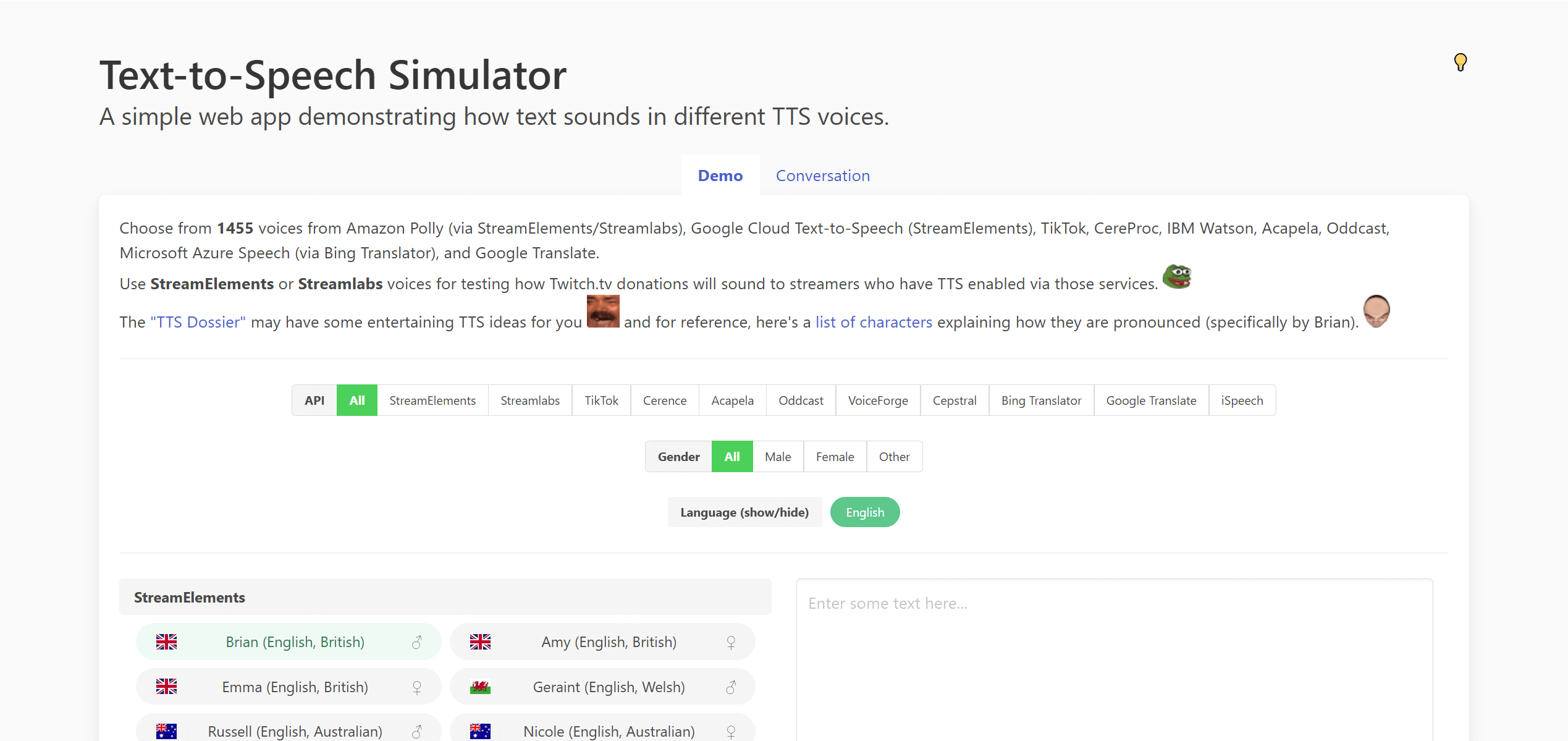
LazyPy.ro/tts is a web-based text-to-speech simulator that lets Twitch streamers preview how their donation messages will sound when read aloud. It’s got a large library of voices from multiple underlying TTS services, giving content creators a single place to test and generate spoken audio from various voice engines.
Free Multi-Engine TTS Aggregator
LazyPy.ro/tts functions as a straightforward web application that converts written text into spoken audio. It showcases how text sounds across more than 1000 different TTS voices. A distinctive capability is the creation of "conversations," where users can combine multiple TTS voices and share the result as a playlist of audio clips. That’s particularly useful if you’re creating dynamic content.
Developers Testing TTS Engines, Hobbyists, and Quick Voice Demos
While general users and developers can demo and compare TTS voices, the primary audience includes:
- Twitch.tv Streamers: They’re using it to test donation messages for StreamElements or Streamlabs TTS features, ensuring messages sound as intended.
- Content Creators: The tool supports the generation of "viral voiceovers" and "TikTok Lady Voice AI" for platforms like YouTube and GoAnimate/Vyond.
Google, Amazon, Microsoft, and IBM TTS in One Interface
The platform integrates with numerous third-party TTS services, offering extensive language support and various technical features:
- Voice Providers: Access voices from Amazon Polly (via StreamElements/Streamlabs), Google Cloud Text-to-Speech, TikTok, CereProc, IBM Watson, Acapela, Oddcast, Microsoft Azure Speech (via Bing Translator), and Google Translate.
- Voice Count: Over 1000 (or 1455) distinct voices are available.
- Language Support: A wide array of languages is supported, including English, Japanese, Polish, German, Arabic, Hindi, Korean, and many others.
- Audio Output: Generated audio can be saved locally. For some services, like Amazon Polly via StreamElements, audio is returned as a data URI.
- Performance: The tool boasts "lightning fast" generation speeds.
- Sharing: Users can copy a direct link to the TTS URL for easy sharing.
- Technology Stack: Built with HTML5, vanilla JavaScript, and requires PHP >= 8.0 for full functionality.
No Batch Processing, Rate Limits, No API Access
Despite its broad utility, LazyPy.ro/tts has several important considerations:
- Third-Party Reliance: Its functionality’s heavily dependent on external TTS services, many of which are live demos or not intended for professional commercial use. You’ll want to check individual service websites for commercial terms.
- API/Session Requirements: Some integrations, like iSpeech, require valid API keys, and TikTok voices necessitate a valid session ID.
- Service Instability: The iSpeech API server can be unreliable, and the Cepstral service often experiences issues due to high traffic.
- Character Limits: Character limits vary significantly by service. Amazon Polly via StreamElements has a 3000-byte limit, while Streamlabs has a 550-byte limit. Complex inputs, such as long emoji sequences or non-Latin characters, can cause errors.
- Occasional Outages: Specific integrated voices, such as those from Streamlabs, have been reported as temporarily unavailable.
- Learning Curve: Some users find the tool requires effort to master, particularly for advanced usage or specific voice models.
Free Web Tool with Usage Limits
LazyPy.ro/tts itself is a free web application. There aren’t any subscription fees or sign-ups to use its demonstration features. However, the underlying third-party TTS services it integrates with often have their own pricing models, typically based on character count, once free usage tiers are exceeded. Users should check the pricing details of individual services if they plan extensive or commercial use.