

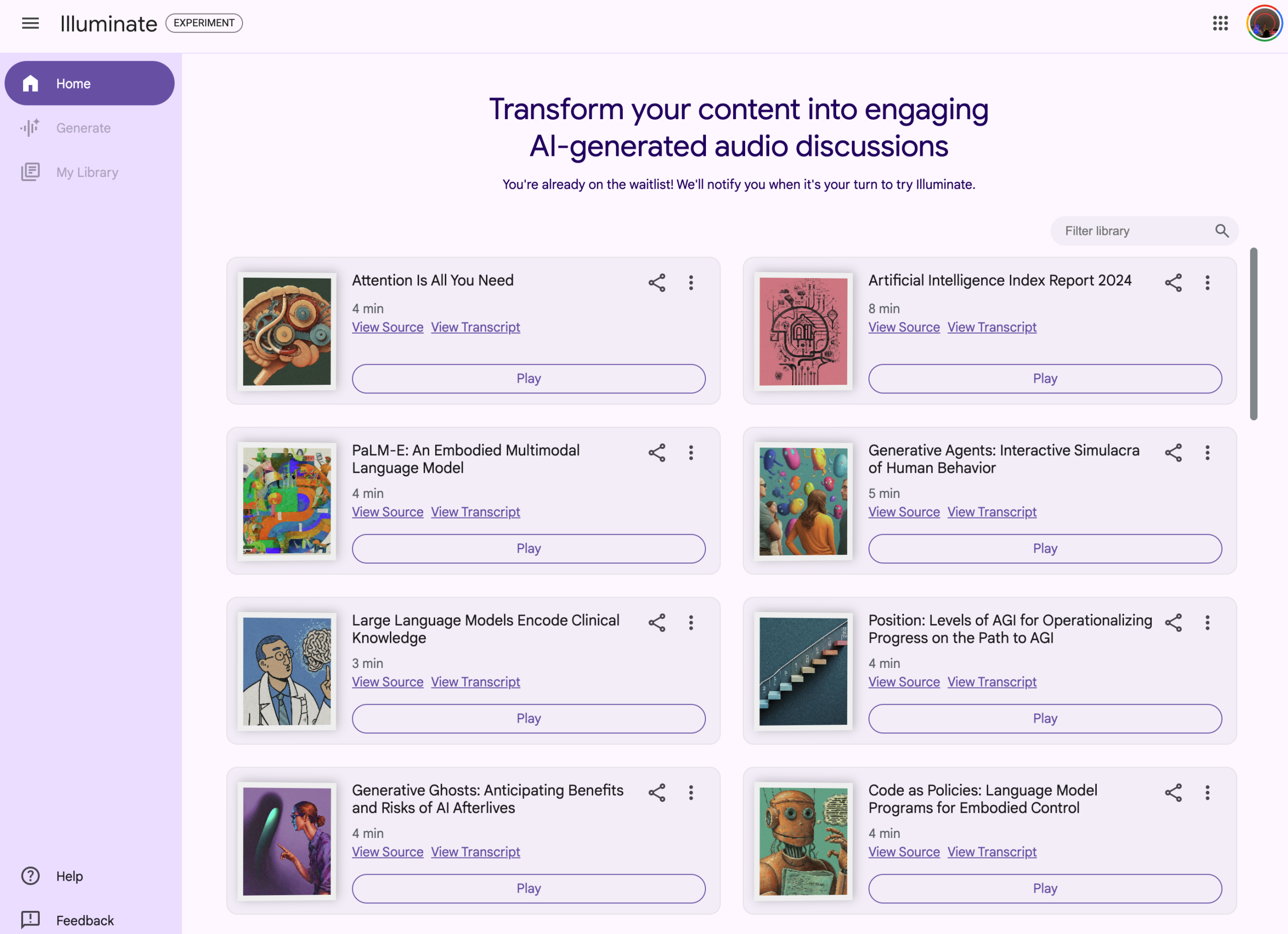
Navigating dense academic papers and technical articles can be time-consuming, especially for busy professionals and students. Google Illuminate, an experimental AI tool from Google, offers a solution by transforming this complex written content into engaging, conversational audio discussions, much like a podcast.
Google Illuminate: AI Podcasts from Academic Papers
Google Illuminate uses the Gemini AI model to process lengthy texts, summarize key points, and present them as a dialogue between two synthetic AI voices. This allows users to consume information efficiently, whether they’re commuting, working out, or simply prefer listening over reading. The tool accepts public URLs, PDF document uploads, or direct topic searches within its interface. The generated audio typically runs for about five minutes and includes a fully labeled, interactive transcript, enabling users to jump to specific sections of the discussion.
Researchers, Students, and Lifelong Learners
This tool serves several user groups that needs to digest complex information quickly and effectively:
- Students and Learners: Simplifies understanding of challenging subjects and research papers through accessible audio summaries.
- Busy Professionals: Facilitates knowledge acquisition during multitasking, turning unproductive time into learning opportunities.
- Researchers and Academics: Helps in staying updated on new research and reviewing literature by providing concise summaries and insights.
- Science Enthusiasts: Makes dense scientific and technical content more approachable and engaging for a wider audience.
Google Illuminate particularly excels at making academic research papers more accessible. Unlike general tools, Illuminate is specifically tuned for academic content, offering a precise and interactive deep dive into research papers. This focus allows for rapid knowledge acquisition and streamlines literature review workflows by providing high-fidelity audio summaries of scholarly PDFs and academic journals.
Gemini-Powered Audio with Conversational Tone
Google Illuminate is built on Google’s Gemini AI model, known for its large context window of up to 2 million tokens, which enables it to process vast amounts of data efficiently. Key technical details include:
- Input Flexibility: Users can provide public URLs of academic papers and web content or upload PDF documents. It’s currently optimized for academic papers from arXiv.org, especially in computer science.
- Output Format: Generates conversational podcasts featuring two synthetic voices (e.g., a male interviewer and a female expert) and provides an interactive, clickable transcript.
- Customization: Users can tailor the podcast’s audience level (beginner, general, expert), tone (e.g., semi-professional), and desired duration.
- Usage Limits: Users can generate up to twenty podcasts per day. Each generated podcast remains in their library for thirty days.
Experimental, Limited to Academic Content, Waitlist
As an experimental tool, Google Illuminate is currently available for free. However, access is often limited, and users might need to join a waitlist. While generally accurate in summarizing content, there’s a potential for loss of nuance or oversimplification of complex methodologies. Users are advised to consult the original source for citation and detailed understanding. Additionally, the tool can’t process paywalled content, sites that opt out of AI indexing, or content flagged by safety filters. Currently, users can’t download the audio files for offline playback, and it primarily supports English audio. Some users have also noted that AI voices, while natural-sounding, might not always match the seriousness of the material, and usage quotas can sometimes be unclear or change without notice.