
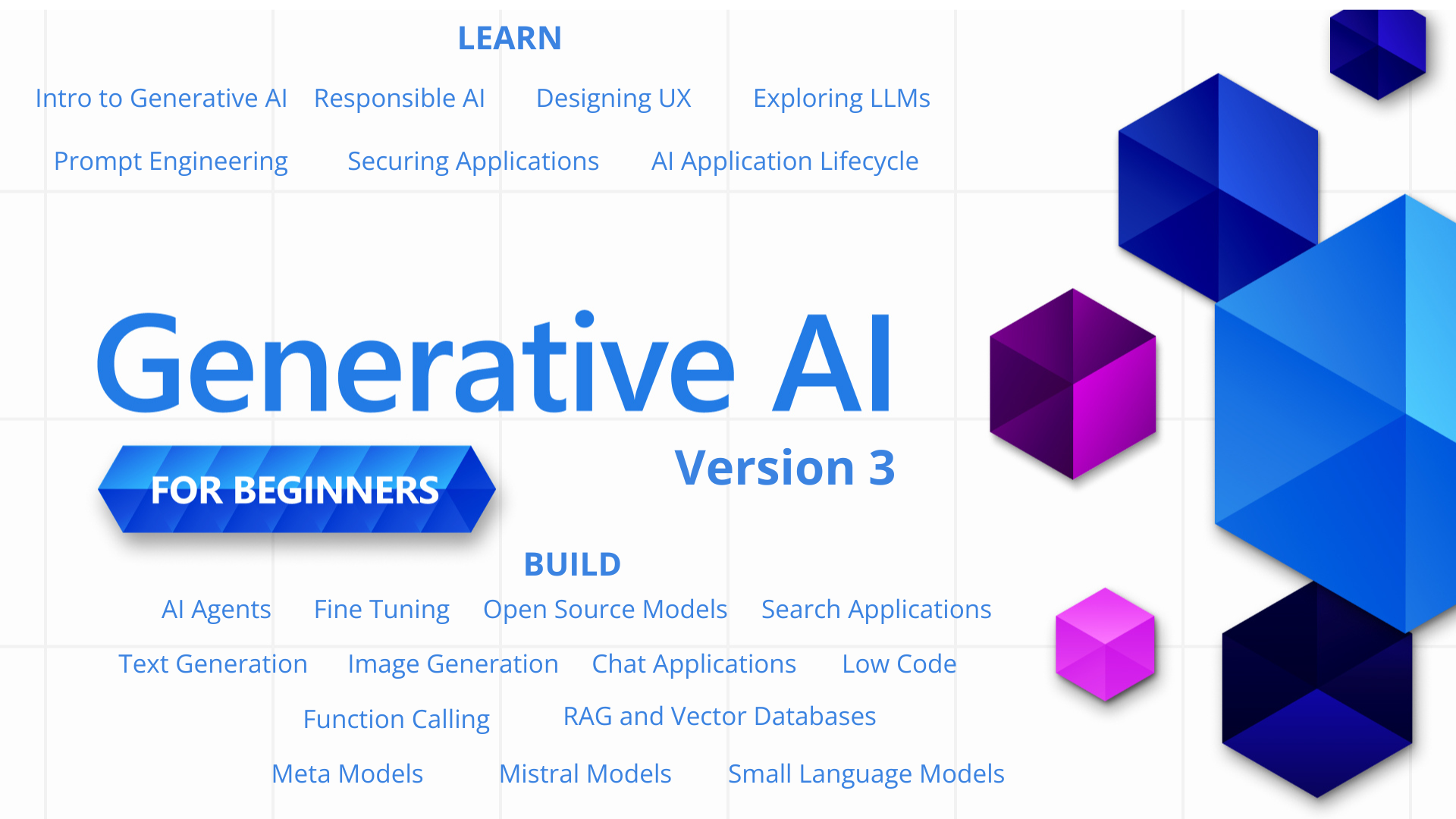
Building generative AI applications can seem daunting, but Microsoft’s "Generative AI for Beginners" offers a structured, free entry point. This thorough learning path demystifies the core concepts behind generative AI, guiding learners through practical application development with a strong emphasis on responsible AI practices.
Microsoft’s 18-Lesson Course: Generative AI for Beginners
This learning path covers essential generative AI topics, including:
- Large Language Models (LLMs): Understanding their mechanics and applications.
- Prompt Engineering: Techniques for effectively interacting with AI models.
- Embeddings and Vector Search: How AI processes and retrieves information.
- Retrieval Augmented Generation (RAG): Enhancing AI responses with external data.
- Responsible AI Development: Ethical considerations and best practices for building AI.
The course also explores various AI application types, such as text and image generation, chat applications, and search tools.
Developers New to AI, Students, and Career Switchers
"Generative AI for Beginners" targets a wide audience, from complete beginners to experienced professionals. It’s particularly beneficial for:
- Developers: Especially Python and TypeScript developers looking to integrate AI into their projects.
- Students and Educators: Seeking a foundational understanding of generative AI.
- Business Users: Interested in how generative AI can be applied across industries like healthcare, media, and marketing.
- AI Engineers and Solution Architects: Aiming to solidify their understanding of core generative AI principles.
18 Lessons from Prompt Engineering to RAG Deployment
The learning path is organized into 18 to 21 lessons. Each lesson includes a short video introduction, detailed written content, and hands-on Jupyter Notebooks. These notebooks provide practical code examples in Python and TypeScript, allowing learners to apply concepts directly. A dedicated .NET Edition is also available. For practical exercises, the course integrates with Azure OpenAI Service, GitHub Marketplace Model Catalog, and the OpenAI API. While Azure examples are used, the underlying principles are platform-agnostic, ensuring broad applicability of the skills learned.
Free, Microsoft-Authored, with Code Examples in Python/TS
Microsoft’s offering stands out due to its structured, hands-on approach and its focus on responsible AI. It provides a low-friction entry point for individuals and teams to upskill in generative AI without any financial commitment. Developed by Microsoft Cloud Advocates, it serves as an authoritative and well-supported educational resource, ensuring the knowledge gained is relevant and practical.
Beginner Level Only, Not a Deep Technical Reference
While the course provides an excellent foundation, it’s crucial to acknowledge the inherent limitations of generative AI. The course itself addresses issues like potential biases and the generation of "hallucinations"—misinformation that AI models can produce. Users must critically assess AI outputs and understand that human fact-checking remains essential. Over-reliance on generative AI tools might also impact independent problem-solving skills. Although the course is free, some related Microsoft generative AI services, like Copilot, involve subscription costs, which have been noted as higher than some alternatives in the market.