

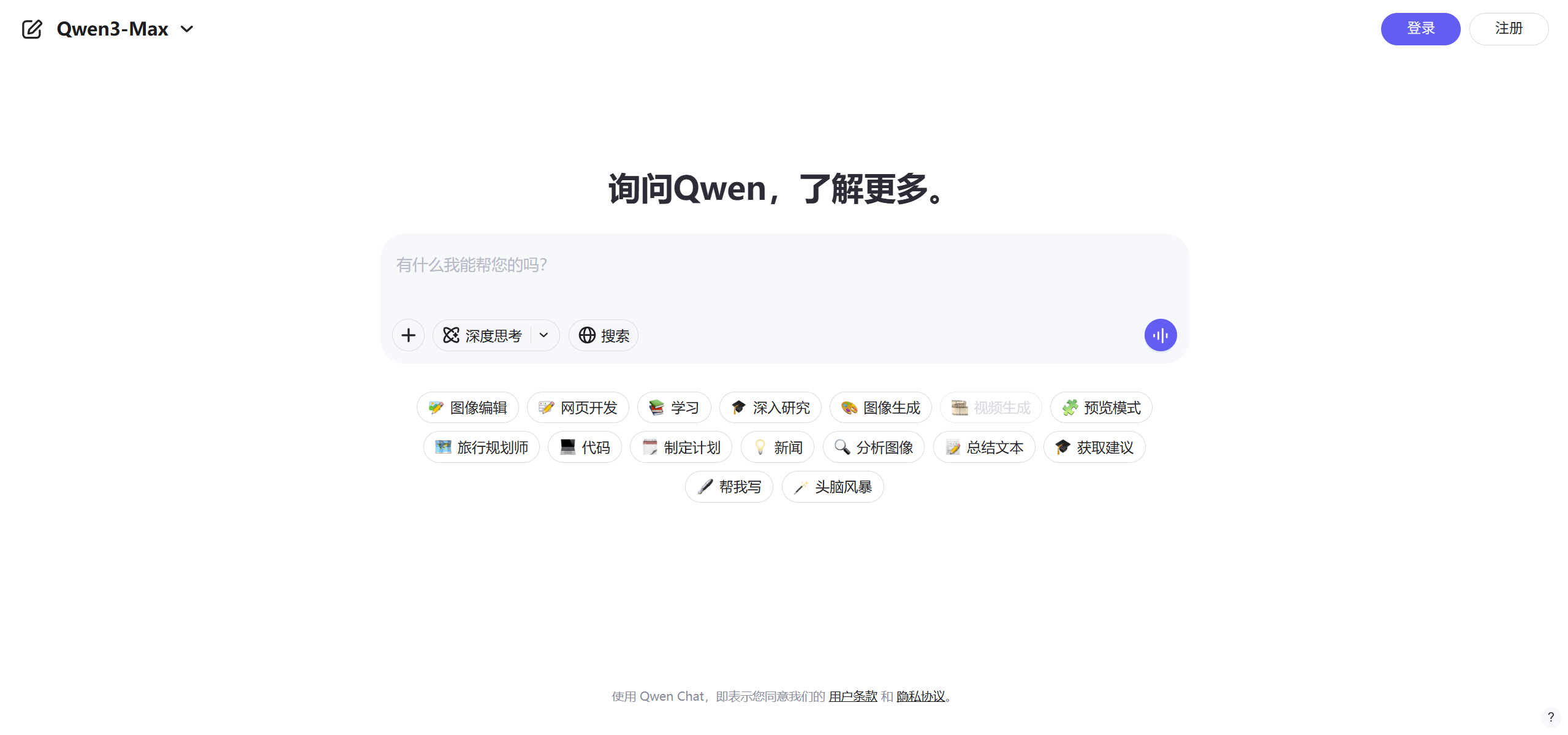
Alibaba Cloud’s Qwen family of models provides a versatile suite of large language models (LLMs) and multimodal models (MLLMs). These models are engineered to tackle what’s needed for a broad spectrum of AI tasks, with a particular emphasis on advanced reasoning and coding capabilities. Users can interact with Qwen via a web interface at chat.qwen.ai or through API access.
Alibaba’s Qwen Chat: Free Access to Qwen3.7-Max and 201 Languages
Qwen provides natural language understanding and generation, coding assistance, and advanced problem-solving. Its multimodal nature allows simultaneous processing of text, images, audio, and video inputs. Key features include:
- Content Generation: Image and video generation, document processing, and summarization.
- Web Search Integration: Connects with external information sources.
- Tool Utilization & Agent Capabilities: Interacts with other applications and tools.
- Dynamic Thinking Modes: Features a "Thinking Mode" for complex logical reasoning and a "Non-Thinking Mode" for faster, general-purpose responses, which users can switch between.
Chinese Users, Global Teams, and Developers
Qwen serves a diverse user base across various sectors:
- Developers and Programmers: It acts as an open-source coding assistant, generating production-ready code, assisting with debugging, and supporting agentic coding for complex tasks.
- Businesses and Enterprises: Use cases span customer service automation, content creation, data analysis, business intelligence, workflow automation, and risk management.
- Students and Researchers: The models help with learning, research, summarizing academic materials, and solving mathematical problems.
- General Users and Creatives: It functions as a versatile chatbot for creative writing, brainstorming, and generating images and videos.
- Bilingual Operations: Its strong Chinese-English bilingual capabilities make it especially useful for organizations operating across Asian and Western markets.
MoE Architecture, 1M Token Context, OpenAI-Compatible API
Qwen encompasses a family of models, including Qwen, Qwen-VL, Qwen-Audio, Qwen-Coder, and various Qwen3 iterations (e.g., Qwen3.7 Max/Plus). Some models use a Mixture-of-Experts (MoE) architecture for efficiency. They support extensive context lengths, up to 128K tokens natively, with some models extensible to 1M tokens. Qwen supports over 119 languages and dialects. Many models are open-source under an Apache 2.0 license, allowing for customization. Qwen also offers an OpenAI-compatible API format. It integrates with platforms like Alibaba Cloud Model Studio, DingTalk, and Zapier MCP.
Competitive with GPT-4o on Chinese and Multilingual Tasks
Qwen models demonstrate high accuracy in coding benchmarks, reasoning, and mathematical problem-solving. Qwen3.7 Max-Preview, for instance, ranks competitively on global AI leaderboards for text and vision tasks. Its "Thinking Mode" provides a unique advantage for deep reasoning, offering detailed insights into its thought process.
Free Web Chat, Paid API from $2.50/Million Tokens
The chat.qwen.ai web interface is generally free to use. For API access, Qwen models utilize a pay-as-you-go token-based pricing structure, similar to other major AI providers. While a limited free tier might be available (potentially region-specific), costs are incurred per million input and output tokens, with tiered pricing for longer context windows. Some Qwen models are noted for being more cost-effective than alternatives like GPT-4o while maintaining comparable performance. Businesses integrating Qwen via API should also consider potential hidden costs for development, tooling, and maintenance.
Chinese Regulatory Constraints, Singapore-Only Free API
Qwen has specific gaps in visual generation capabilities:
- Image and video generation quality lags behind its text and code capabilities, often producing generic results.
- Users report issues with content filters flagging innocuous words, likely due to API-level restrictions.
- The free tier is restricted to the Singapore region, which may add latency for users elsewhere.