

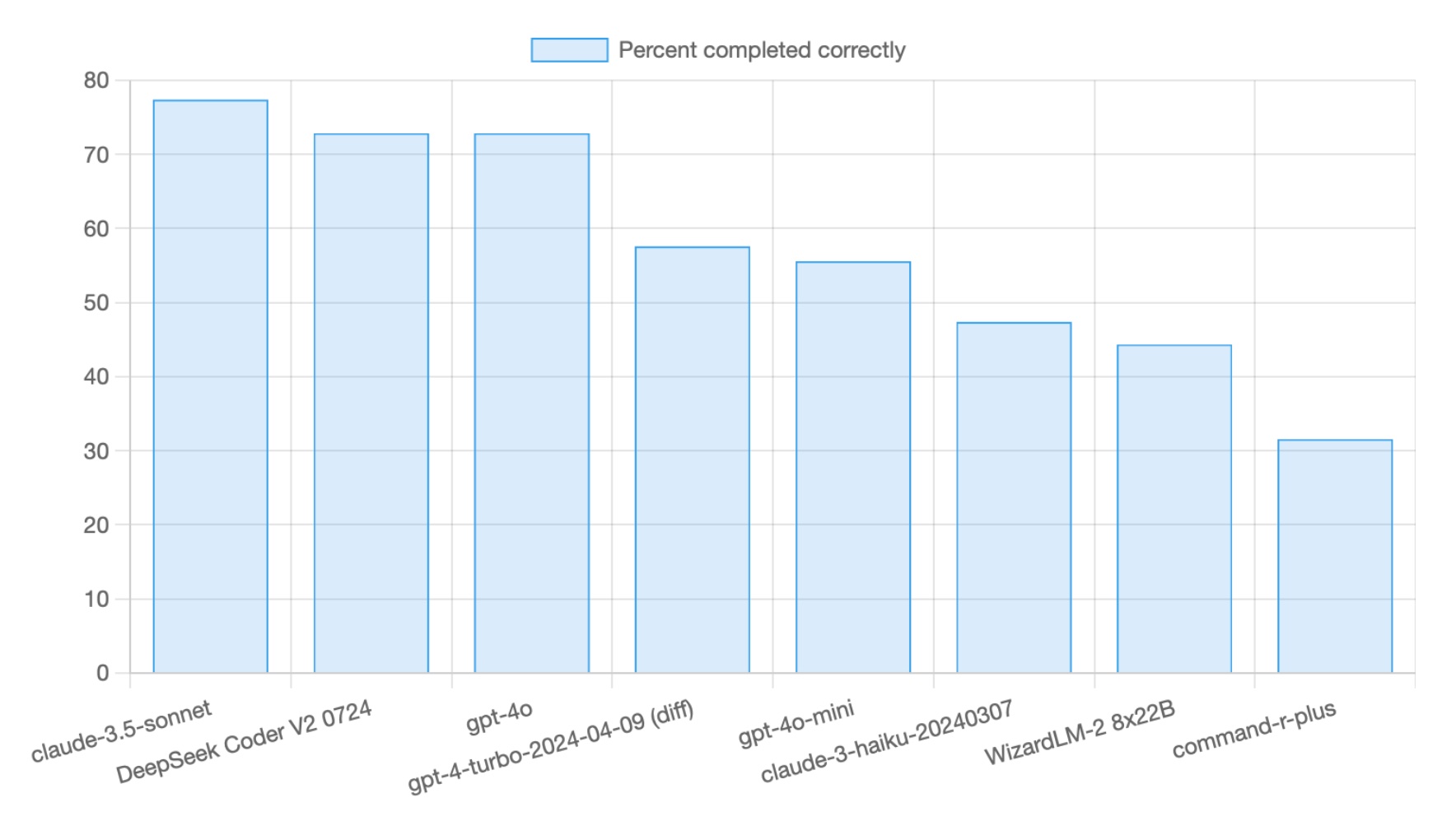
Evaluating Large Language Models (LLMs) for coding tasks requires reliable, real-world benchmarks. The Aider LLM Leaderboards provide a free, quantitative measure of how effectively various LLMs handle coding requests, from generating new code to editing existing files and incorporating feedback.
Aider’s LLM Coding Benchmark: Edit Format and Error Rates
The Aider LLM Leaderboards quantitatively assess LLM performance in coding tasks. It evaluates an LLM’s ability to translate natural language requests into executable code that passes unit tests. The system also measures how well models edit existing code and format those edits correctly.
The primary benchmark, known as the polyglot benchmark, challenges LLMs with 225 Exercism coding exercises. These exercises span six programming languages: C++, Go, Java, JavaScript, Python, and Rust. Each model receives two attempts per problem. After a failed first attempt, the model gets test error feedback, allowing the benchmark to measure both initial problem-solving and the ability to edit code based on feedback.
Key metrics reported include:
- Percentage of correct solutions (initial and after feedback)
- Cost per run
- Adherence to correct edit formats (e.g.,
diffand whole-file modes) - Percentage of well-formed cases
- Error outputs and malformed responses
- Token usage (prompt and completion)
- Test timeouts
AI Engineers Evaluating Models for Code Generation
Developers, researchers, businesses, and AI enthusiasts can use these leaderboards to identify the most capable LLMs for coding-related tasks. The benchmarks help users make informed decisions when selecting an LLM for interactive coding assistance. This approach reflects real-world usage patterns, focusing on practical code editing rather than isolated code generation.
Python, JavaScript, and Multi-Language Edit Tasks
The benchmarks support C++, Go, Java, JavaScript, Python, and Rust. To ensure safety and isolation, the evaluation process runs within Docker containers, preventing potentially harmful code generated by LLMs from affecting the host system. Aider offers a flexible API for running benchmarks and generating reports, providing detailed insights into LLM performance.
Free Web Dashboard with Full Methodology
The Aider LLM Leaderboards are free to access, offering "Free AI Coding Model Benchmarks." The underlying Aider software is open-source, licensed under the Apache License 2.0, which permits free use, reproduction, and distribution. While the tool itself is free, the benchmarks track the "cost per run" for the commercial LLMs being evaluated. This indicates that using these commercial models for your own projects would incur costs from their respective providers.
Benchmarks Single-File Edits, Not Multi-File Refactoring
A significant concern for the Aider benchmarks, and similar evaluations, is the potential for data leakage. LLMs might have been trained on the Exercism problems used in the benchmark, which could lead to inflated scores that don’t accurately reflect true reasoning ability. Some users also worry about an "LLM wall," suggesting that optimizing models for specific coding benchmarks might lead to regressions in other areas or a lack of generalization.
Furthermore, the Aider benchmarks primarily measure direct code editing rather than complex, multi-step "agentic" coding tasks. There have also been instances of incorrect cost reporting for some models due to issues with underlying token counting libraries. Users should verify cost estimates independently.
Real-World Editing Tasks, Not Synthetic Benchmarks
Aider’s benchmarks excel at evaluating LLMs within the context of an AI pair programming tool. They focus on practical code editing capabilities and the correct use of edit formats like diff and whole-file modes, differentiating them from benchmarks that test only isolated code generation. This end-to-end evaluation, including the ability to incorporate test error feedback across multiple programming languages, offers a practical measure of LLMs for interactive coding assistance. This approach reflects real-world usage patterns and correlates strongly with users’ perceived coding skill of models.
For more details, visit the official Aider documentation: https://aider.chat/docs/leaderboards/