

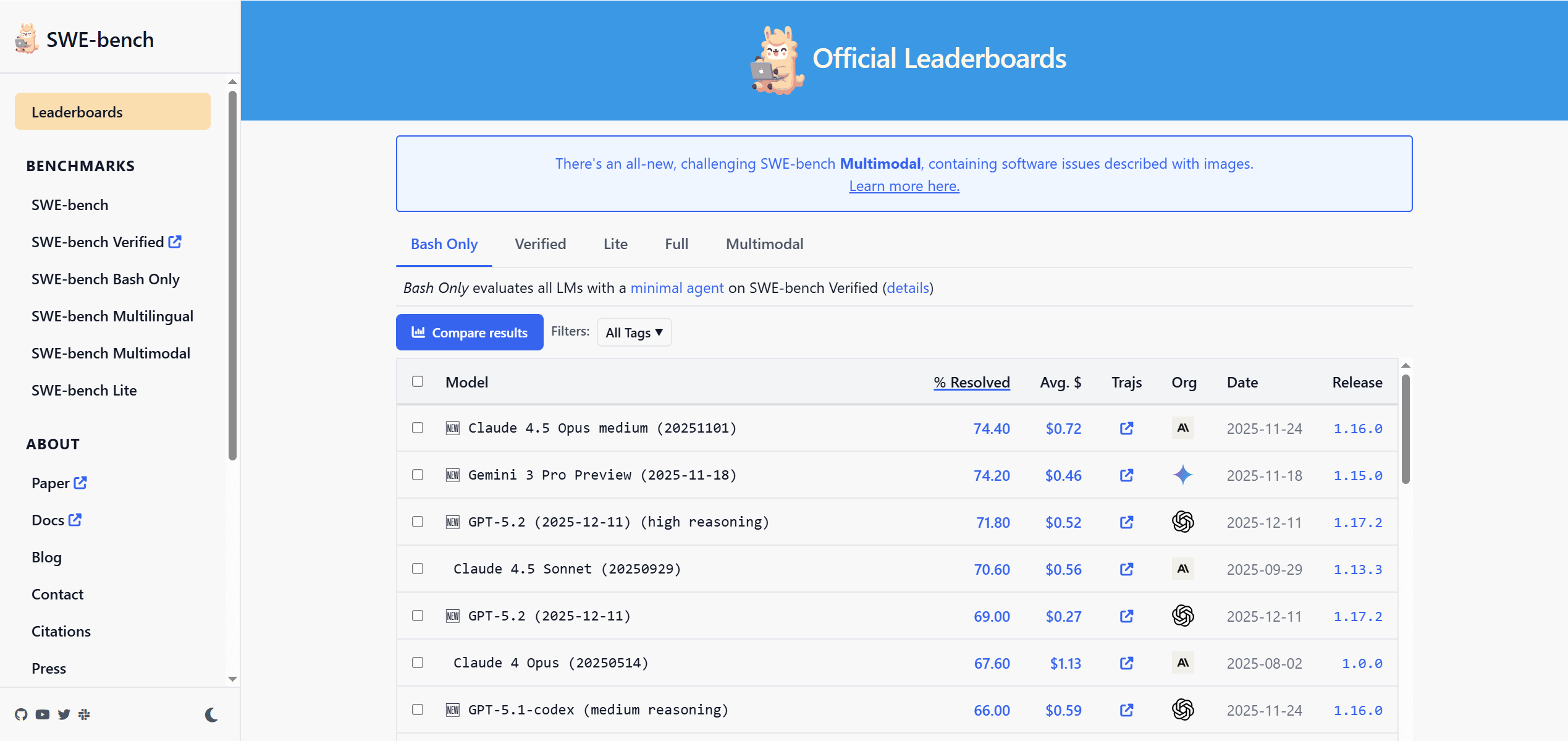
AI models face a significant challenge in replicating the nuanced problem-solving required for real-world software engineering. Traditional coding benchmarks often fall short, testing isolated snippets rather than full, end-to-end tasks. SWEBench addresses this gap by providing a reliable evaluation framework that assesses AI coding models and large language models (LLMs) against actual GitHub issues within live codebases.
SWEBench: Real GitHub Issues as AI Coding Benchmarks
SWEBench functions by presenting AI models with real GitHub issues and their corresponding codebases. The model’s objective is to generate a code patch that successfully resolves the problem described in the issue. This isn’t just about writing code; it demands context understanding, managing dependencies, and ensuring the solution’s correctness. The generated patch is then validated by running the repository’s unit tests. This process confirms the issue is fixed and that no new regressions have been introduced, providing a thorough measure of the AI’s capability.
Measuring AI Code Generation Against Real Bug Fixes
Researchers and practitioners in AI and software engineering are the primary users of SWEBench. It serves as a critical tool for:
- Benchmarking Performance: Comparing the effectiveness of different AI coding agents and LLMs in tasks like bug fixing and feature implementation.
- Gaining Insights: Understanding how LLMs approach code style and implement solutions.
- Realistic Evaluation: Assessing an AI’s ability to function as an "agentic" coder, handling complex, real-world development scenarios beyond simple coding puzzles.
2,294 Issue-PR Pairs from 12 Popular Python Repos
SWEBench’s design incorporates several key technical details:
- Focus on Python: The original dataset primarily draws from 12 popular open-source Python repositories. A variant, SWE-bench Multimodal, extends this to include issues with visual elements.
- Containerized Environments: Evaluations occur within consistent, containerized Docker environments, ensuring reproducibility. Cloud-based options, such as through Modal, are also available.
- Dataset Sizes: The original dataset includes 2,294 real GitHub Issue-Pull Request pairs. Other versions offer different scales, such as SWE-bench Lite (300 instances) and SWE-bench Verified (500 human-validated problems).
- Performance Metric: Success is measured by the "resolved rate," which quantifies the proportion of issues an AI model successfully fixes, verified by passing unit tests.
Python-Only, Setup Complexity, Time-Consuming Evaluation
While SWEBench offers a more realistic evaluation, it faces several challenges:
- Dataset Quality Issues: Earlier versions encountered problems like "solution leakage" and weak test cases, potentially leading to inflated scores. Some tasks were also found to be unsolvable, possibly underestimating model capabilities.
- Resource-Intensive Evaluation: The evaluation process can be demanding in terms of computational resources and time. Unit tests can sometimes be overly specific or misaligned with the problem, causing valid solutions to be rejected.
- Contamination Risk: A significant concern is that LLMs, especially those trained on extensive public internet data, might have been exposed to the benchmark’s problems, leading to artificially high scores that don’t reflect genuine problem-solving.
- Scope Limitations: SWEBench primarily focuses on bug fixing and doesn’t fully cover other crucial software development tasks like generating new code, architectural design, or ensuring long-term code maintainability.
- Setup Variance: The specific evaluation setup or scaffolding used around an LLM can significantly influence its reported performance, leading to score discrepancies for the same model.
- Aging Dataset: As a static dataset, SWEBench can become outdated, potentially reducing its relevance to current software development practices over time.
Free and Open-Source on GitHub
SWEBench is described as a "Free AI Coding Model Benchmark & Leaderboard." While the benchmark itself is freely accessible, running evaluations, especially with advanced LLMs, can incur costs related to API usage and computational resources. The benchmark can be accessed via Hugging Face and its official website: https://www.swebench.com/