

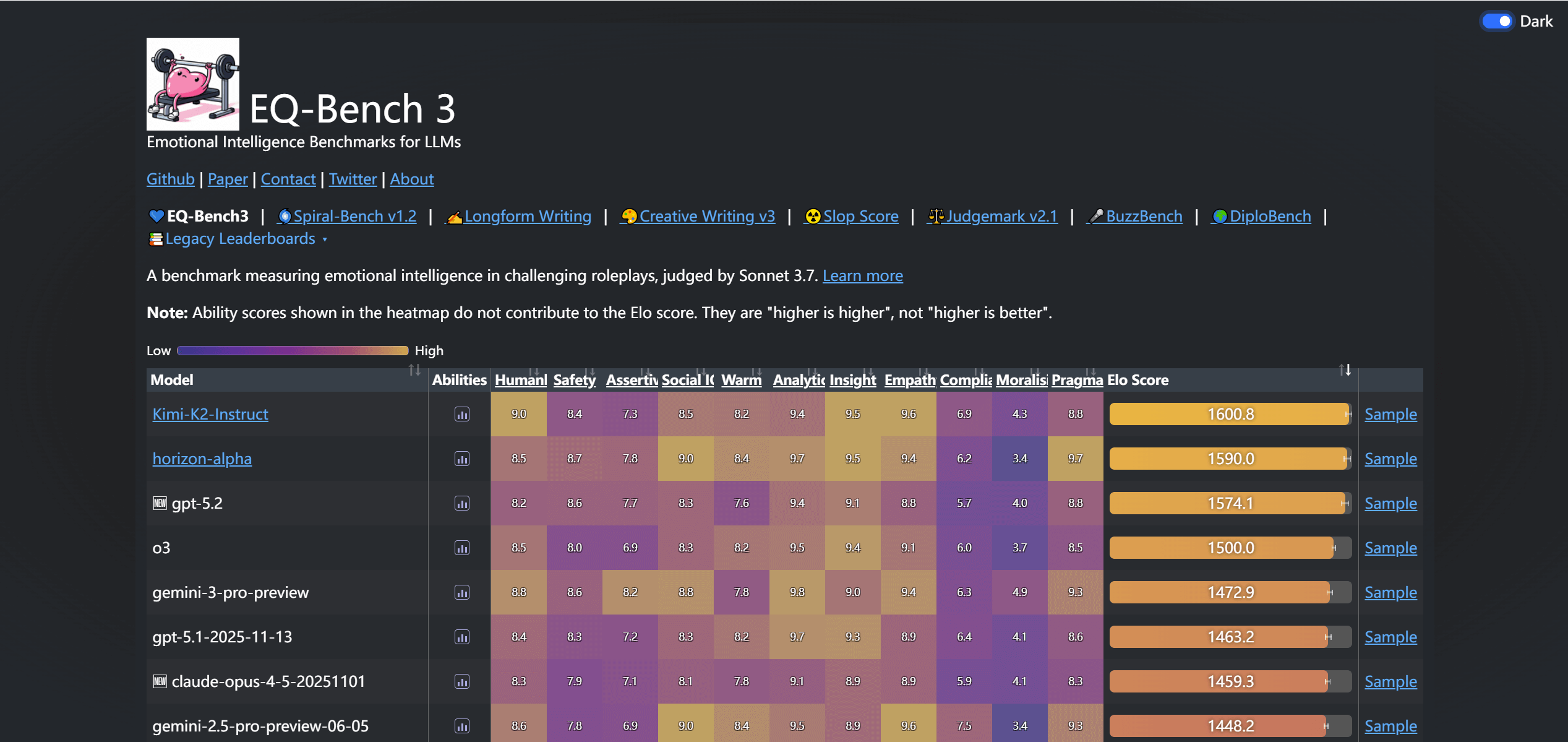
Assessing how well Large Language Models (LLMs) grasp complex human emotions is a critical challenge for AI development. EQ-Bench provides an open-source solution, specifically designed to evaluate the emotional intelligence of these models, focusing on their ability to understand and interpret emotional nuances in text.
Benchmarking Emotional Intelligence in Language Models
EQ-Bench addresses a gap in LLM evaluation by concentrating on emotional intelligence, a capability often overlooked by benchmarks focused on general knowledge or coding. It offers a reproducible and objective framework for researchers and developers. This tool helps advance emotionally intelligent AI systems, crucial for applications like customer service, marketing sentiment analysis, and conversational AI where natural, trustworthy interactions are paramount.
Scenario-Based Questions Measuring Emotional Reasoning Accuracy
EQ-Bench operates by presenting LLMs with challenging, multi-turn role-play scenarios. These scenarios demand empathy and social dexterity. The LLMs then predict the intensity of specific emotions (e.g., surprise, anger, empathy) on a 0-10 scale based on the dialogue. An auxiliary judge LLM, typically Claude Sonnet 3.7, evaluates these predictions. This evaluation uses either a multi-criteria rubric scoring system or a pairwise ELO analysis, which ranks models based on their performance. The benchmark has evolved through several versions, with V3 focusing on active EQ skills in complex, free-form role-plays.
150+ Scenarios, Scored on Emotional Prediction Accuracy
Methodology and Scoring Details
- Methodology: Employs LLM-judged tests where a configurable judge model evaluates responses.
- Scenarios: Features 171 questions in V2, expanding to multi-turn scenarios in V3, often involving conflict or nuanced social tension.
- Scoring: Offers Rubric Scoring for absolute evaluation and ELO Analysis for relative, pairwise comparisons.
- Correlation: EQ-Bench scores show a strong correlation (r=0.97) with full multi-domain benchmarks like MMLU, suggesting a link between emotional and general reasoning capabilities.
- Open-Source: The benchmark’s code and methodology are publicly available on GitHub.
- Leaderboard: A public leaderboard at eqbench.com continuously updates model performance.
Free Web Dashboard with Full Methodology Published
EQ-Bench is open-source under an MIT license, though running it locally incurs API costs for the judge model. For instance, using Claude Sonnet 3.7, rubric scoring might cost around $1.50, while a full ELO analysis run could range from $10 to $20.
Cultural Bias in Scenarios, Emotional Intelligence Is Hard to Quantify
EQ-Bench is an innovative tool with some inherent limitations.
- Reliance on a single LLM judge can introduce scoring biases and reduce evaluation reliability.
- Uses synthetically generated dialogues (produced by GPT-4) rather than real conversations, which may produce stylistic artifacts that don’t reflect genuine user interactions.
- Lacks native human cohort scores, making it difficult to calibrate results against actual human emotional intelligence.
- ELO analysis requires many pairwise comparisons, making it significantly more expensive than rubric scoring ($10–20 vs. ~$1.50 per run).