

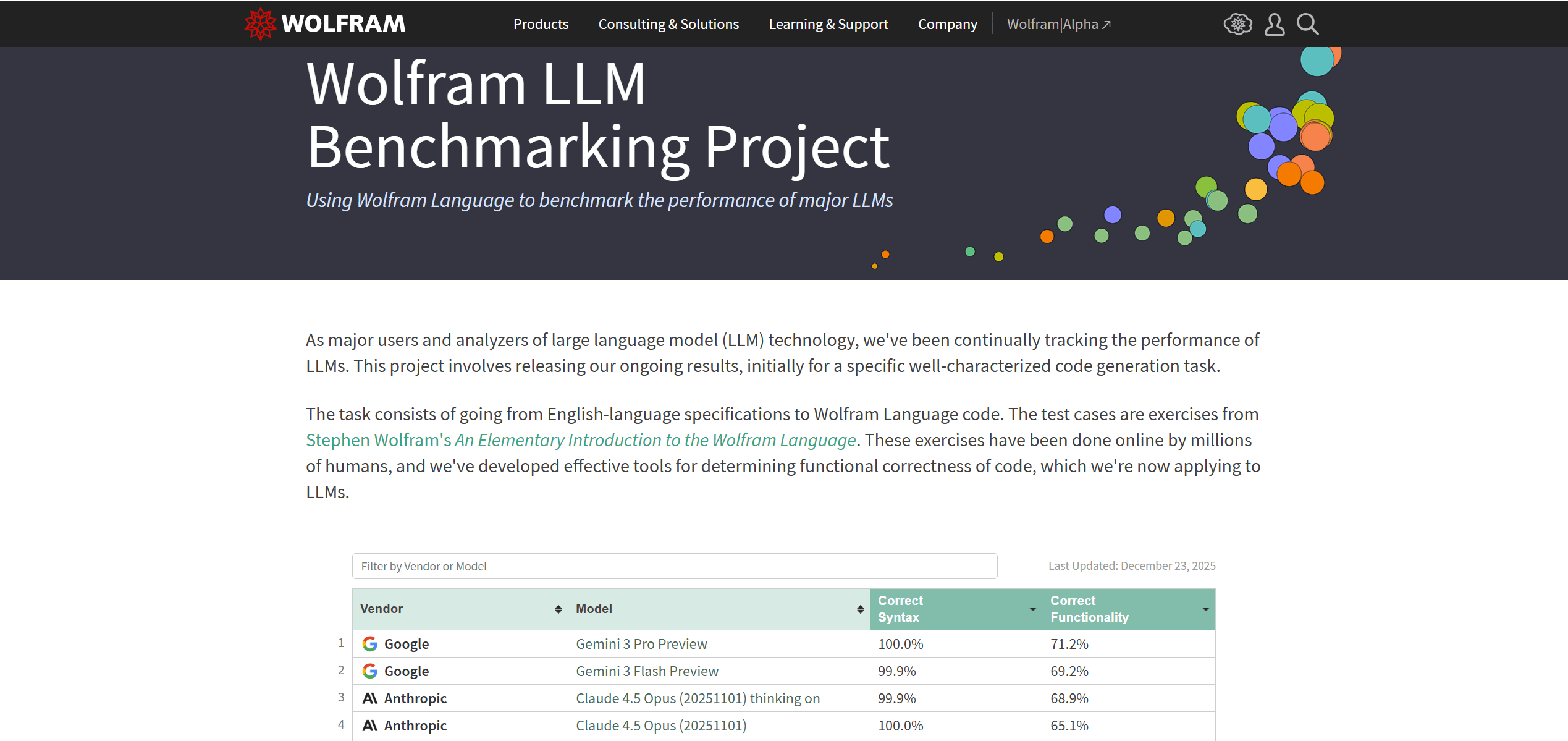
The Wolfram LLM Benchmarking Project systematically evaluates large language models’ ability to generate correct Wolfram Language code, testing their computational accuracy and factual correctness against a standardized suite of problems.
Systematic LLM Testing with Wolfram Language Tasks
The project benchmarks LLMs by testing their capacity to translate English-language specifications into functional Wolfram Language code. It draws exercises from "An Elementary Introduction to the Wolfram Language" and employs specialized tools to verify the correctness of the generated code. The results of these evaluations are continuously published, offering an evolving view of LLM capabilities.
Researchers, Data Scientists, and Wolfram Platform Users
This benchmarking tool serves a diverse audience:
- LLM Developers: They can submit their models for evaluation and access datasets and tools to understand performance.
- Researchers and Practitioners: The project helps them compare LLM performance, grasp model capabilities, and guide fine-tuning efforts.
- Organizations and Businesses: It assists in selecting appropriate LLMs for specific needs, integrating Wolfram functionality into AI workflows, and enhancing AI applications.
- Resource-Constrained Developers: Smaller companies or universities can use the project to choose models based on quality and latency, and to quickly evaluate internal model versions.
Symbolic Computation, Knowledge-Based, and Multi-Step Tasks
The benchmarking process relies on Wolfram Language, which offers high-level controls for automated evaluation. It supports integration with various LLMs from providers like OpenAI, Anthropic, and HuggingFace. All benchmark data and results are made available in a computable format within the Wolfram Data Repository. A key advantage is the Wolfram Language evaluation engine, which is designed to deliver correct and deterministic results in complex computational tasks, thereby helping to counteract LLM hallucinations.
Identifying Where Models Fail on Structured Reasoning
The Wolfram LLM Benchmarking Project excels at providing precise and deterministic evaluation for code generation, particularly within the Wolfram Language ecosystem. Its strength comes from using Wolfram’s integrated technology stack, which combines symbolic computation, data-driven insights, and technical expertise. This approach allows the project to inject accurate, real-time computation and knowledge into LLM-based systems. It directly tackles LLM limitations in areas demanding high computational accuracy and factual correctness, where unassisted LLMs might otherwise produce incorrect or fabricated information.
Niche Domain, Results May Not Generalize to Other Tasks
This benchmarking project has inherent limitations:
- Benchmarks capture a snapshot of model capability and may not reflect improvements made after evaluation.
- Evaluation criteria and scoring methods can introduce biases that favor certain model architectures.
- The project focuses on specific task categories, leaving some model capabilities untested.