

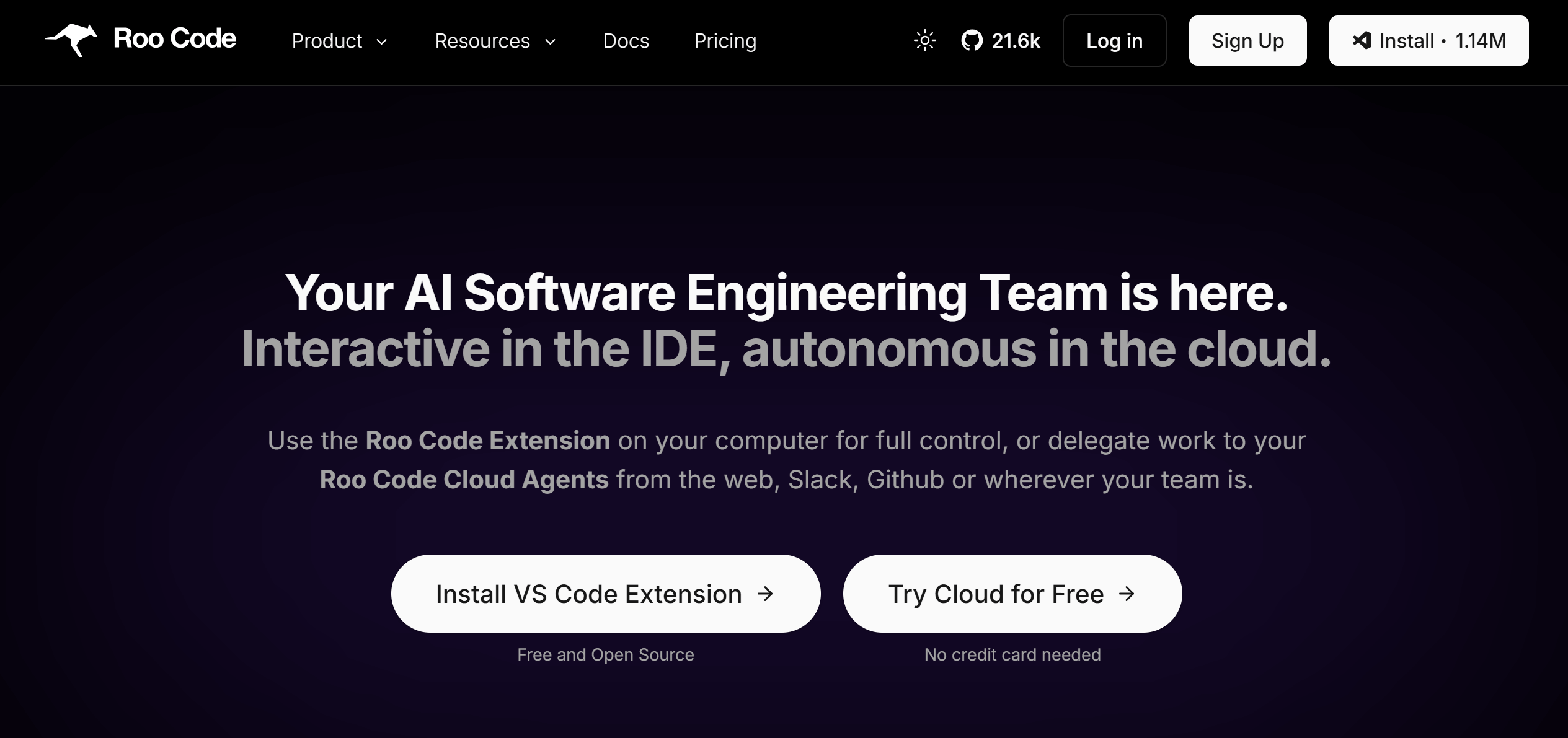
Roo Code was an open-source AI coding agent integrated into Visual Studio Code that offered AI-powered code manipulation, terminal command execution, and file editing. Developed by Roo Code Inc., it has since ceased active development.
Autonomous Coding Agent in VS Code
Roo Code brought AI-powered coding directly into the VS Code development environment. It allowed for code manipulation, terminal command execution, and offered customizable modes tailored for tasks like code reviews, testing, and debugging. Developers could generate code from natural language descriptions, refactor and debug existing code, update documentation, answer codebase questions, and automate repetitive tasks. A checkpoint system, integrated with Git, captured project state snapshots during AI-assisted workflows.
Developers, Solo Coders, and Rapid Prototypers
Roo Code targeted software engineers and full-stack developers utilizing VS Code. It suited individual developers looking for lightweight AI assistance within their IDE, those automating workflows, scripting browser/terminal actions, and users who preferred simplicity and using their own API keys. Specific applications included automating repetitive programming tasks, evolving codebases, assisting junior developers, and testing autonomous software development workflows. Its various modes—Code, Architect, Ask, Debug, Orchestrator, and Custom—adapted to different phases of software development, from planning to implementation.
Multi-LLM Support, File System Access, and Terminal Commands
As a VS Code extension, Roo Code integrated smoothly with the IDE and its terminal. It was model-agnostic, supporting a wide range of AI providers including Anthropic, OpenAI, Google Gemini, AWS Bedrock, and local models via Ollama. The tool offered extensive customizability, including prompt templates, mode-specific configurations, and the ability to create custom modes with specific tools enabled or disabled. Users could also control context limits and automatic condensing, managing what information was included in each conversation. Codebase indexing allowed natural language queries about the code, and real-time terminal control enabled command execution and output reading within VS Code.
Free Extension; API Costs Depend on Provider
Roo Code’s core was free and open-source under an Apache 2.0 license. It operated on a "Bring Your Own Key" (BYOK) model, meaning users were responsible for the API costs of their chosen large language model (LLM) providers (e.g., OpenAI, Anthropic, Google Gemini). A "Cloud Team" plan was available for $99/month, offering shared AI coding configurations and unlimited users. Cloud agents were billed at $5/hour in credits, with inference paid via pre-purchased credits.
Complex Tasks May Loop, API Costs Can Accumulate
The most significant limitation of Roo Code is its shutdown on May 15, 2026. Beyond its discontinuation, users frequently reported high token usage, leading to substantial API costs, especially with expensive models. The tool struggled with files exceeding approximately 1,000 lines of code, often failing to apply diffs correctly. Changing the selected AI model during a task could lead to context loss, and it didn’t automatically test changes unless specifically prompted. Configuring custom modes and model routing also presented a steeper learning curve. It supported only one session per VS Code window, limiting parallel tasks, and users noted issues with model inconsistencies and occasional bugs like codebase indexing failures.
Plan-then-Execute Mode for Multi-Step Code Changes
Roo Code was recognized for its deep IDE integration, enabling direct file manipulation and terminal command execution within a developer’s existing workflow. Its customizable modes and prompt templates provided flexibility for specific development tasks like code reviewing or testing. Compared to alternatives, Roo Code offered more granular control and flexibility, particularly with its mode system, and was reported to achieve approximately 30% lower API costs due to efficient diff-based editing. It excelled in "precision strike" capabilities for complex code modifications and provided greater transparency in API control and context management. Its multi-agent approach, allowing agents to design, reason, and implement collaboratively, was also a key differentiator.