

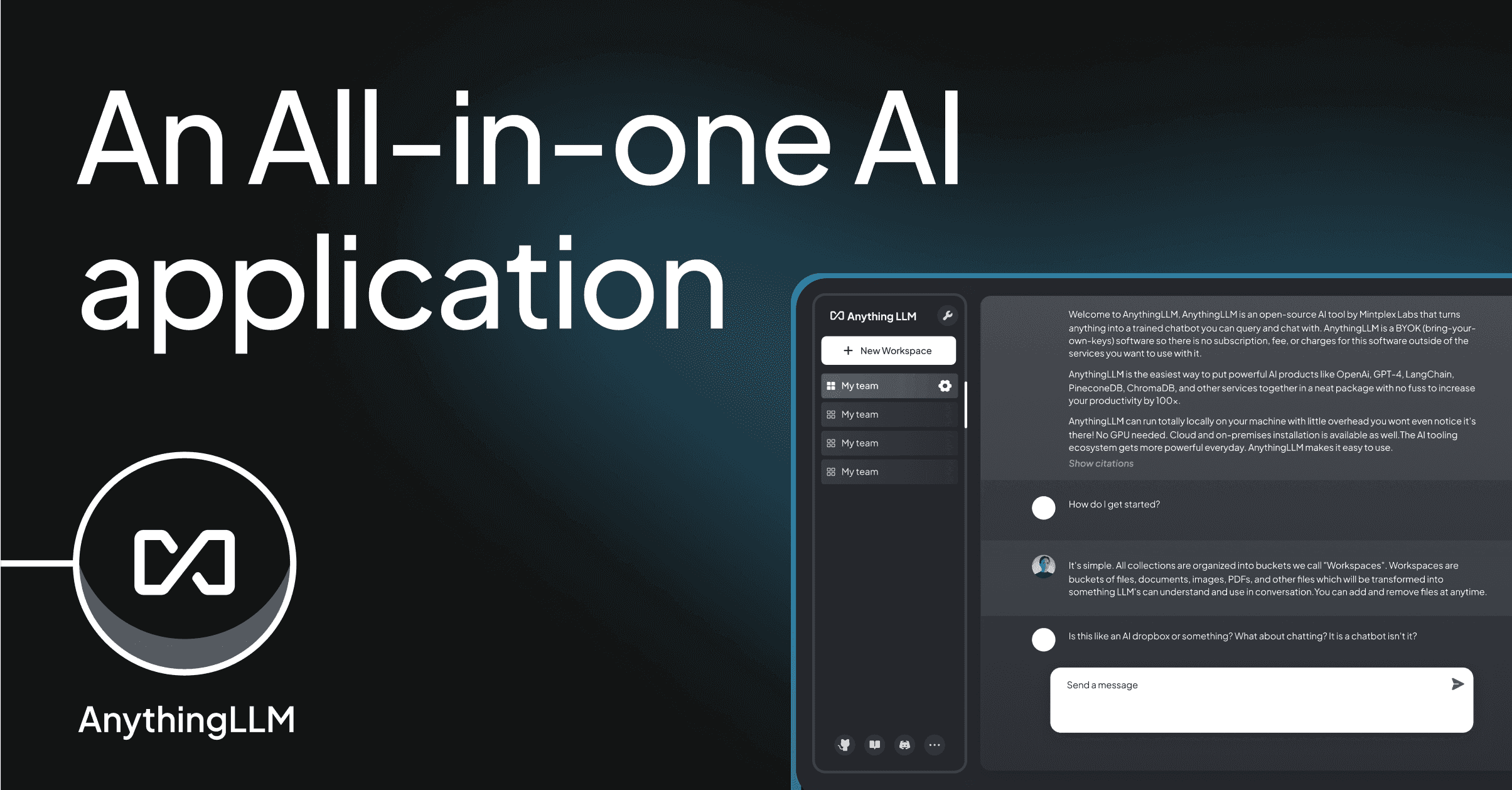
For individuals and teams seeking to interact with their documents using AI while maintaining full data privacy, AnythingLLM offers a reliable, self-hostable solution. This open-source, full-stack AI application focuses on Retrieval-Augmented Generation (RAG), allowing users to chat with their data through various Large Language Models (LLMs) without sending sensitive information to third-party cloud services. It acts as an orchestration layer, handling document ingestion, chunking, embedding, retrieval, and chat interactions. It doesn’t provide the LLM itself, but rather the framework to use them with your data.
Self-Hosted RAG with Multi-User Permissions
AnythingLLM targets technical users comfortable with self-hosting via Docker, as well as small businesses, large corporations, developers, and remote teams. Its core appeal lies in providing private and customizable AI solutions. Use cases span personal document RAG, small-team knowledge base sharing, internal knowledge bases, research workflows, and private enterprise deployments. It’s particularly suited for privacy-focused individuals and teams handling sensitive data, such as private legal research or analyzing confidential business intelligence, where keeping data on-premises is critical.
Document Parsing, Embedding, and Citation-Backed Answers
AnythingLLM allows users to upload various document types and interact with them via a chat interface. It uses LLMs to answer questions based on the provided content. The tool includes a no-code agent builder for creating AI agents with capabilities like web browsing, code execution, and API calls. It supports a wide array of LLM providers and vector databases, offering flexibility in how users process and store their data. The application itself is lightweight, requiring minimal RAM and CPU, but running local LLMs effectively often necessitates significant hardware, particularly a GPU with ample VRAM (e.g., 24GB for an RTX 3090).
PDF, DOCX, XLSX, Websites, and 20+ Data Connectors
AnythingLLM boasts broad compatibility, supporting numerous document formats including PDF, DOCX, TXT, Markdown, CSV, XLSX, PPTX, HTML, and over 50 code file types. It can also process audio files via Whisper transcription and scrape content from GitHub repositories, YouTube transcripts, Confluence pages, and websites. For LLM integration, it connects with more than 30 providers like Ollama, LM Studio, OpenAI, Anthropic, Google Gemini, and AWS Bedrock. It also offers LanceDB built-in and supports other vector databases such as Pinecone and Chroma. Workspace isolation helps organize different knowledge bases and LLM settings.
Free Self-Hosted, Enterprise SaaS Available
The desktop application and Docker self-hosted versions of AnythingLLM are free under the MIT license. This makes advanced RAG capabilities accessible without subscription costs for the core application. For hosted cloud versions, pricing starts at $50/month for a Basic tier (under 5 users, under 100 documents) and goes up to $99/month for a Pro tier with a 72-hour support SLA. A $25/month plan for small teams has also been mentioned. It’s important to note that while AnythingLLM’s orchestration layer can be free, the costs associated with using external LLM APIs (e.g., OpenAI, Anthropic) are separate and borne by the user. For fully local inference, users typically pair it with free local LLM runners like Ollama.
Docker Setup Required, Embedding Quality Varies by Model
A significant limitation of AnythingLLM is the technical complexity involved in self-hosting. This often requires familiarity with Docker, command-line interfaces, and server management, which can be a barrier for non-technical users. There’s a common misunderstanding that "local" means the LLMs themselves run locally by default; however, AnythingLLM is local, but the LLMs usually require a separate local runtime (like Ollama) or connection to a cloud API. The hosted cloud version has specific limitations, including no built-in LLM, limited capacity for the built-in embedder (which can crash with large documents), and restricted support for custom agents or Model Context Protocol (MCP) due to security and resource constraints. Users have also reported issues with RAG accuracy, noting that the quality of responses depends heavily on embedding model choice and chunking strategy, and sometimes failing to retrieve specific document sections. Like all LLM-based tools, AnythingLLM is subject to general LLM limitations such as computational constraints (token limits), potential hallucinations, and difficulties with complex reasoning.