

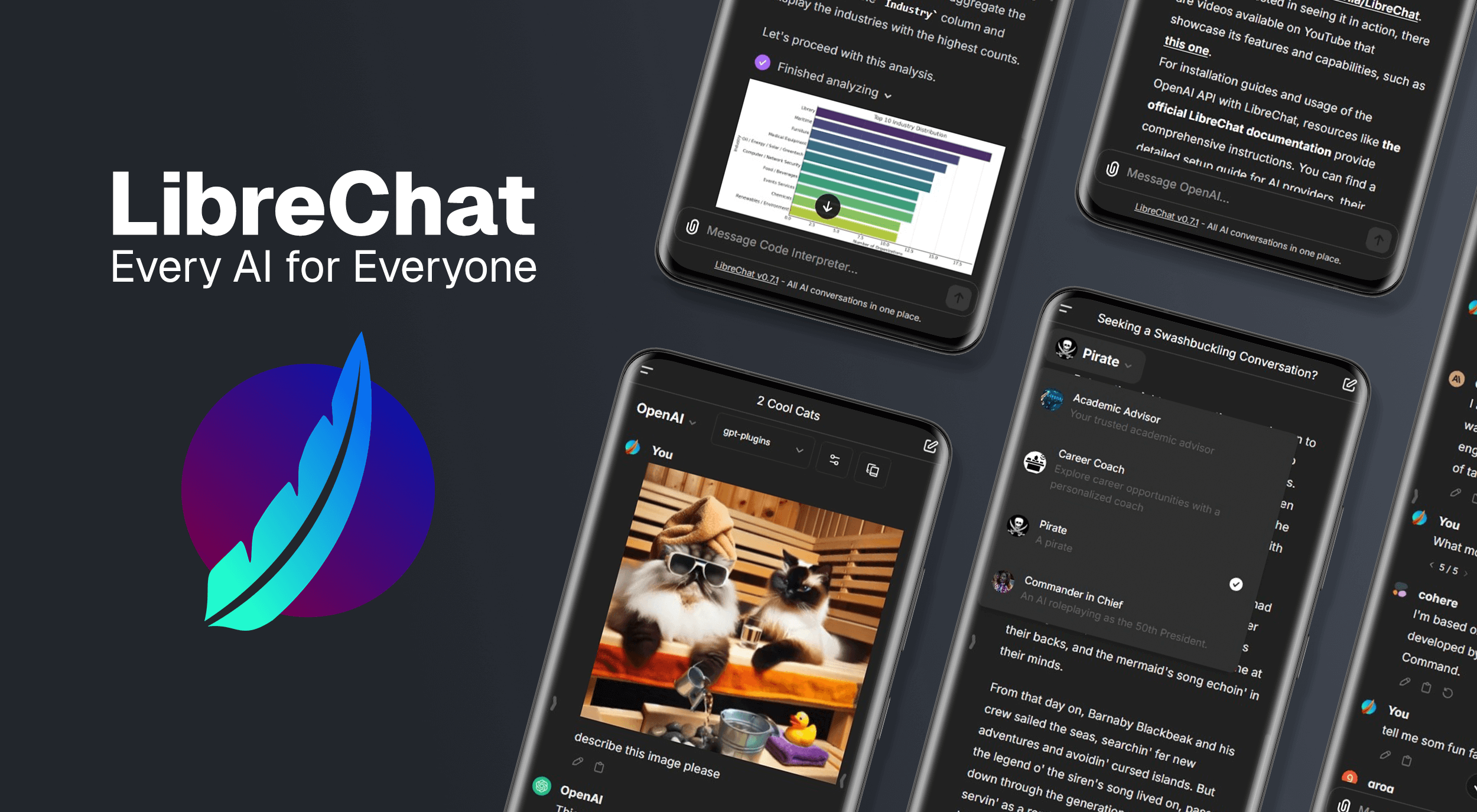
LibreChat is an open-source, self-hosted AI chat platform that unifies interactions with various large language models and AI providers through a single interface. It supports diverse integrations while giving organizations full control over their data and deployment.
Self-Hosted Multi-Model Chat with OpenAI, Claude, and Gemini
LibreChat provides a ChatGPT-like experience, but with a critical difference: it’s entirely under the user’s control. This platform allows engagement with multiple AI models from various providers through one unified dashboard. This approach eliminates vendor lock-in and the need to switch between different applications, streamlining workflows for developers, researchers, AI enthusiasts, and enterprises alike. It’s particularly beneficial for those prioritizing data privacy, flexibility, and control over their AI infrastructure, including Fortune 500 companies, universities, and government agencies.
Conversation Branching, File Upload, and Plugin System
The platform’s feature set extends beyond basic chat, supporting complex AI interactions:
- AI Agents: Create agents capable of file handling, code execution, and API actions.
- Code Interpreter: Execute code in various programming languages and generate artifacts like React components or HTML.
- Multimodal Interactions: Upload and analyze images and documents directly within conversations.
- Retrieval Augmented Generation (RAG): Query uploaded files for contextually relevant responses.
- Conversation Management: Utilize conversation branching, instant search across chat history, and persistent memory.
- Model Presets: Configure and save settings for different model interactions.
- Web Search: Integrate web search capabilities (e.g., Bing, Google) for up-to-date information.
Docker Deployment, MongoDB, and OpenAI-Compatible APIs
LibreChat’s architecture is built for flexibility and broad compatibility:
- Supported Models: It integrates with a wide array of AI models, including OpenAI (GPT-3.5, GPT-4, GPT-4o, o1, o3 series), Anthropic (Claude 3.5 Sonnet, Opus, Haiku), Google (Gemini Pro & Advanced, Gemini 2.0), Azure OpenAI, AWS Bedrock (Claude, Llama), Mistral, Ollama (for local LLMs), DeepSeek, Groq, OpenRouter, and any custom OpenAI API-compatible services.
- Deployment: Designed for self-hosting, typically deployed using Docker or Docker Compose on a Virtual Private Server (VPS) or local server.
- Database: Uses MongoDB for storing conversation history and other data.
- Authentication: Offers enterprise-ready Single Sign-On (SSO) with OAuth2, SAML, LDAP, and two-factor authentication.
- Plugins & APIs: Integrates with LangChain plugins, allows custom endpoints, and supports API integration via OpenAPI schemes. It also features Zapier, WolframAlpha, and DALL-E 3 for image generation.
Free and Self-Hosted; API Costs Depend on Provider
LibreChat itself is free and open-source, licensed under MIT. The primary costs come from two areas:
- Self-Hosting Infrastructure: This includes expenses for a Virtual Private Server or cloud hosting. A typical setup might cost around $20 per month for hosting.
- AI Model API Usage: Users pay directly for the API calls made to integrated AI models (e.g., OpenAI, Anthropic, Google). These costs can range from $100 to $150 per month, depending on usage. Managed service providers also offer hosting, with their own pricing structures.
Requires Technical Setup, Docker and MongoDB Knowledge Needed
LibreChat has certain limitations that administrators should prepare for:
- Configuration Issues: Users have reported an incoherent configuration system, issues with API keys not saving correctly via the UI, and problems with plugins or endpoints not appearing as expected.
- Scalability Concerns: There are doubts about its ability to scale effectively for very large user bases (e.g., over 100,000 users) due to potential bottlenecks with MongoDB, Node.js, and I/O operations.
- Enterprise Governance Gaps: For large organizations, built-in features for tracking usage, costs, and spending per user or team are absent, which can lead to accountability issues. The freedom for users to select models and adjust parameters may also pose governance risks.
- MongoDB SSPL Licensing: The default use of MongoDB under the Server Side Public License (SSPL) could potentially obligate organizations providing LibreChat as a service (even internally) to open-source their entire software stack.
- RAG Accuracy: When using Retrieval Augmented Generation (RAG) with internal documents, there’s a potential for general questions to be inadvertently influenced by irrelevant content, which might reduce accuracy.
- Missing User-Friendly Features: Compared to some commercial alternatives, LibreChat may lack certain user-friendly features like dedicated mobile applications or integrated voice chat.