

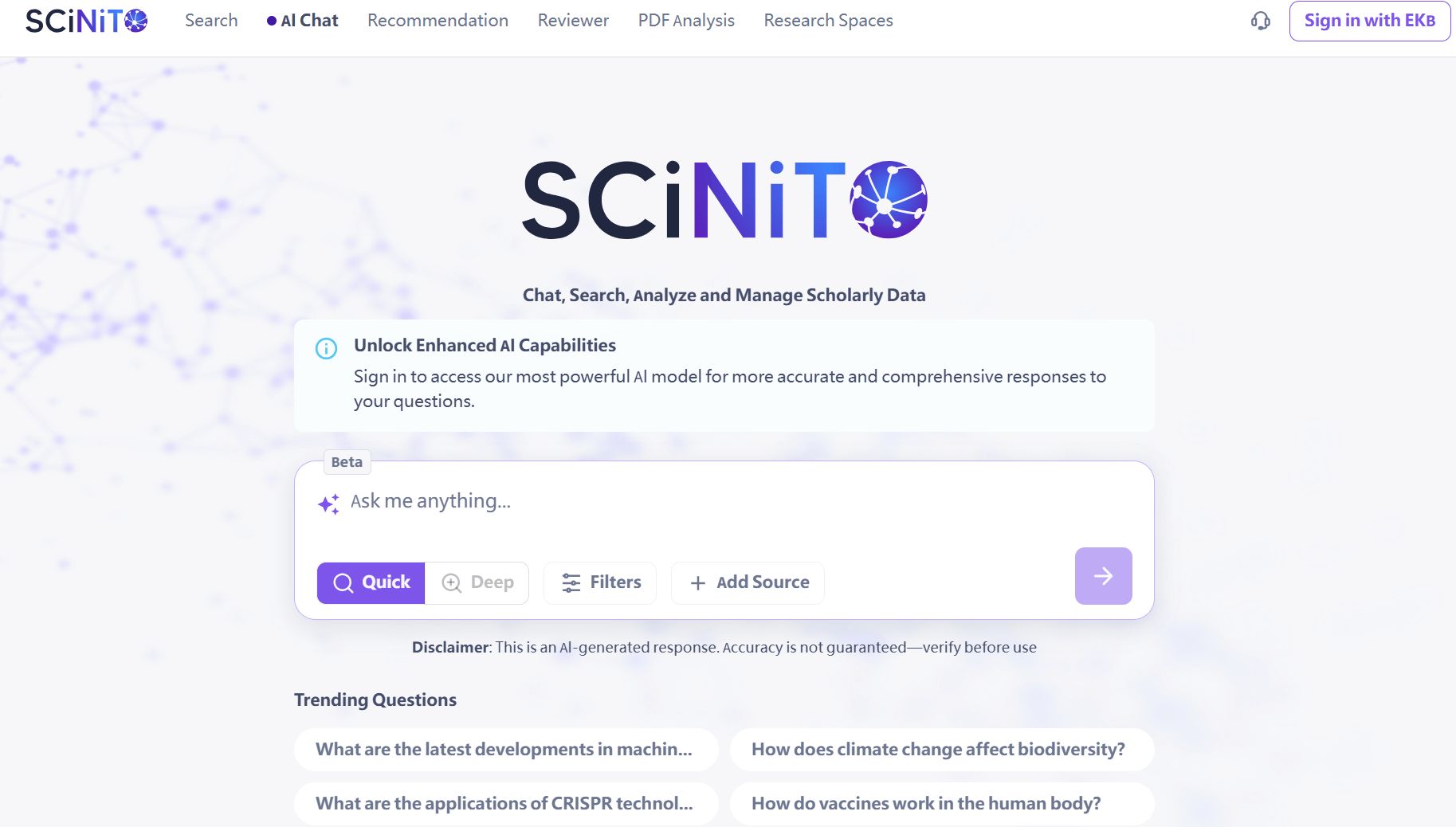
Scinito is an AI-powered platform designed to assist academics and researchers from discovery to publication, offering smart search, AI chat for insights, manuscript writing assistance, and publication tools. It covers the full research workflow in a single environment.
AI Research Assistant with Semantic Paper Discovery
Scinito provides a full suite of AI-driven tools tailored for academic work. Its "Smart Search" engine indexes over 260 million scholarly documents, allowing researchers to efficiently discover relevant literature. The platform’s "AI Chat" generates summaries, identifies trends, and offers citation-rich insights, while a "Deep Research" mode can produce multi-section syntheses with extensive references, significantly reducing manual review time for complex topics.
For manuscript preparation, the "Reviewer Agent" offers AI-powered evaluation, providing feedback on clarity, structure, grammar, and logical flow to enhance paper quality before submission. A "Journal Recommender" suggests suitable publication venues by analyzing a manuscript’s title and abstract, incorporating journal metrics. Scinito also features "PDF Analysis," enabling users to upload and interact with scholarly articles, extracting summaries, explanations of figures and methods, and identifying key findings and limitations. The platform supports collaborative research through project management features, allowing users to organize articles, add notes, and invite peers to shared workspaces.
PhD Students, Postdocs, and Lab Researchers
Scinito targets individual researchers, academics, university students (undergraduate, master’s, and PhD), professors, and institutions. Its tools are particularly useful for conducting thorough literature reviews, preparing and refining research manuscripts, identifying appropriate journals, drafting grant proposals, and organizing research materials. It also aids in quickly understanding complex academic papers and facilitating collaboration among co-authors and colleagues.
PubMed, arXiv, and Semantic Scholar Integration
Scinito supports PDF format for its analysis tool and integrates with institutional subscriptions and libraries, offering Single Sign-On (SSO) for organizational users. The platform indexes over 260 million scholarly documents, drawing data from sources like Open Alex, Crossref, Wikidata, and Research Organization Registry (ROR). It supports multilingual searches and results in languages such as Arabic, German, and French. Scinito emphasizes data security with advanced encryption and strict access controls to keep manuscripts private. A key feature, "Research Space," ensures that AI responses are grounded exclusively in user-selected sources, promoting academic control and transparency by providing verified citations and direct links to original papers.
Free Trial with Subscription Plans for Heavy Users
Scinito operates on a freemium model:
- Essential Plan: Free for individual researchers. Includes unlimited search access and basic AI chat with monthly limitations on AI queries.
- Advanced Collaboration Plan: Institutions can contact Scinito for this plan. It offers unlimited AI access, the Journal Recommender, Reviewer Agent, institutional holdings integration, SSO login, and dedicated technical support.
It’s important to note that the PDF Analysis tool is a paid feature, even for individual users on the free plan, and the free plan includes a monthly cap on AI queries. While Scinito aims for accuracy, users should always critically evaluate AI-generated content, though the platform’s ability to focus AI chat on specific selected papers helps mitigate the risk of broad or generic answers.
Limited to English-Language Papers and STEM Focus
Scinito has several practical constraints:
-
Free Tier Limits: The free tier restricts the number of searches and deep research queries.
-
Research Scope: Deep Research mode can take significant time to produce results.
-
Source Coverage: May not index all specialized or paywalled academic databases.
-
Output Length: Multi-section syntheses have character limits.