

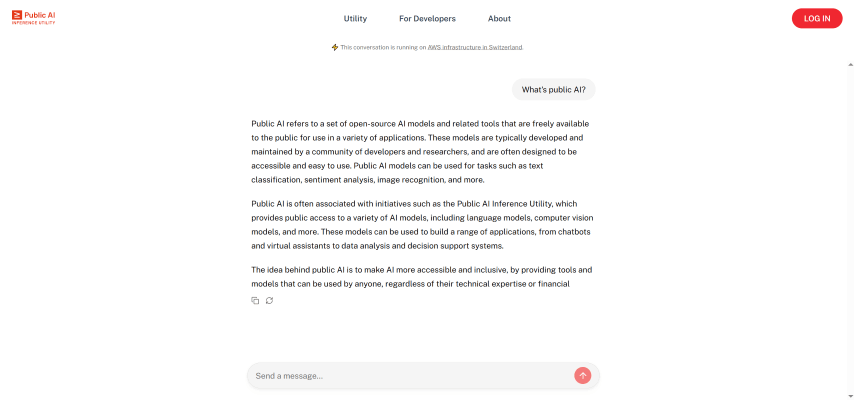
Apertus is an open-source large language model developed by the Swiss AI Initiative, designed for researchers and enterprises that need transparent, compliant, and multilingual AI. Built on the IcedDL framework, it prioritizes reproducibility and European data sovereignty.
1000+ Languages Including Romansh and Swiss German
Apertus serves as a versatile base AI model, capable of natural conversation, text generation, knowledge queries, and code assistance. Its core strength lies in its strong multilingual capabilities, supporting over 1,000 languages, including minority ones like Romansh and Swiss German. This makes it particularly useful for applications requiring direct translation or content generation in underrepresented languages, bypassing the need for English as an intermediary.
Researchers, Public Institutions, and EU Enterprises
The primary audience for Apertus includes researchers, companies, public institutions, and administrations. Specific use cases include powering e-commerce platforms, extracting multilingual information for fields like medicine, creating internal knowledge chatbots based on proprietary data, and automating administrative tasks. Developers and AI enthusiasts can also build upon and customize the model due to its open-source nature.
70B Parameters, Apache 2.0, and GDPR-Compliant EU Hosting
Apertus is available in 8 billion (8B) and 70 billion (70B) parameter versions. The 8B model is efficient for real-time applications and local deployment, while the 70B model handles advanced reasoning and complex document analysis. It boasts a context window of 65,536 tokens. The model is fully open-source, with its architecture, weights, training data, and training recipes publicly available under an Apache 2.0 license. This transparency allows for auditing, reproducibility, and commercial use. Trained on approximately 15 trillion tokens, with about 40% non-English, its data is ethically sourced from public and legal sources, respecting robots.txt and copyright. Inference is EU-hosted, ensuring data remains within Germany or Switzerland for GDPR compliance, and it’s designed to comply with the EU AI Act’s transparency requirements and Swiss data protection laws.
Free Chat, Hugging Face, and OpenAI-Compatible API
Users can try Apertus through the Public AI Inference Utility chat interface at publicai.co/chat. For deeper integration, Apertus is accessible via Hugging Face, Amazon SageMaker, Swisscom AI Platform, and the Public AI Network. It supports integration with Open WebUI and local deployment, and offers an OpenAI-compatible API.
$0.10/Million Input Tokens, $0.20/Million Output Tokens
While the public chat interface is free, API access and enterprise solutions feature transparent, pay-per-use pricing with volume discounts and individual enterprise packages. A free trial period is available. For the Apertus 8B Instruct model, pricing is set at:
| Plan | Price | Key Details |
|---|---|---|
| 1M Input Tokens | $0.10 | For processing user prompts and data |
| 1M Output Tokens | $0.20 | For generating AI responses |
Lags Behind GPT-4 in Reasoning, 70B Needs Heavy Hardware
Despite its strengths, Apertus has some limitations. It generally lags behind top proprietary models like GPT-4 or Claude in raw performance, particularly in complex reasoning, mathematics, and programming tasks. Users might encounter less accurate results and hallucinations. While strong in multilingualism, it can make noticeable mistakes in less common languages. As a foundational model, it wasn’t designed with extensive user-facing features or a dedicated mobile app. The 70B model requires significant computing resources, and even the 8B model needs about 16GB of RAM for local use. Full tool-use capabilities are still under development, and the 8B Instruct model’s token pricing is considered somewhat expensive compared to other open-weight models of similar size.