

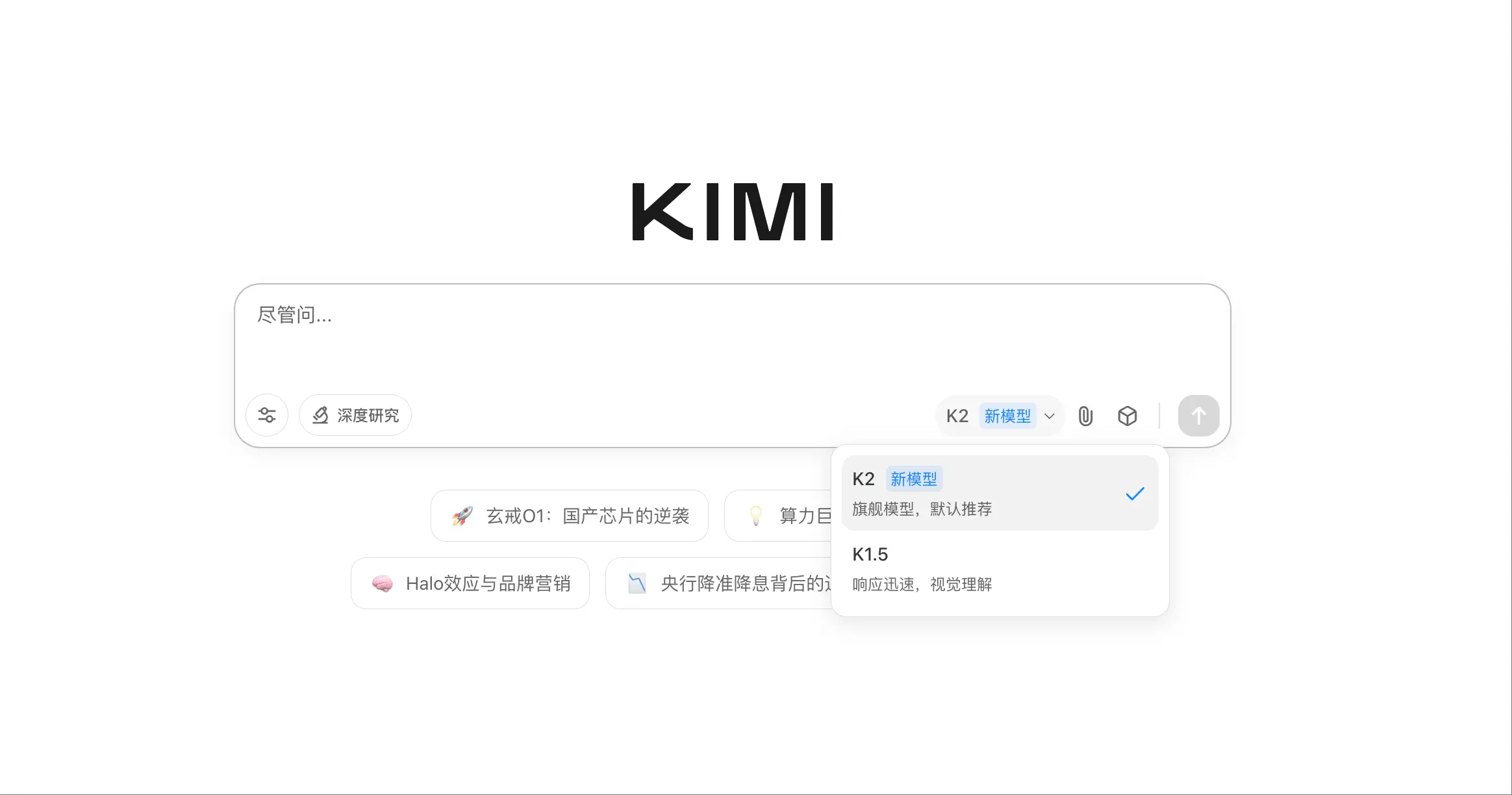
Kimi, an artificial intelligence chatbot and a series of large language models (LLMs) from Moonshot AI, excels at tackling complex problems and generating professional presentations. It uses advanced natural language understanding and long-context processing to handle diverse tasks, from coding to document analysis.
Kimi (Moonshot AI): 2M-Token Context Chinese AI Assistant
Kimi’s core strength lies in its ability to process vast amounts of information and its multimodal capabilities. It handles text, images, and video inputs, making it versatile for various applications. The platform’s agentic capabilities allow it to plan and execute multi-step tasks autonomously, even orchestrating multiple agents through its "Agent Swarm" technology. This enables it to go beyond simple responses, performing complex operations like generating and debugging code, creating presentations, building websites, and analyzing various document types.
Chinese Users, Long-Document Analysts, and Researchers
Kimi serves developers, researchers, content creators, and general users:
- Coding and Development: Kimi generates and debugs code in languages such as Python, JavaScript, Go, and Rust. It can also edit entire code repositories and convert UI mockups or video walkthroughs into functional front-end code.
- Content and Presentation Creation: Users can generate articles, blog posts, business plans, and create professional presentations and websites from simple prompts.
- Business and Productivity: It assists with brainstorming business ideas, creating financial models, drafting marketing strategies, and supporting legal intelligence, such as contract review.
Moonshot-v1, 2M Token Context, Web Search Integration
Kimi’s models, including the latest K2.6 and K2.5, are built on a Mixture-of-Experts (MoE) architecture. K2.5, for instance, features 1 trillion parameters, activating 32 billion per request. These models boast a large context window of 256K tokens, with some sources indicating up to 2 million tokens for enhanced accuracy. Kimi is natively multimodal, processing text, images, and video, with vision and language trained together.
It supports various document formats, including PDFs, Word files, PowerPoint, Excel, and CSV. Kimi offers an OpenAI-compatible API for integration with existing SDKs like LangChain and can integrate with enterprise tools such as Jira and Slack. It includes real-time web search capabilities, providing source citations, and is multilingual, proficient in English, Mandarin, Spanish, French, German, and other languages.
Kimi operates in different modes:
- Instant: Provides fast answers.
- Thinking: Engages in deep reasoning.
- Agent: Plans multi-step tasks.
- Agent Swarm: Executes parallel multi-agent tasks.
Kimi K2.6 has demonstrated strong performance in coding benchmarks like SWE-Bench Pro, scoring 58.6%, which slightly outperforms GPT-5.5 and Claude Opus 4.7.
Free Web/App, API at Competitive Pricing
Kimi offers both API-based token pricing and membership plans. API pricing for Kimi K2.6 is approximately $0.95 per million input tokens and $4.00 per million output tokens, while Kimi K2.5 costs $0.60 per million input tokens and $3.00 per million output tokens. Automatic context caching can reduce input costs by 80-85%. Web search incurs an additional $0.005 per call plus token costs.
Membership plans start at $19/month for the Moderato tier, providing access to the Kimi chat interface, agent credits, Deep Research, Kimi Code, and tools for slides and websites. Higher tiers (Allegretto, Allegro, Vivace) offer more features like Agent Swarm and increased quotas. API usage is billed separately from membership. A free tier is available via web and mobile, but it has strict rate limits, including 1 concurrent request and 3 requests per minute.
Longest Context Window Among Chinese AI Assistants
Kimi excels in long-context processing, handling massive datasets and lengthy documents (up to 256K tokens) more effectively than many alternatives. This makes it ideal for in-depth research and document analysis without losing coherence. Its API pricing is significantly more cost-efficient than competitors like GPT and Claude, potentially reducing inference costs by 75-95%, which is crucial for cost-sensitive applications. Kimi is particularly strong in agentic coding workflows, including multi-file software projects and DevOps automation, with its Agent Swarm mode capable of coordinating specialized sub-agents to generate complex systems. It also stands out in multimodal UI/UX generation, efficiently converting visual specifications (like mockups or video recordings) into functional code and websites.
Chinese-First, Censorship Compliance, Limited English Quality
Kimi has output quality variations depending on prompts:
- Free tier has strict rate limits — one concurrent request and three requests per minute, often triggering "server busy" errors.
- Output quality varies significantly based on prompt clarity and task complexity.
- Advanced features and higher usage limits require paid subscriptions.