
Baidu’s Ernie chatbot uses a family of large language models (LLMs) called ERNIE (Enhanced Representation through Knowledge Integration) to offer advanced artificial intelligence capabilities. This multimodal AI processes and generates content across text, images, audio, and video, providing a versatile tool for various applications.
Beyond Chat: Ernie’s Multimodal Capabilities
Ernie is designed to understand complex questions, provide clear answers, and assist with learning, problem-solving, and communication. Its core capabilities include natural language understanding, generation, reasoning, and memory. It can perform tasks such as sentiment analysis, question answering, content creation, summarization, data analysis, and language translation. The AI also demonstrates strong reasoning and coding abilities.
Individual, Developer, and Enterprise Use Cases
Ernie serves several user groups, from individual users to large enterprises, with tailored access and functionalities:
- Individual users can access Ernie Bot for conversational AI, text generation, content summarization, and interpreting multimodal inputs.
- Developers can utilize Ernie’s APIs through Baidu AI Cloud’s Qianfan platform to build custom applications and multimodal workflows.
- Enterprise users and businesses integrate Ernie into commercial products and services for advanced language and vision understanding. Specific use cases include customer support chatbots, document processing (e.g., OCR, chart analysis, PDF summarization), content creation (e.g., marketing content, SEO optimization), mathematical calculations, and coding. It also integrates into Baidu’s ecosystem, such as Search and Maps.
Ernie is particularly optimized for Chinese-language tasks, understanding cultural nuances and generating responses in multiple Chinese dialects.
From 3.5 to 5.0: The ERNIE Model Family
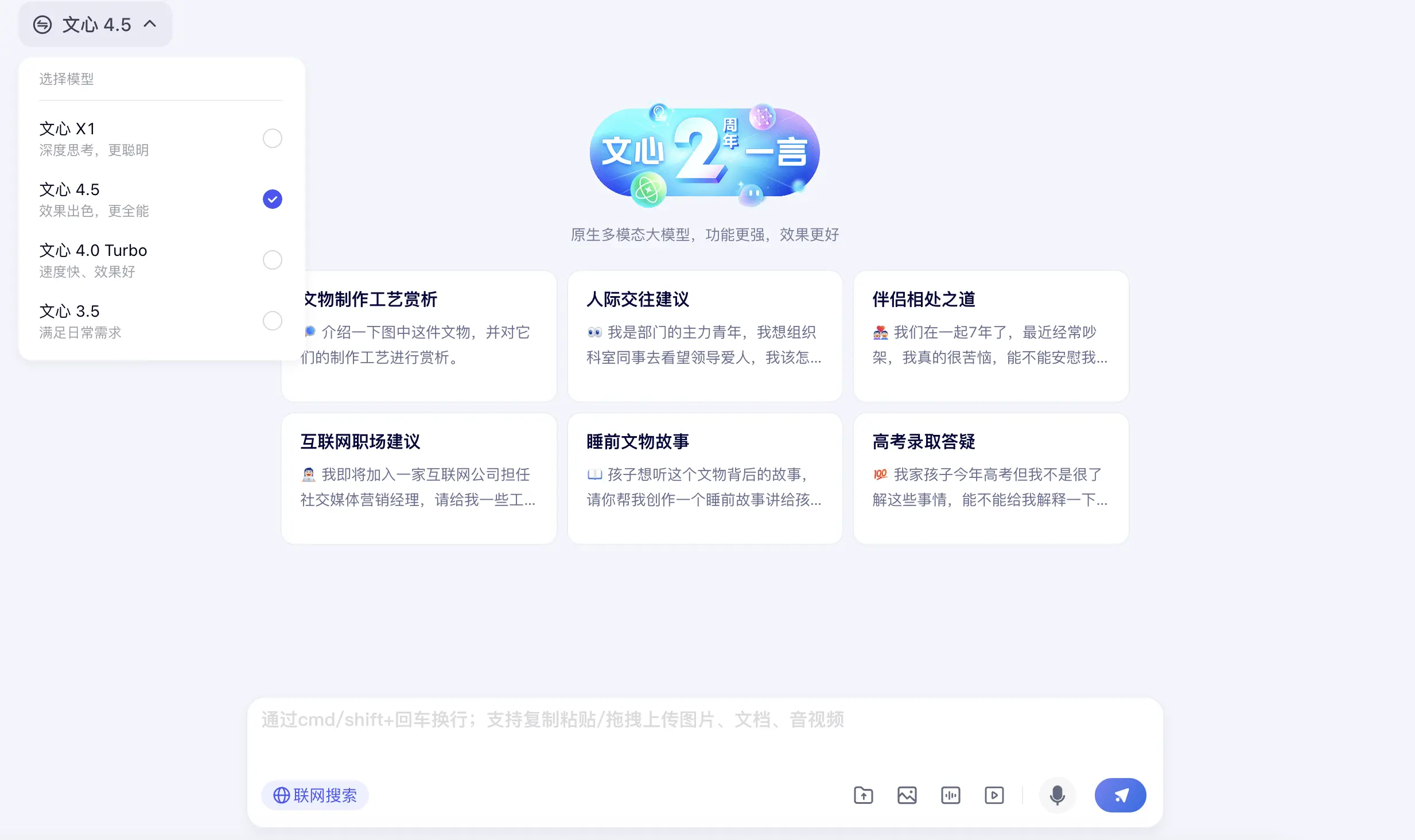
Ernie is built on various ERNIE models, including 3.5, 4.0, 4.5, X1, and 5.0. ERNIE 5.0 is described as "omnimodal" due to its native processing of text, images, audio, and video. This model utilizes a Mixture of Experts (MoE) architecture with 2.4 trillion parameters, activating only about 3% per task for efficiency. It’s built on Baidu’s PaddlePaddle framework.
Baidu claims high accuracy for Ernie, with ERNIE 3.5 reportedly surpassing ChatGPT 3.5 and outperforming GPT-4 in Chinese-language tasks. ERNIE 4.5 shows strong performance in Chinese-language tasks, math, and multimodal benchmarks, reportedly outperforming GPT-4o in some multimodal tasks. ERNIE 5.0 has reportedly outperformed GPT 5.1 High and Gemini 2.5 Pro in reasoning and multimodal understanding benchmarks. ERNIE 4.5 21B A3B supports a context window of up to 120K tokens.
Integrations are primarily through Baidu AI Cloud’s Qianfan platform for APIs and within Baidu’s own ecosystem, such as Baidu Search and Maps. It also supports plugins like "Baidu Search" and "ChatFile."
Free Tier, 59.9 Yuan/Month Pro, and API Pricing
Ernie Bot offers a free version for individual users, providing access to models like ERNIE Bot 3.5 and newer versions such as 4.5 and X1. This free access may come with usage caps or slower response times. For more advanced features, a Professional Plan chatbot subscription costs 59.9 yuan per month (approximately $8.18 USD), with a discounted rate for auto-renewal, offering access to the latest models and higher usage limits.
API access for developers and enterprises is token-based, with pricing varying by model. For example, ERNIE 4.5 input tokens can start at $0.55 per million, and output tokens at $2.20 per million, while ERNIE X1 is even more cost-effective. Newer models like ERNIE 4.5 21B A3B (released August 2025) are priced at $0.070 per million input tokens and $0.280 per million output tokens. Baidu emphasizes competitive and cost-effective pricing compared to global alternatives.
Chinese-Language Superiority and Ecosystem Integration
Ernie excels in tasks requiring deep understanding and generation in the Chinese language, including cultural nuances and various dialects, often outperforming alternatives like ChatGPT in this domain. Its native multimodal processing (text, images, audio, video) allows it to handle diverse data types cohesively, leading to more accurate visual reasoning, document understanding, and math-based problem-solving. Ernie offers cost-effective performance, particularly for API access, making it an attractive option for businesses seeking advanced AI capabilities at a lower price point. Its tight integration within the Baidu ecosystem provides real-time information access and personalized services. It also demonstrates strong capabilities in document processing, accurately extracting and analyzing data from various formats.
Censorship, Access Barriers, and English Quality Gaps
A significant limitation of Ernie is its subjection to Chinese government censorship, leading to refusal to answer questions on sensitive political topics. The AI also exhibits social biases and stereotypes from its training data, which can lead to negative or offensive content. Accessibility outside China can be challenging, often requiring a mainland China mobile phone number for signup, and the interface is predominantly in Chinese, necessitating translation tools for non-Chinese speakers. Like other LLMs, Ernie can experience hallucinations. While strong in Chinese, its English translation quality has been described as "robotic" and "literal."